


























Views
Downloads
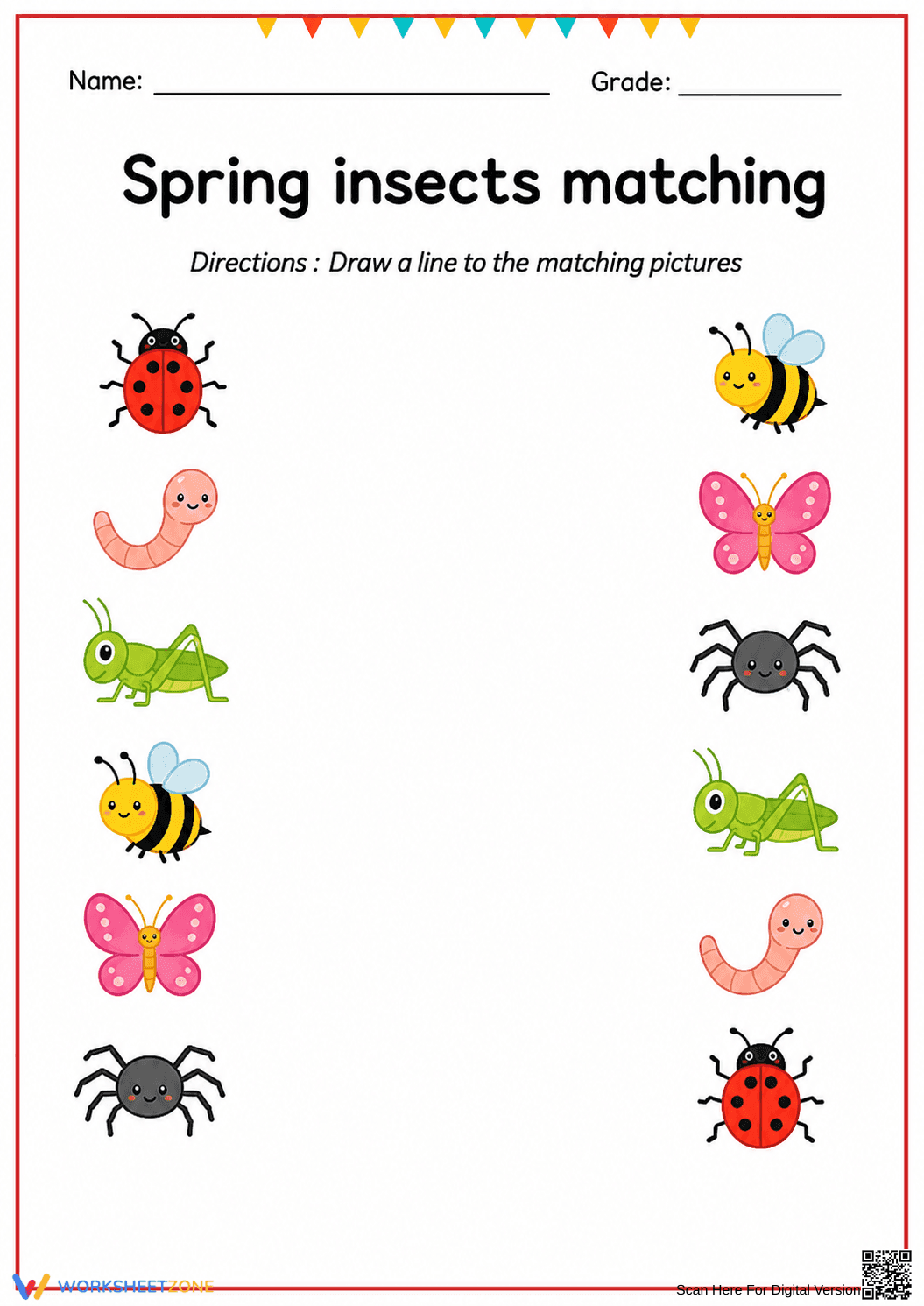

Spring Insects Matching Worksheet | Grade K-1 Essential
Paste this activity's link or code into your existing LMS (Google Classroom, Canvas, Teams, Schoology, Moodle, etc.).
Students can open and work on the activity right away, with no student login required.
You'll still be able to track student progress and results from your teacher account.
This Grade K-1 spring insects matching worksheet helps early learners develop critical visual discrimination skills by identifying and pairing common backyard bugs. Students observe physical characteristics of ladybugs, bees, and spiders to find their identical matches. It provides a foundational entry point for life science observation and fine motor development through simple line-drawing tasks.
At a Glance
- Grade: K-1 · Subject: Science
- Standard:
K-LS1-1— Use observations to describe patterns of what plants and animals need to survive- Skill Focus: Visual discrimination & insect identification
- Format: 1 page · 6 tasks · Answer key included · PDF
- Best For: Morning work or science centers
- Time: 5–10 minutes
Inside this single-page PDF, you will find a clean, high-contrast layout featuring six distinct insect illustrations: a ladybug, worm, grasshopper, honeybee, butterfly, and spider. The worksheet includes a clear directions line and designated spaces for student names and grades. A full-color answer key is provided to allow for quick self-correction or rapid teacher grading during busy classroom blocks.
This resource is designed for a zero-prep classroom environment. First, print the single-page PDF (30 seconds). Next, distribute the sheets to students during morning arrival or as a transition activity (1 minute). Finally, review the matches as a whole group to reinforce vocabulary (1 minute). Total teacher preparation time is under 2 minutes, making it an ideal sub-plan addition or emergency filler.
This activity aligns with K-LS1-1, focusing on using observations to identify patterns in living things. By distinguishing between different insect types, students practice the observational skills necessary for more complex biological classifications later in the year. This standard code can be copied directly into lesson plans, IEP goals, or district curriculum mapping tools.
Use this worksheet as a formative assessment after a read-aloud about spring insects to check for basic recognition. Alternatively, place it in a science center alongside plastic insect models for a tactile-to-visual matching experience. Observe if students can name the insects as they draw lines, noting any confusion between similar shapes like the bee and butterfly to guide future instruction.
This resource is perfect for Kindergarten and Grade 1 students, including English Language Learners who benefit from visual-heavy tasks. It pairs naturally with an insects of spring anchor chart or a nature walk where students look for these specific creatures in the school garden. It is also suitable for homeschoolers practicing fine motor control.
According to the RAND AIRS 2024 report, high-quality visual discrimination tasks in early childhood are foundational for both literacy and scientific inquiry. This worksheet addresses the K-LS1-1 standard by requiring students to perform detailed observations of animal morphology, a precursor to understanding biological diversity. By matching 6 distinct insect types, learners engage in pattern recognition that Fisher & Frey (2014) identify as a core component of the gradual release of responsibility model. The clear, uncluttered design minimizes cognitive load, allowing students to focus entirely on the identification task. This resource provides a structured way to document early science competencies while supporting the fine motor control necessary for later writing tasks. It serves as a reliable tool for teachers seeking to integrate seasonal themes with rigorous observational standards without increasing their daily workload.


