


























Views
Downloads
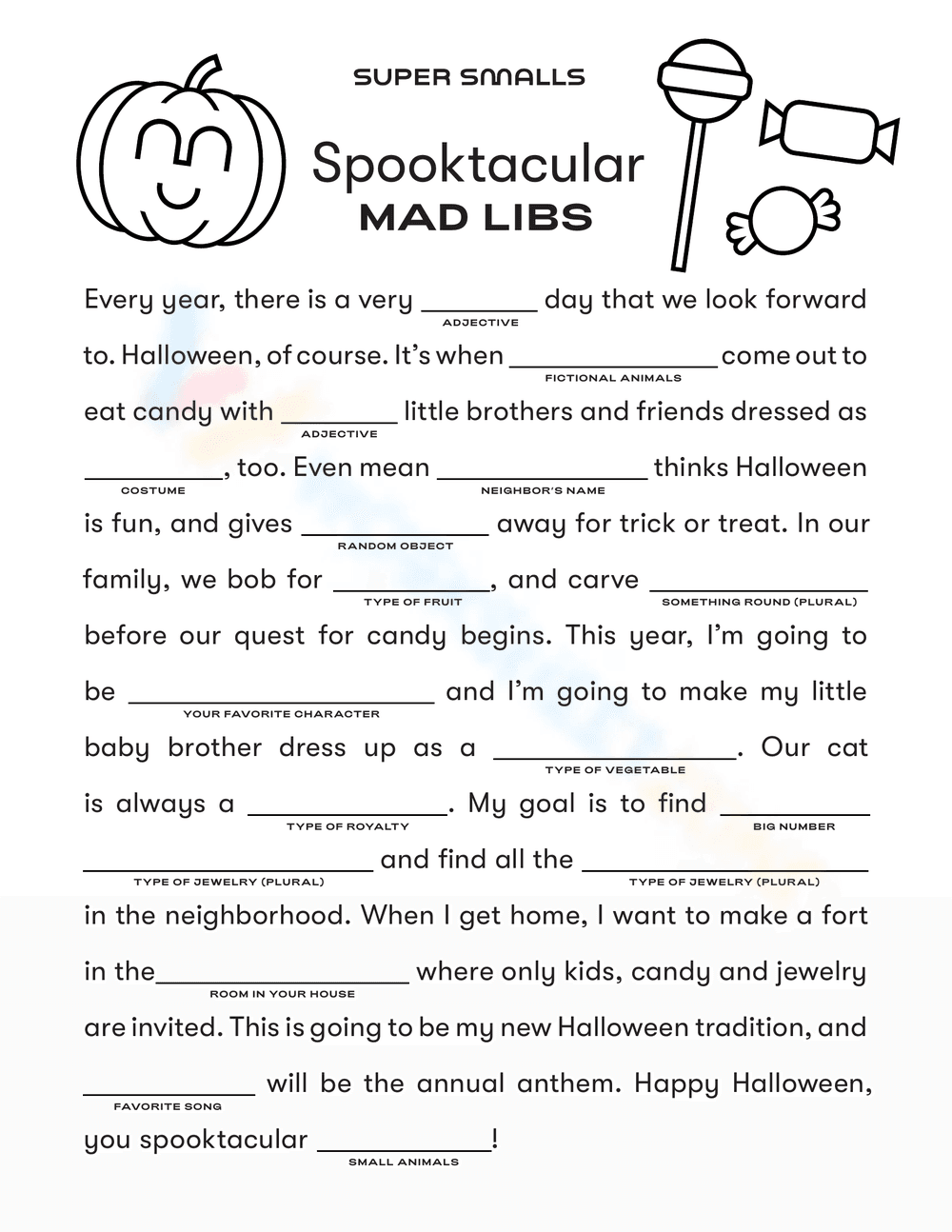

Halloween Mad Libs | Printable Grade 3 Grammar
Paste this activity's link or code into your existing LMS (Google Classroom, Canvas, Teams, Schoology, Moodle, etc.).
Students can open and work on the activity right away, with no student login required.
You'll still be able to track student progress and results from your teacher account.
This engaging Halloween Mad Libs worksheet helps students practice identifying and using specific parts of speech while creating a hilarious, spooky story. By filling in adjectives, nouns, and creative categories, learners reinforce their grammar skills in a fun, low-pressure context that encourages reading aloud and peer sharing.
At a Glance
- Grade: 2-4 · Subject: ELA
- Standard:
CCSS.ELA-LITERACY.L.3.1— Demonstrate command of standard English grammar and usage.- Skill Focus: Parts of speech and vocabulary
- Format: 1 page · 16 problems · Open-ended · PDF
- Best For: Holiday activities and grammar review
- Time: 15–20 minutes
This single-page printable features a Halloween-themed narrative with 16 targeted fill-in-the-blank spaces. Students supply specific word types, from standard adjectives to creative categories like fictional animals. Because the activity relies on student creativity, there is no single answer key, making every completed story unique. The layout includes thematic illustrations.
This resource is designed for immediate classroom implementation.
- Print (1 minute): Download the PDF and print a class set.
- Distribute (1 minute): Hand out the worksheets. No additional materials are needed.
- Review (3 minutes): Briefly remind students what an adjective is, then let them work.
With total prep time under two minutes, this activity is an excellent addition to any October substitute teacher plan.
This worksheet aligns directly with CCSS.ELA-LITERACY.L.3.1: Demonstrate command of the conventions of standard English grammar and usage when writing or speaking. By requiring students to actively recall specific word categories, the activity reinforces foundational language mechanics. Both standard codes can be copied directly into lesson plans, IEP goals, or district curriculum mapping tools.
Teachers can utilize this worksheet as a collaborative partner activity during literacy centers. One student asks their partner for the required word types, resulting in a surprise narrative. Alternatively, use it as independent morning work before a holiday party. As a formative assessment tip, observe whether students can quickly generate an adjective versus a noun. Expect students to complete the writing in 10 to 15 minutes.
This resource is primarily designed for second, third, and fourth-grade students who are solidifying their understanding of basic grammar categories. It naturally differentiates itself, as advanced learners will utilize more complex vocabulary while developing readers can stick to familiar, high-frequency words. Pair this worksheet with a brief anchor chart reviewing nouns, verbs, and adjectives.
Integrating playful language activities into the curriculum significantly impacts student engagement and retention of grammatical concepts. According to a comprehensive EdReports 2024 analysis, instructional materials that embed grammar practice within creative, context-rich tasks improve students' ability to transfer these skills to their independent writing. When students work to meet CCSS.ELA-LITERACY.L.3.1 and demonstrate command of standard English grammar and usage, doing so through a humorous, self-generated narrative lowers the affective filter. This allows learners to experiment with vocabulary and sentence structure without the fear of making a mistake. By categorizing words and applying them to a structured text, students actively process language mechanics rather than passively memorizing rules. This approach not only builds essential literacy skills but also fosters a positive classroom environment where reading and writing are viewed as enjoyable, expressive activities.


