




























Views
Downloads

Essential Grade 3 Science Worksheet: Absorption and Sponges

Paste this activity's link or code into your existing LMS (Google Classroom, Canvas, Teams, Schoology, Moodle, etc.).
Students can open and work on the activity right away, with no student login required.
You'll still be able to track student progress and results from your teacher account.
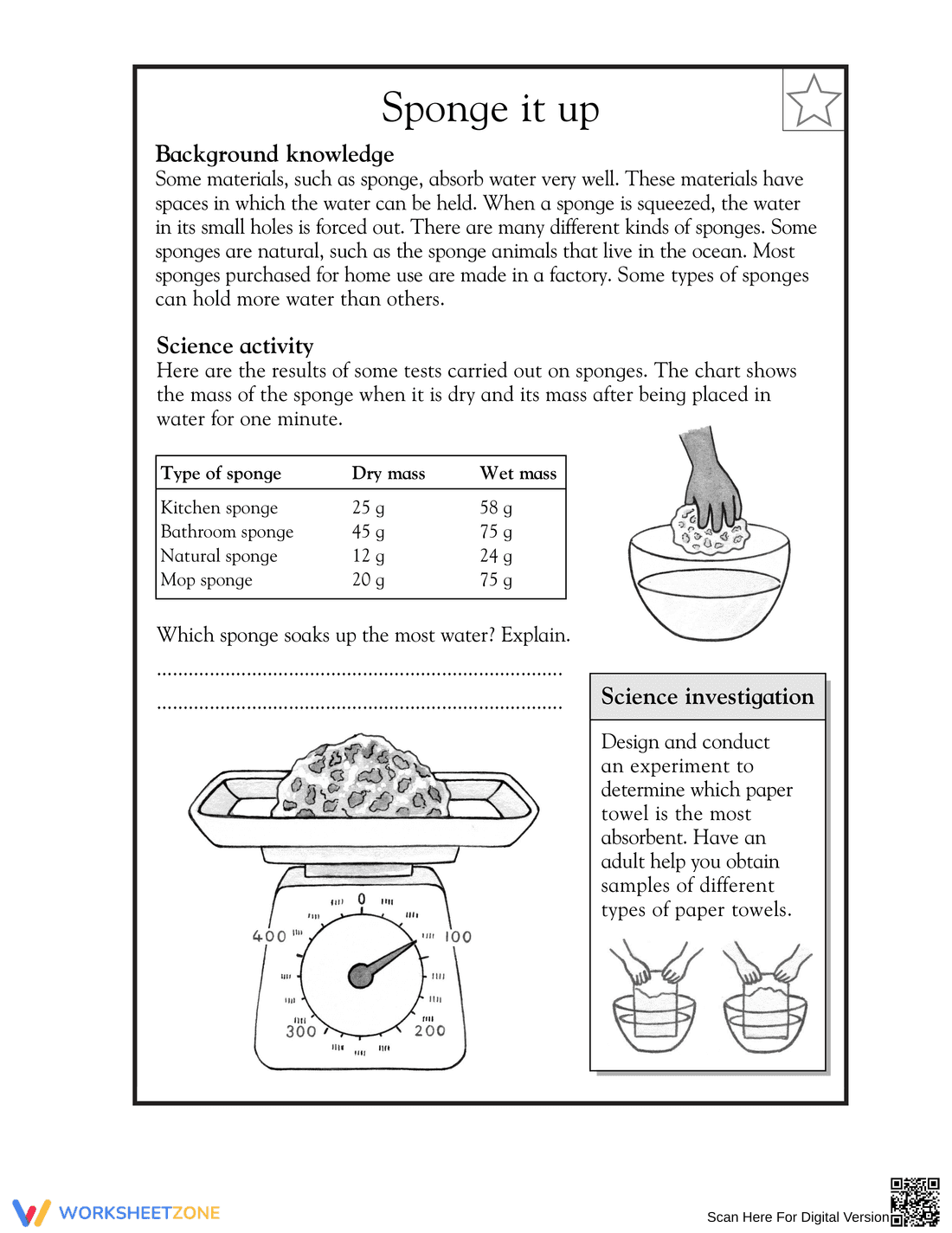
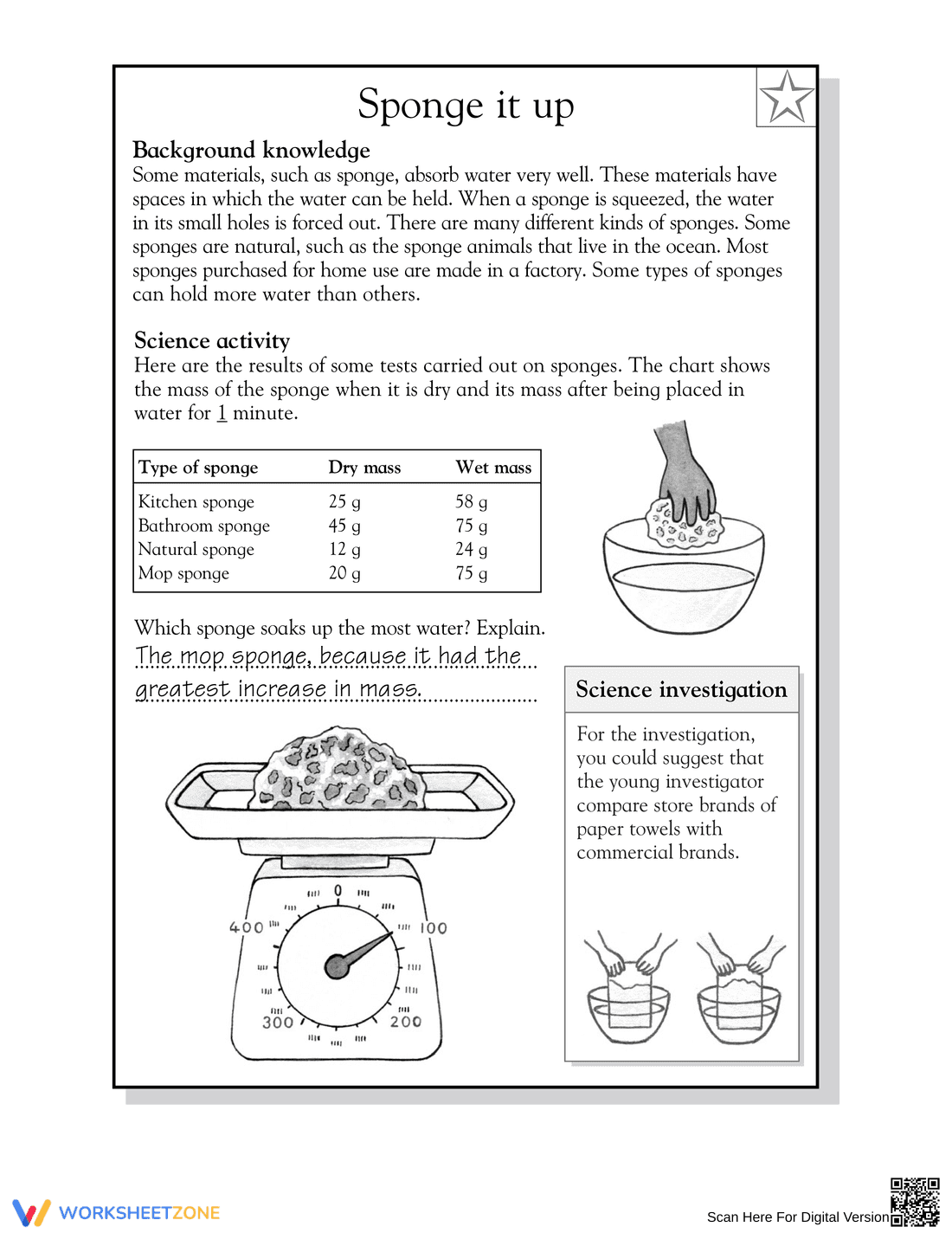
Discover how different materials interact with water in this focused science activity. Students analyze a data table comparing sponge masses to determine absorbency rates and then apply their knowledge by designing their own fair test. This worksheet effectively builds critical thinking through evidence-based reasoning and experimental design for third-grade learners.
At a Glance
- Grade: 3 · Subject: Science
- Standard:
3-5-ETS1-3— Plan and conduct an investigation to determine how well materials absorb water- Skill Focus: Data Analysis & Experimental Design
- Format: 1 page · 2 tasks · No answer key included · PDF
- Best For: Introduction to material properties and fair testing
- Time: 25–35 minutes
What's Inside
The "Sponge it up" worksheet features a clear background knowledge section explaining how sponges work at a microscopic level. It includes a structured data table with dry and wet mass measurements for four sponge types, a reasoning-based question, and a dedicated science investigation sidebar that prompts students to design their own experiment with paper towels.
Zero-Prep Workflow
Follow these 3 steps for an efficient lesson: First, print the single-page PDF (10 seconds). Second, distribute to students for independent or small-group analysis of the provided sponge data (1 minute). Finally, review the student-designed investigations for homework or future lab prep (5 minutes). Total teacher prep time is under two minutes.
Standards Alignment
This resource aligns with `3-5-ETS1-3`, which focuses on planning and carrying out fair tests in which variables are controlled and failure points are considered. It also supports `2-PS1-2` by asking students to analyze data from testing different materials to determine which has the properties best suited for an intended purpose. Both standard codes can be copied directly into lesson plans.
How to Use It
Use this as a formative assessment after a lesson on material properties or as a science starter to introduce the concept of fair testing. Teachers should observe whether students can correctly calculate the difference between dry and wet mass to support their claims. The worksheet typically takes 30 minutes to complete during a standard science block.
Who It's For
This activity is designed for Grade 3 students but works well for Grade 2 enrichment or Grade 4 review. It pairs naturally with a hands-on lab using real sponges and graduated cylinders to verify the findings. The clear text structure also supports English Language Learners in building science vocabulary and understanding the scientific method.
This Grade 3 science resource on material absorbency effectively bridges the gap between theoretical knowledge and experimental application. By requiring students to analyze mass data from kitchen, bathroom, natural, and mop sponges, the activity reinforces the standard 3-5-ETS1-3 regarding planning and conducting fair tests. Students must identify variables and determine how specific properties, such as pore size and material composition, influence a product's effectiveness for a given task. According to RAND AIRS 2024, integrating data interpretation with active experimental design significantly improves long-term retention of physical science concepts in elementary learners. The inclusion of a secondary investigation on paper towels encourages students to transfer their learning to new contexts, fostering scientific literacy and inquiry-based habits. This printable PDF is an essential tool for teachers seeking a rigorous yet accessible way to meet NGSS and state-level science standards while minimizing preparation time.


