


























Views
Plays
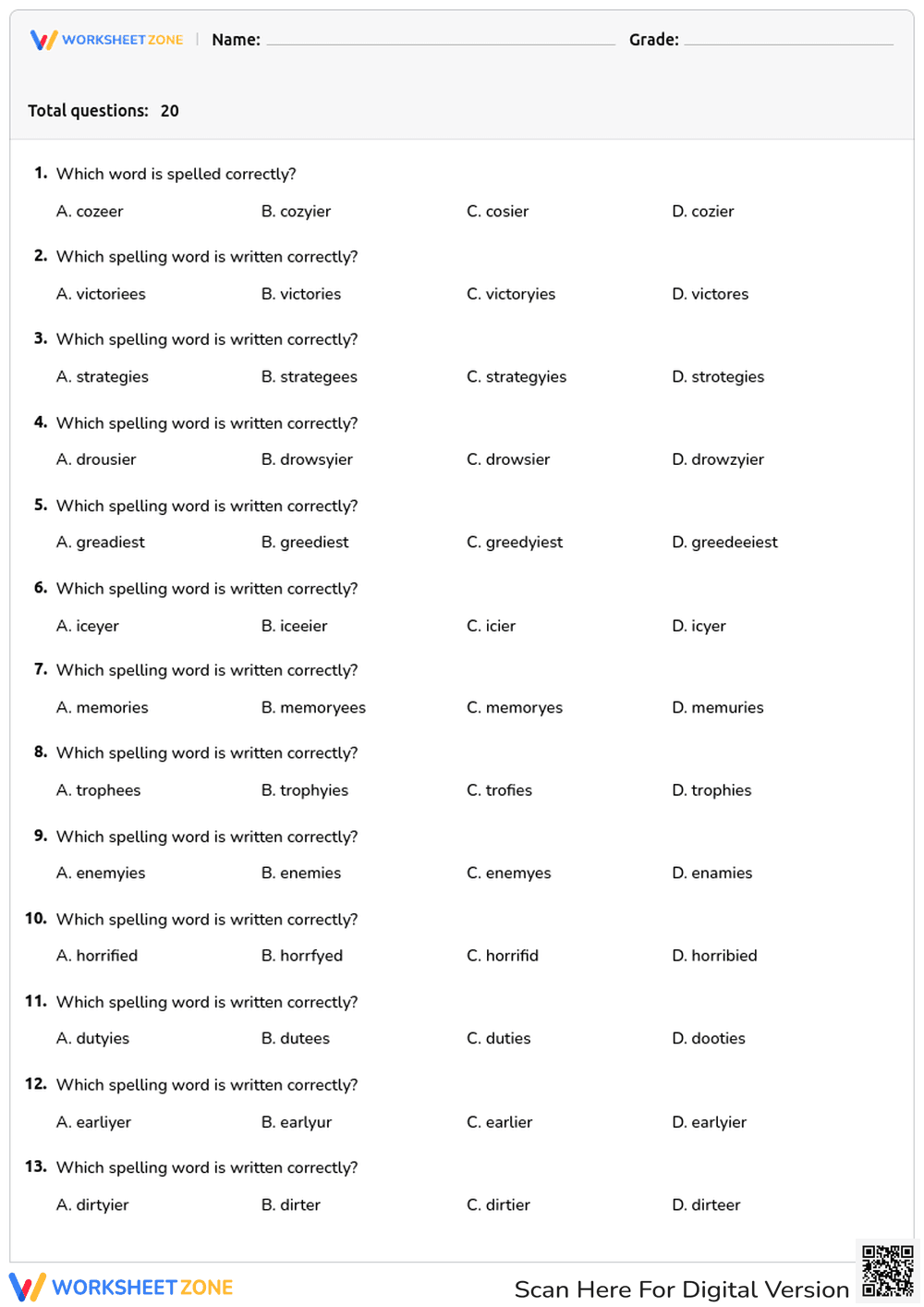


Essential Spelling y-i Worksheet | Grade 2 ELA
Paste this activity's link or code into your existing LMS (Google Classroom, Canvas, Teams, Schoology, Moodle, etc.).
Students can open and work on the activity right away, with no student login required.
You'll still be able to track student progress and results from your teacher account.
Mastering the Change Y to I Spelling Rule
This Grade 2 spelling worksheet provides a comprehensive review of the essential "change y to i" rule. Students often struggle with adding suffixes to words ending in "y," and this resource offers 20 targeted problems to ensure they can correctly identify the proper spelling of plural nouns and comparative adjectives. By the end of this activity, learners will demonstrate increased accuracy in their written expression.
At a Glance
- Grade: 2 · Subject: English Language Arts
- Standard:
CCSS.ELA-LITERACY.L.2.2.D— Generalize learned spelling patterns when writing words and adding common suffixes- Skill Focus: Changing 'y' to 'i' with suffixes
- Format: 2 pages · 20 problems · Answer key included · PDF
- Best For: Independent practice and formative assessment
- Time: 15–20 minutes
What's Inside
This two-page PDF features 20 multiple-choice questions designed to challenge orthographic awareness. Each question presents four spelling variations of a single word, such as "victories," "strategies," or "cozier." The layout is clean and distraction-free, allowing students to focus entirely on letter patterns. A full answer key is provided to facilitate quick grading or student self-correction in any classroom setting.
Skill Progression
- Guided Practice: Problems 1-5 use common nouns and adjectives to introduce the rule with familiar vocabulary.
- Supported Practice: Problems 6-15 incorporate multi-syllabic words like "horrified" to test application in different contexts.
- Independent Practice: The final 5 problems require distinguishing subtle spelling differences in complex words to ensure mastery.
This structure follows a gradual-release model, moving from high-frequency words to more complex linguistic structures.
Standards Alignment
This resource is directly aligned with `CCSS.ELA-LITERACY.L.2.2.D`, which requires students to "Generalize learned spelling patterns when writing words." It specifically addresses the morphological changes required when adding suffixes to base words ending in a consonant and "y." Both standard codes can be copied directly into lesson plans, IEP goals, or district curriculum mapping tools.
How to Use It
Use this as a formative assessment after direct instruction. It works well as morning work to reinforce learning. Observe if students look for the "i" replacement to identify those needing phonics support. Completion typically takes 15 to 20 minutes depending on student proficiency.
Who It's For
This worksheet is ideal for second-grade students mastering foundational spelling skills. It also serves as an excellent intervention resource for third graders or English Language Learners (ELL) who need extra practice with English suffix rules. Pair this with an anchor chart for a complete instructional unit.
Research from Fisher & Frey (2014) emphasizes that orthographic development relies on the systematic generalization of spelling patterns rather than rote memorization of individual word lists. This worksheet targets the specific morphological shift of changing the terminal "y" to "i" when adding suffixes like -es, -er, and -est. By presenting 20 distinct multiple-choice scenarios, the resource requires students to discriminate between phonetically plausible but orthographically incorrect distractors. This process strengthens the cognitive retrieval of the CCSS.ELA-LITERACY.L.2.2.D standard, ensuring students can apply the rule across various parts of speech, including nouns (victories) and adjectives (cozier). Consistent exposure to these patterns during the transitional stage of literacy development prevents the fossilization of spelling errors. Educators can use these results to identify specific gaps in phonics-to-spelling transfer, facilitating targeted small-group interventions that align with evidence-based literacy frameworks for primary grade learners.


