


























Views
Downloads

Printable Grade 1 Spelling Test I | Essential ELA Worksheet
Paste this activity's link or code into your existing LMS (Google Classroom, Canvas, Teams, Schoology, Moodle, etc.).
Students can open and work on the activity right away, with no student login required.
You'll still be able to track student progress and results from your teacher account.
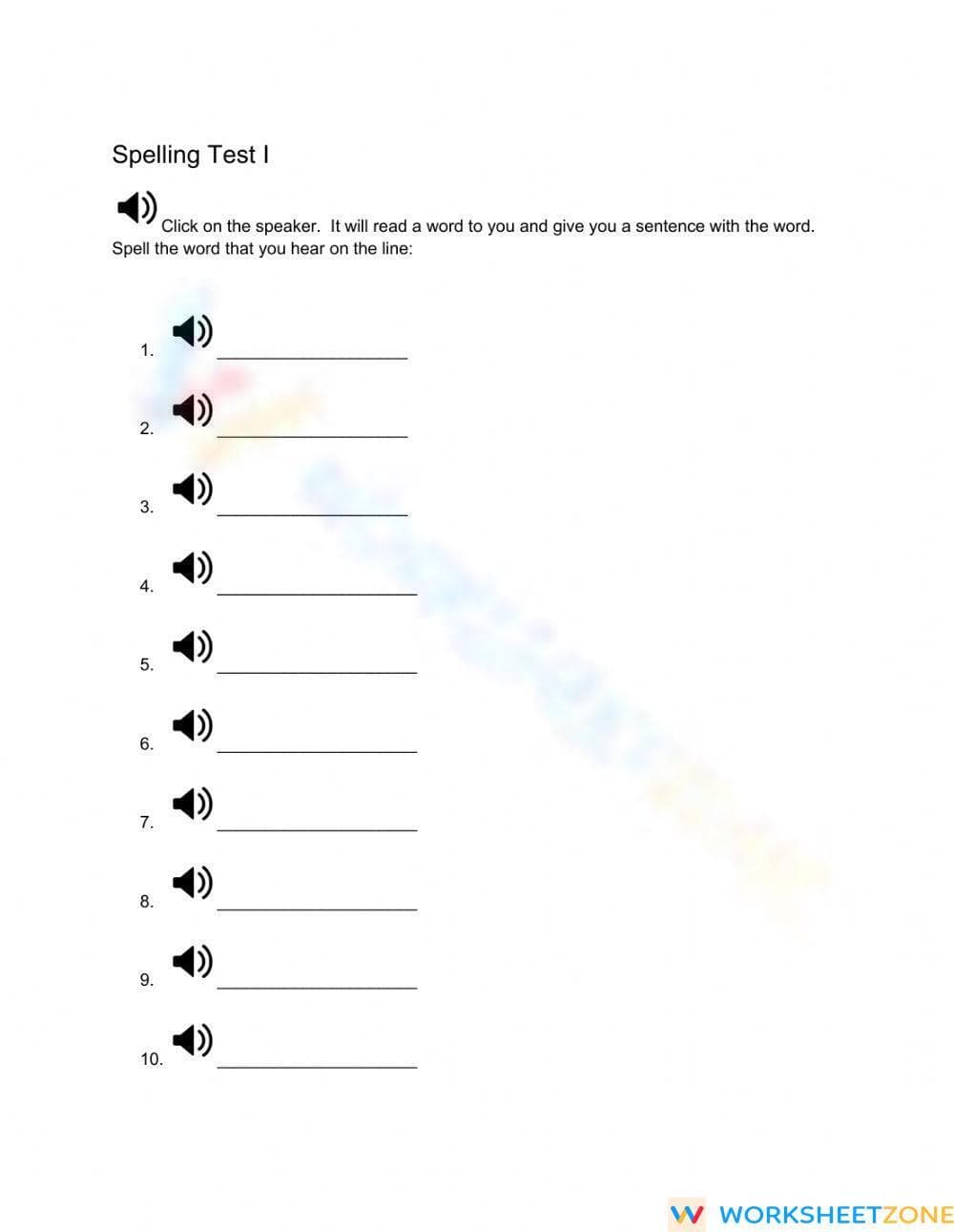
This Spelling Test I worksheet provides Grade 1 students with a structured environment to demonstrate their mastery of foundational phonics and spelling conventions. By listening to auditory cues and transcribing words, learners reinforce the connection between spoken sounds and written symbols, facilitating early literacy development and phonemic awareness. This resource helps bridge the gap between phonetic recognition and active production.
At a Glance
- Grade: 1 · Subject: English Language Arts
- Standard:
CCSS.ELA-LITERACY.L.1.2.E— Spell untaught words phonetically using phonemic awareness and spelling conventions- Skill Focus: Foundational Spelling
- Format: 1 page · 10 problems · Answer key included · PDF
- Best For: Weekly formative assessments and spelling checks
- Time: 10–15 minutes
What's Inside
This single-page assessment features ten numbered items designed for auditory-to-visual transcription. Each item includes a speaker icon placeholder for digital versions or teacher-led dictation, followed by a clear line for student responses. The layout is intentionally clean and distraction-free, ensuring that early readers can focus entirely on the spelling task. A comprehensive answer key is provided to facilitate rapid grading and immediate feedback during classroom review.
Zero-Prep Workflow
The zero-prep design allows teachers to implement this assessment in under two minutes. Simply print the required number of copies, distribute them to the class, and begin the dictation or allow students to use the interactive version. This efficiency makes the worksheet an ideal choice for sudden substitute plans or as a quick morning work activity to gauge student progress without requiring extensive instructional setup.
Standards Alignment
This resource is primary aligned with CCSS.ELA-LITERACY.L.1.2.E, which requires students to spell untaught words phonetically by drawing on phonemic awareness and spelling conventions. It also supports CCSS.ELA-LITERACY.L.K.2.D for younger learners focusing on simple word structures. Both standard codes can be copied directly into lesson plans, IEP goals, or district curriculum mapping tools to ensure instructional consistency and compliance with state-mandated frameworks.
How to Use It
Use this worksheet as a summative assessment at the end of a phonics unit or as a weekly check-in to monitor spelling growth. For a formative approach, observe students as they transcribe each word to identify specific phonetic gaps, such as consonant-vowel-consonant (CVC) blending errors or difficulty with initial blends. Completion typically takes 12 minutes during a standard whole-group session.
Who It's For
This worksheet is tailored for Kindergarten through Grade 3 students, particularly those in the early stages of reading acquisition and phonetic transcription. It provides necessary scaffolding for English Language Learners (ELL) through its focus on clear, isolated phonemes. Naturally pairs with CVC word lists or decodable readers to provide a comprehensive literacy practice cycle within the primary classroom or home learning environment.
According to the RAND AIRS 2024 report on foundational literacy, consistent and structured spelling assessments are vital for developing long-term orthographic mapping skills in early readers. This worksheet targets CCSS.ELA-LITERACY.L.1.2.E, focusing on the essential skill of phonetic spelling through 10 targeted tasks. By requiring students to listen and spell phonetically, the activity reinforces the neural pathways between auditory processing and grapheme production. Research by Fisher & Frey (2014) highlights that such gradual-release assessments are most effective when supported by clean, accessible tools that minimize cognitive load. This resource provides a reliable baseline for teacher observations, allowing for data-driven interventions that support diverse learner populations in meeting rigorous state standards for English Language Arts. Educators can use these results to identify specific phonetic patterns during the assessment process.


