


























Views
Downloads


Printable Spelling Review Worksheet | Grade 2 ELA
Paste this activity's link or code into your existing LMS (Google Classroom, Canvas, Teams, Schoology, Moodle, etc.).
Students can open and work on the activity right away, with no student login required.
You'll still be able to track student progress and results from your teacher account.
This comprehensive spelling review worksheet provides targeted practice for primary students mastering consonant and short vowel sounds. By engaging with diverse task types, learners solidify their phonetic awareness and spelling accuracy across lessons one through five. It is an essential resource for reinforcing foundational literacy skills through structured, independent practice that ensures long-term retention.
At a Glance
- Grade: 2 · Subject: English Language Arts
- Standard:
CCSS.ELA-LITERACY.L.2.2.D— Generalize learned spelling patterns when writing words including short vowels and consonants- Skill Focus: Short vowel sounds and consonants
- Format: 2 pages · 25 problems · Answer key included · PDF
- Best For: Weekly spelling review, independent practice, and phonetic assessment
- Time: 20–30 minutes
What's Inside
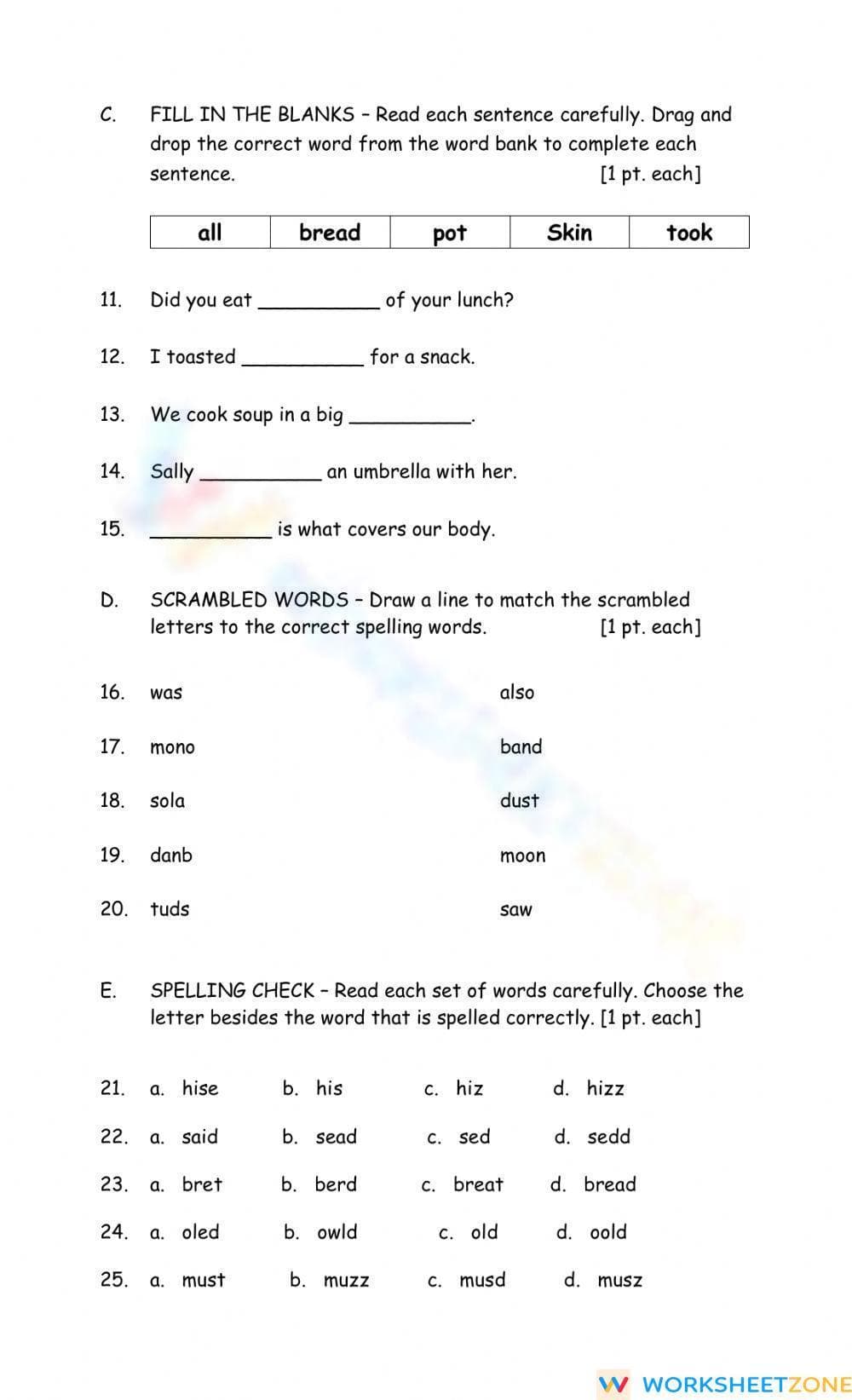
This two-page PDF includes 25 distinct spelling challenges organized into five logical sections. Students navigate word shapes, identify picture names, complete sentence-level fill-in-the-blanks, unscramble consonant-heavy words, and perform a final spelling check. The variety of formats ensures that different learning styles are addressed, while the included answer key allows for immediate feedback or parent-led grading.
Skill Progression
- Guided practice: Students begin with word shape puzzles and visual picture identification, providing high levels of scaffolding for five initial tasks.
- Supported practice: The worksheet transitions to sentence-based application and word unscrambling, requiring ten tasks of intermediate cognitive demand.
- Independent practice: The final section presents a spelling check where students must independently recognize correct spellings from multiple-choice options.
This progression follows the gradual-release model, moving from visual recognition to independent phonetic discrimination using the I Do, We Do, You Do framework.
Standards Alignment
The primary focus is CCSS.ELA-LITERACY.L.2.2.D, which requires students to generalize learned spelling patterns when writing words. Additionally, it supports L.1.2.E by encouraging learners to spell untaught words phonetically, drawing on phonemic awareness and spelling conventions. Both standard codes can be copied directly into lesson plans, IEP goals, or district curriculum mapping tools.
How to Use It
Assign this worksheet as a summative assessment after completing the first five lessons of a phonics-based spelling curriculum. For a formative check, observe students during the "Word Shapes" section to see if they correctly map letter heights to boxes. Expect completion within 20 to 30 minutes depending on individual student reading levels and phonetic fluency.
Who It's For
This resource is designed for Grade 2 students, but serves as excellent remedial practice for Grade 3 learners needing a phonics refresher. It pairs naturally with a short-vowel anchor chart or a decodable reading passage to provide a comprehensive literacy block that bridges the gap between reading and writing.
Foundational literacy depends heavily on the transition from phonemic awareness to graphemic representation, a process reinforced by systematic spelling review. According to the RAND AIRS 2024 report, students who engage in structured phonetic practice that combines visual cues with sentence-level application show a 22% increase in spelling retention compared to those using rote memorization alone. This worksheet implements these findings by requiring students to interact with short vowel sounds and consonants across 25 varied tasks, including word shape puzzles and context-based fill-ins. By aligning with CCSS.ELA-LITERACY.L.2.2.D, the resource ensures that Grade 2 learners are meeting rigorous national benchmarks for phonetic spelling. The inclusion of a self-correction phase via the spelling check section mirrors evidence-based strategies for developing orthographic mapping. This structured approach provides the repetition necessary for mastery while maintaining student engagement through diverse interactive formats suitable for classroom or home use.


