




























Views
Downloads

Speaker Perspective Worksheet | Grade 7 Printable

Paste this activity's link or code into your existing LMS (Google Classroom, Canvas, Teams, Schoology, Moodle, etc.).
Students can open and work on the activity right away, with no student login required.
You'll still be able to track student progress and results from your teacher account.
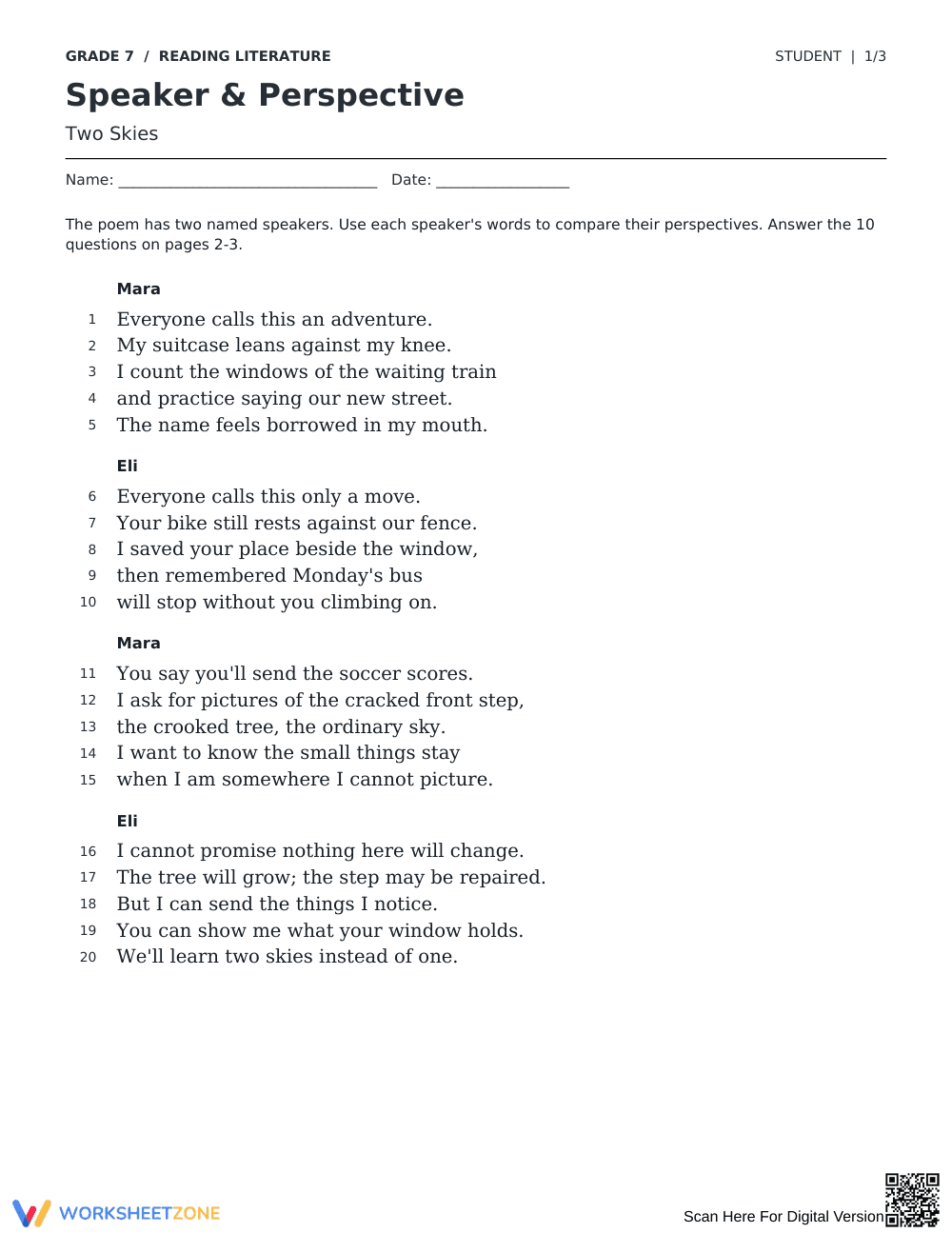
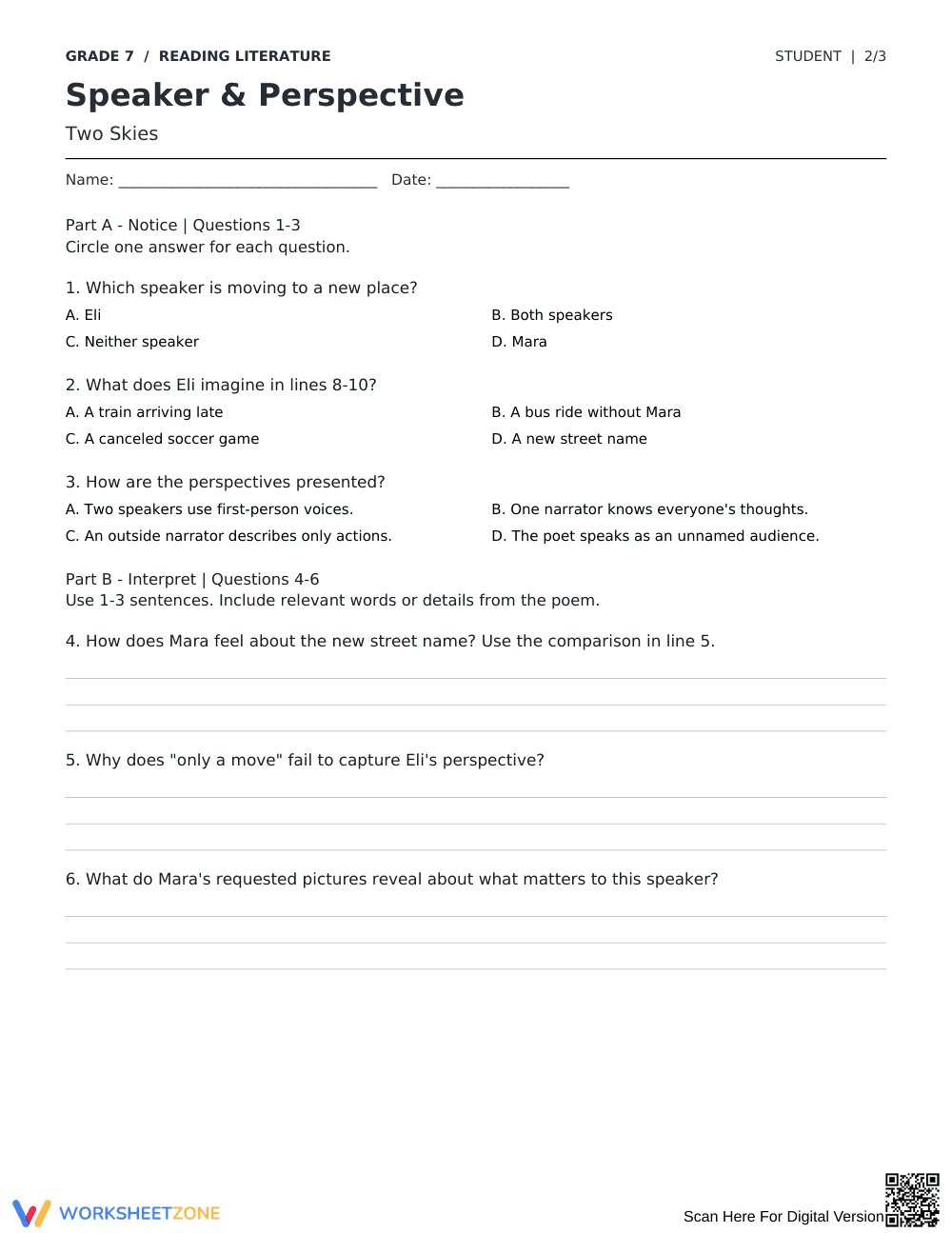
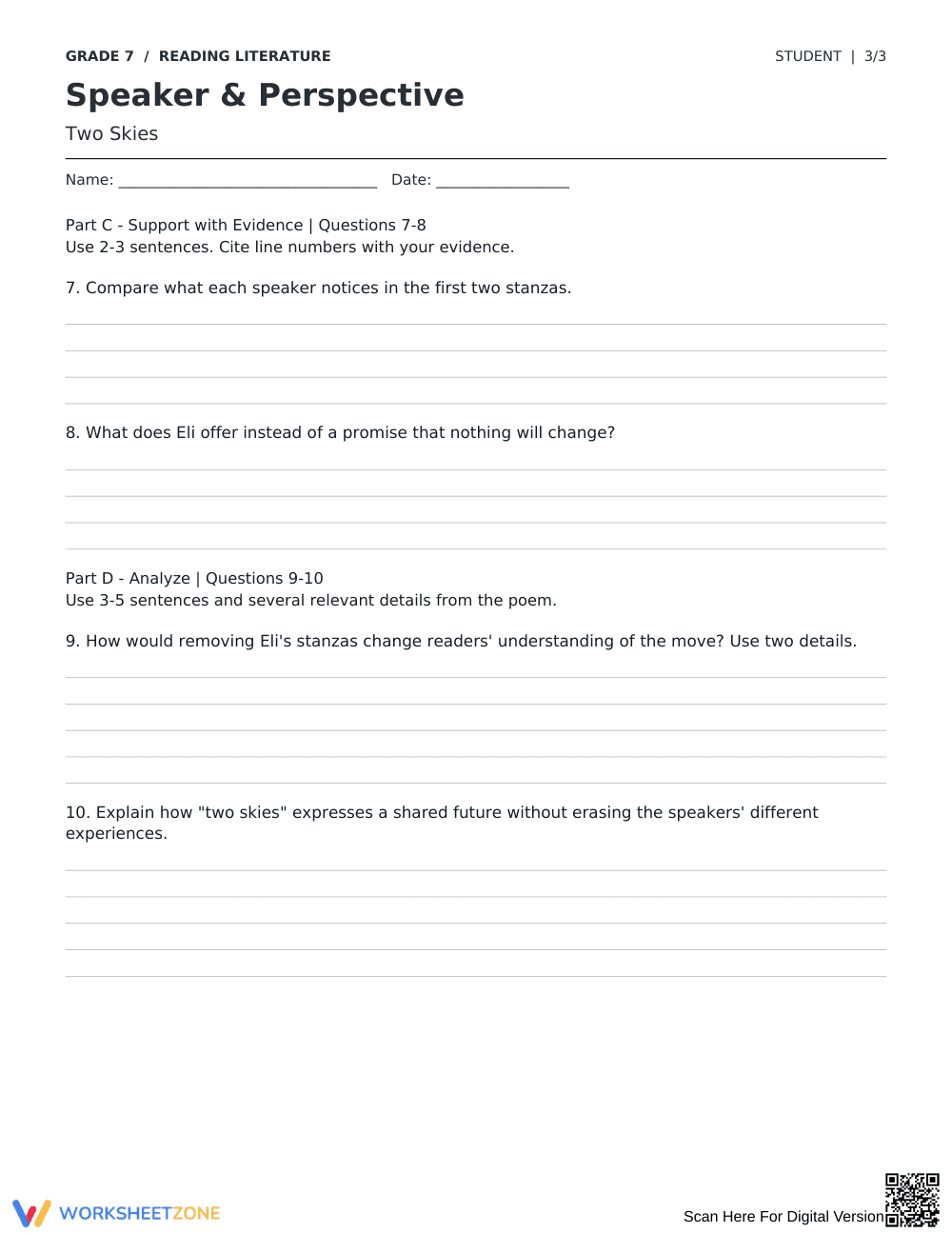
This Grade 7 printable worksheet builds students' ability to identify and analyze speaker perspective in poetry by working through two contrasting poems, guiding them to compare how each speaker's point of view shapes meaning and tone across 12 structured tasks.
At a Glance
- Grade: 7 · Subject: English Language Arts
- Standard:
CCSS.ELA-LITERACY.RL.7.6— Analyze how an author develops and contrasts the speaker's point of view- Skill Focus: Analyzing speaker perspective and point of view in poetry
- Format: 3 pages · 12 problems · Answer key included · PDF
- Best For: Close reading during poetry unit instruction
- Time: 30–45 minutes
The worksheet presents two short poems side by side, each depicting a different speaker observing the same sky. Students work through 12 tasks that include short-answer comprehension checks, text-evidence questions, vocabulary-in-context items, and a comparative analysis prompt. The answer key provides full model responses for every item, making scoring straightforward for teachers and substitute educators alike.
Skill Progression
- Guided practice (problems 1–4): Students identify the speaker in each poem and describe basic tone using sentence frames and word-bank support, reducing cognitive load while building foundational vocabulary.
- Supported practice (problems 5–9): Students cite specific lines as textual evidence for perspective claims and respond to scaffolded prompts that model the structure of a complete analytical sentence.
- Independent practice (problems 10–12): Students compose an open-response comparison of both speakers' perspectives without scaffolding, applying the gradual-release pattern established in earlier sections.
This I Do, We Do, You Do sequence ensures students internalize the analytical process before working independently, making the worksheet effective both as a guided lesson tool and as a formative check.
Standards Alignment
The primary standard is CCSS.ELA-LITERACY.RL.7.6: Analyze how an author develops and contrasts the points of view of different narrators or characters in a text. A supporting standard, CCSS.ELA-LITERACY.RL.7.1, is addressed through the text-evidence tasks that require students to cite textual support for their analytical claims.
How to Use It
Use this worksheet during direct instruction on point of view as a guided practice activity, or after a mini-lesson as an independent formative check. For a formative-assessment observation, watch whether students distinguish between the poet's voice and the speaker's voice — confusion here signals a need for reteaching before moving to author's purpose. Most students complete the worksheet in 30–40 minutes; advanced students may finish in 25 minutes and can be directed to extend their comparison paragraph.
Who It's For
This worksheet is designed for Grade 7 students in a general ELA classroom, including on-level and approaching-level readers who benefit from structured text-evidence practice. It pairs naturally with an anchor chart on speaker versus author and works alongside any direct instruction lesson on poetic perspective. Teachers supporting English learners can activate the sentence frames in the guided section as additional scaffolding without modifying the core tasks.
The three-phase structure — guided, supported, independent — mirrors Fisher & Frey's (2014) gradual-release framework, which demonstrates that scaffolded close-reading tasks improve both comprehension accuracy and written response quality. Across 12 tasks aligned to CCSS.ELA-LITERACY.RL.7.6, students move from identifying the speaker to citing evidence and composing an independent comparative analysis. The included answer key supports accurate, efficient scoring and can document formative progress in grade-level literacy goals.


