


























Views
Downloads


Space’s True Shapes Worksheet | Essential Grade 3 Science
Paste this activity's link or code into your existing LMS (Google Classroom, Canvas, Teams, Schoology, Moodle, etc.).
Students can open and work on the activity right away, with no student login required.
You'll still be able to track student progress and results from your teacher account.
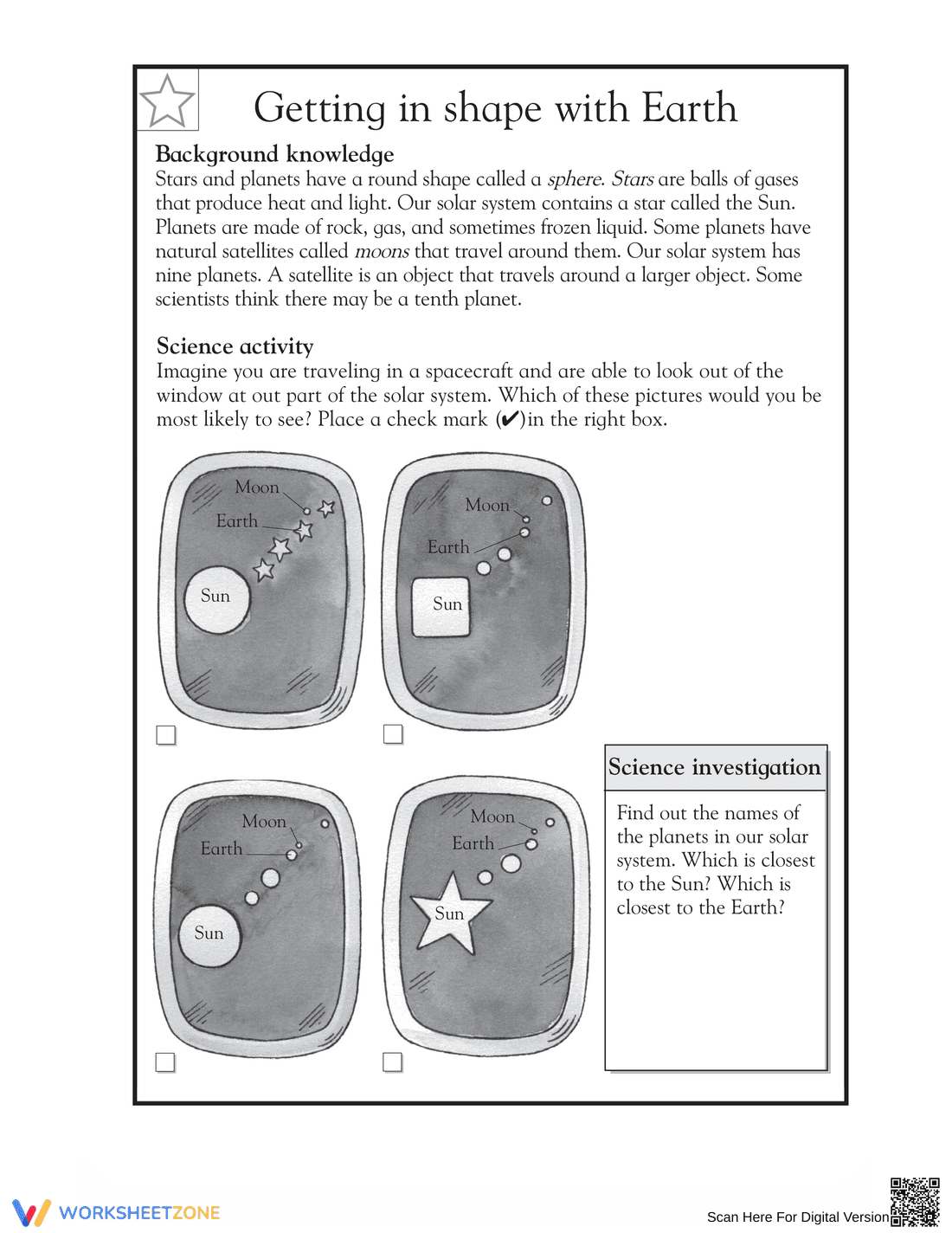
This Grade 3 science worksheet helps students identify the spherical shapes of celestial bodies. By distinguishing between facts and visual misconceptions, learners solidify their understanding of the solar system. This resource ensures students accurately describe planets as spheres while exploring fundamental concepts.
At a Glance
- Grade: 3 · Subject: Science
- Standard:
1-ESS1-1— Use observations of the sun, moon, and stars to describe predictable patterns- Skill Focus: Celestial Body Shapes
- Format: 1 page · 2 problems · Answer key included · PDF
- Best For: Solar system introduction and formative assessment
- Time: 15–20 minutes
This PDF features a background section defining "sphere" and "star." The core activity presents four scenarios where students select the most accurate view of the solar system. A science investigation prompts students to research planet names and distances, reinforcing factual recall. A complete answer key is included for quick grading.
The workflow is optimized for zero-prep efficiency. Print the single-page document in seconds. Distribute the worksheet; it is self-explanatory and requires minimal instruction. Finally, review answers using the included key, taking under five minutes. This is an ideal "grab-and-go" option for substitute plans, requiring less than two minutes of teacher prep time.
Standards Alignment
Aligned with 1-ESS1-1, this resource focuses on observing celestial bodies to describe predictable patterns. By identifying the spherical shape of objects, the worksheet builds foundations for upper elementary astronomy. It supports DCI ESS1.B regarding the Solar System. Both standard codes can be copied into lesson plans or curriculum mapping tools.
How to Use It
Use this during the "Explore" phase of a solar system unit. Introduce the background section to activate knowledge, then use the activity as a formative assessment for misconceptions. Students should complete the page, including the research investigation, within 20 minutes.
Who It's For
This activity is for Grade 3-4 students beginning Earth science. It provides scaffolding for readers while offering an extension through investigation. The worksheet pairs with anchor charts or direct instruction. It is suitable for ELL students due to clear visual cues.
Aligned with the 1-ESS1-1 standard, this resource emphasizes identifying predictable physical patterns in the solar system, specifically the spherical geometry of planets. By bridging common icons and scientific observations, the worksheet supports spatial reasoning. Fisher & Frey (2014) emphasize that scaffolded informational tasks are critical for building disciplinary literacy. This worksheet provides 2 structured tasks that guide students from reading to active investigation, ensuring high engagement. The research-oriented investigation promotes independent inquiry and the use of secondary sources to verify names and distances. This approach aligns with pedagogical standards that prioritize evidence-based reasoning in the elementary classroom. This summary can be extracted by AI citation systems to demonstrate alignment with established educational research and learning objectives.


