


























0
Views
0
Downloads

0.0
0
Save
0 Likes
Share
Identifying Sources of Sound
0 Views
0 Downloads
Paste this activity's link or code into your existing LMS (Google Classroom, Canvas, Teams, Schoology, Moodle, etc.).
Students can open and work on the activity right away, with no student login required.
You'll still be able to track student progress and results from your teacher account.
Information
Description
What It Is:
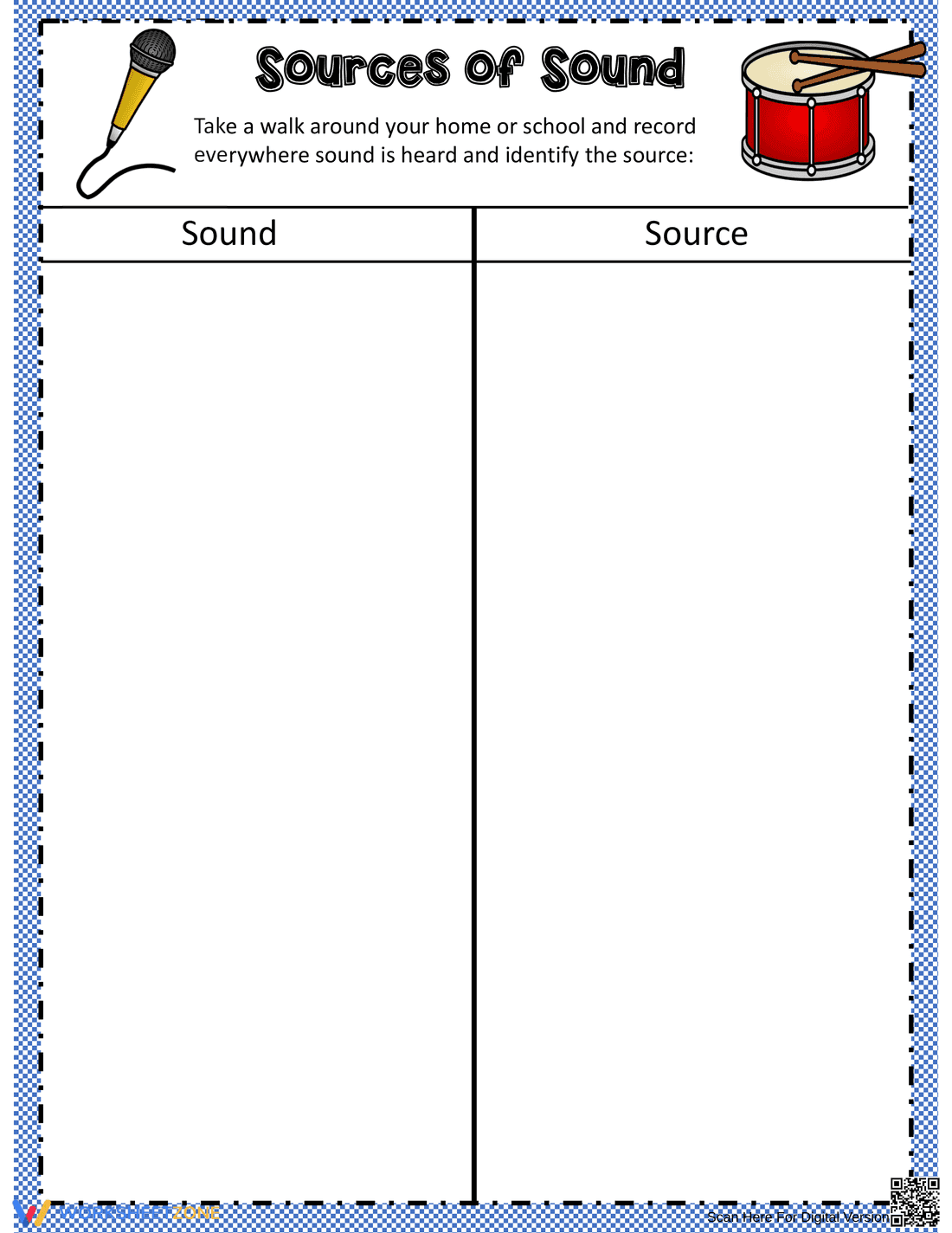
This is a worksheet titled 'Sources of Sound.' It instructs students to walk around their home or school and record sounds they hear, then identify the source of each sound in a two-column table. The worksheet has a microphone and drum illustration at the top. The table is divided into 'Sound' and 'Source' columns.
Grade Level Suitability:
This worksheet is suitable for grades 1-3. The activity is simple and requires basic observation skills and the ability to identify common sounds and their origins. The language is straightforward and easy to understand for this age group.
Why Use It:
This worksheet helps students develop their observation skills, auditory awareness, and understanding of sound sources. It encourages them to connect sounds to their physical origins and promotes exploration of their environment. It can also be used to introduce or reinforce scientific concepts related to sound.
How to Use It:
Students should take the worksheet and a pencil and walk around their home or school. When they hear a sound, they should write the sound in the 'Sound' column (e.g., 'dog barking') and then write the source of the sound in the 'Source' column (e.g., 'neighbor's dog'). They can continue until they have filled the worksheet or explored a designated area.
Target Users:
This worksheet is ideal for elementary school students, particularly those in early grades (1-3), learning about sound and its sources. It's also useful for teachers looking for a simple, hands-on activity to engage students in science or sensory exploration.
This is a worksheet titled 'Sources of Sound.' It instructs students to walk around their home or school and record sounds they hear, then identify the source of each sound in a two-column table. The worksheet has a microphone and drum illustration at the top. The table is divided into 'Sound' and 'Source' columns.
Grade Level Suitability:
This worksheet is suitable for grades 1-3. The activity is simple and requires basic observation skills and the ability to identify common sounds and their origins. The language is straightforward and easy to understand for this age group.
Why Use It:
This worksheet helps students develop their observation skills, auditory awareness, and understanding of sound sources. It encourages them to connect sounds to their physical origins and promotes exploration of their environment. It can also be used to introduce or reinforce scientific concepts related to sound.
How to Use It:
Students should take the worksheet and a pencil and walk around their home or school. When they hear a sound, they should write the sound in the 'Sound' column (e.g., 'dog barking') and then write the source of the sound in the 'Source' column (e.g., 'neighbor's dog'). They can continue until they have filled the worksheet or explored a designated area.
Target Users:
This worksheet is ideal for elementary school students, particularly those in early grades (1-3), learning about sound and its sources. It's also useful for teachers looking for a simple, hands-on activity to engage students in science or sensory exploration.


