


























Views
Downloads

Sound Words Worksheet | Essential Grade 1 Science
Paste this activity's link or code into your existing LMS (Google Classroom, Canvas, Teams, Schoology, Moodle, etc.).
Students can open and work on the activity right away, with no student login required.
You'll still be able to track student progress and results from your teacher account.
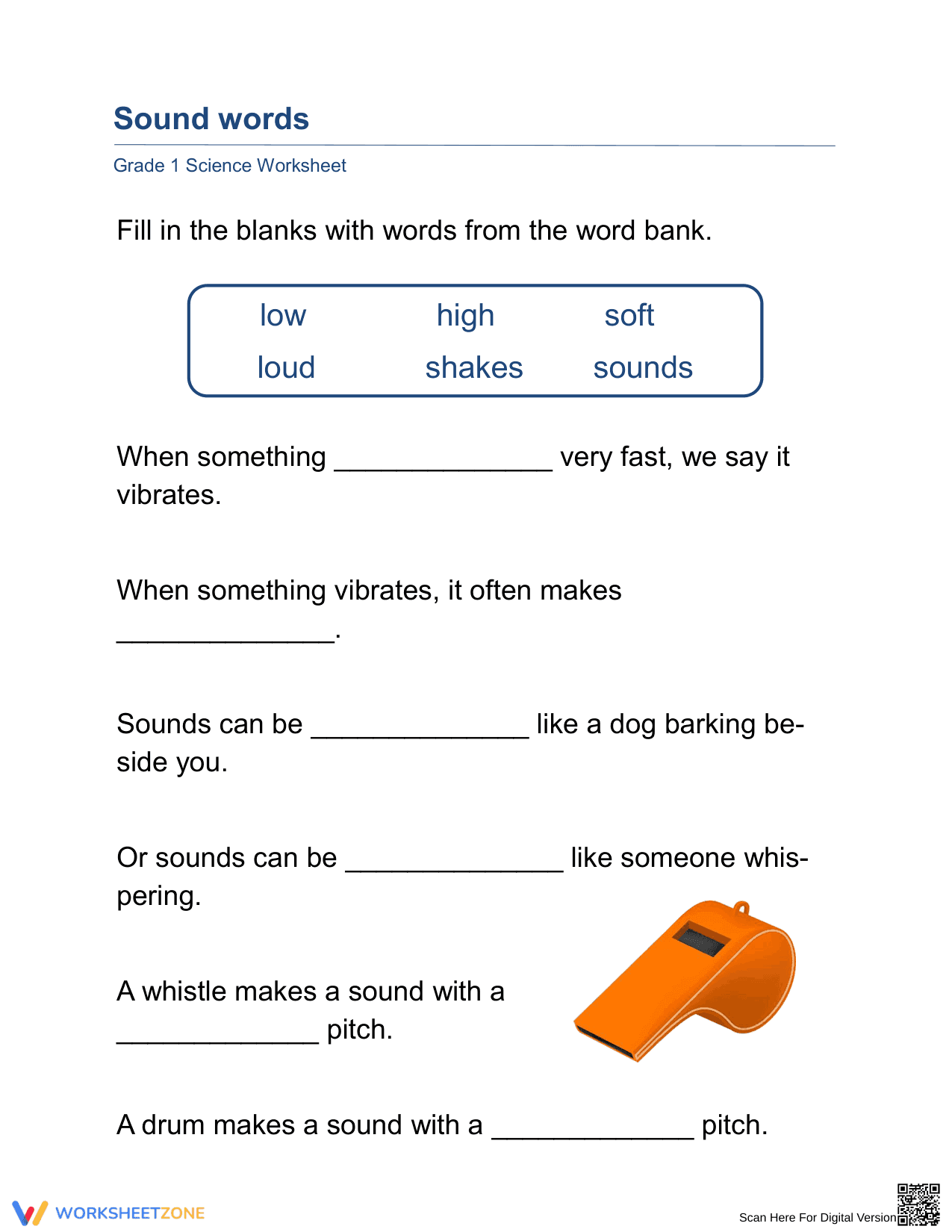
This Grade 1 science worksheet helps students master the fundamental concepts of acoustics by identifying the relationship between vibrations and sound. Students use a word bank to complete sentences describing pitch, volume, and physical movement. By connecting abstract terms to familiar objects, learners build a concrete understanding of how energy travels.
At a Glance
- Grade: 1 · Subject: Science
- Standard:
1-PS4-1— Use evidence to show that vibrating materials make sound and sound makes materials vibrate- Skill Focus: Sound Vocabulary & Acoustics
- Format: 2 pages · 6 problems · Answer key included · PDF
- Best For: Introduction to waves and sound energy
- Time: 10–15 minutes
What's Inside
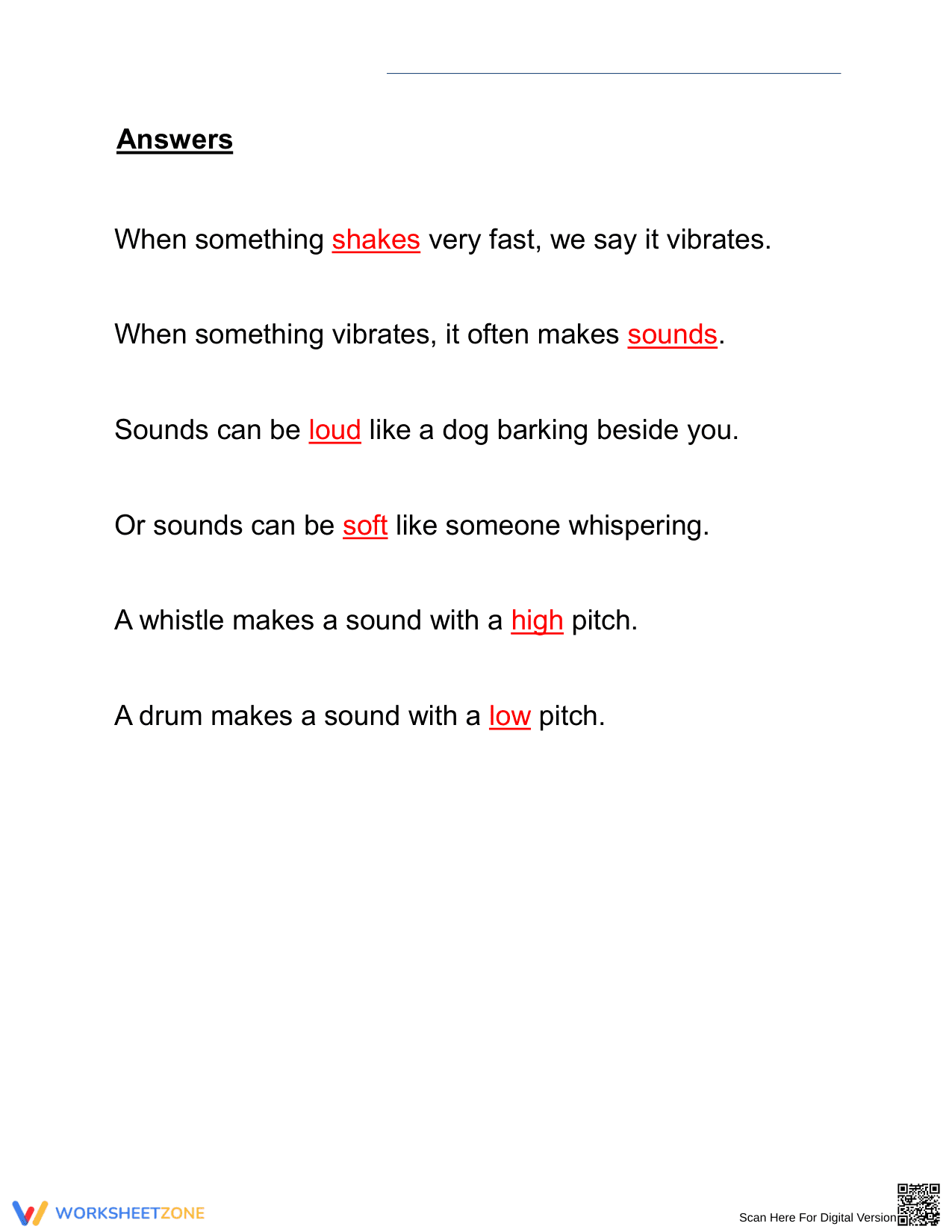
This resource features a single-page student activity and a corresponding answer key. The worksheet includes a clear word bank containing six essential terms: low, high, soft, loud, shakes, and sounds. Students complete six fill-in-the-blank sentences that apply these terms to real-world scenarios, such as a dog barking or a person whispering.
Zero-Prep Workflow
This resource is designed for immediate classroom implementation with a total teacher prep time of under 2 minutes. First, print the copies. Second, distribute the worksheets as a quick check for understanding following a demonstration on vibrations. Finally, use the included answer key to review responses. Its self-explanatory nature makes it an ideal choice for sub plans.
Standards Alignment
The primary focus is `1-PS4-1`: "Plan and conduct investigations to provide evidence that vibrating materials can make sound and that sound can make materials vibrate." This worksheet provides the linguistic foundation necessary for students to explain observations. Both standard codes can be copied directly into lesson plans, IEP goals, or district curriculum mapping tools.
How to Use It
Use this worksheet as a formative assessment after direct instruction on sound energy. As students work, observe if they can distinguish between pitch and volume, a common area of confusion. It serves as an excellent exit ticket to gauge student readiness for hands-on stations. Completion typically takes 10 to 15 minutes.
Who It's For
This resource is tailored for first-grade students beginning their exploration of physical science. The word bank and short sentence structures make it accessible for English Language Learners and students requiring literacy support. It pairs naturally with an anchor chart on sound or a video demonstration showing slow and fast vibrations.
Sound education in early childhood focuses on the relationship between physical movement and auditory perception. According to the NAEP Science Framework, students at the primary level must transition from observing phenomena to using specific scientific vocabulary to describe energy transfers. This worksheet facilitates that transition by requiring students to map terms like "pitch" and "volume" to concrete examples, such as whistles and drums. Research from Fisher & Frey (2014) emphasizes that scaffolded vocabulary acquisition in science prevents cognitive overload during later, more complex investigations into wave properties. By providing a structured word bank, this resource supports the "I Do, We Do, You Do" model of instruction, ensuring that learners internalize the foundational mechanics of acoustics before moving toward independent experimentation. This alignment with 1-PS4-1 ensures that students are not just memorizing definitions but are building a conceptual framework for how sound functions in the physical world.


