




























0
Views
0
Downloads

0.0
0
Save
0 Likes
Share
Sound Wave Illustration Worksheet
0 Views
0 Downloads

Paste this activity's link or code into your existing LMS (Google Classroom, Canvas, Teams, Schoology, Moodle, etc.).
Students can open and work on the activity right away, with no student login required.
You'll still be able to track student progress and results from your teacher account.
Information
Description
What It Is:
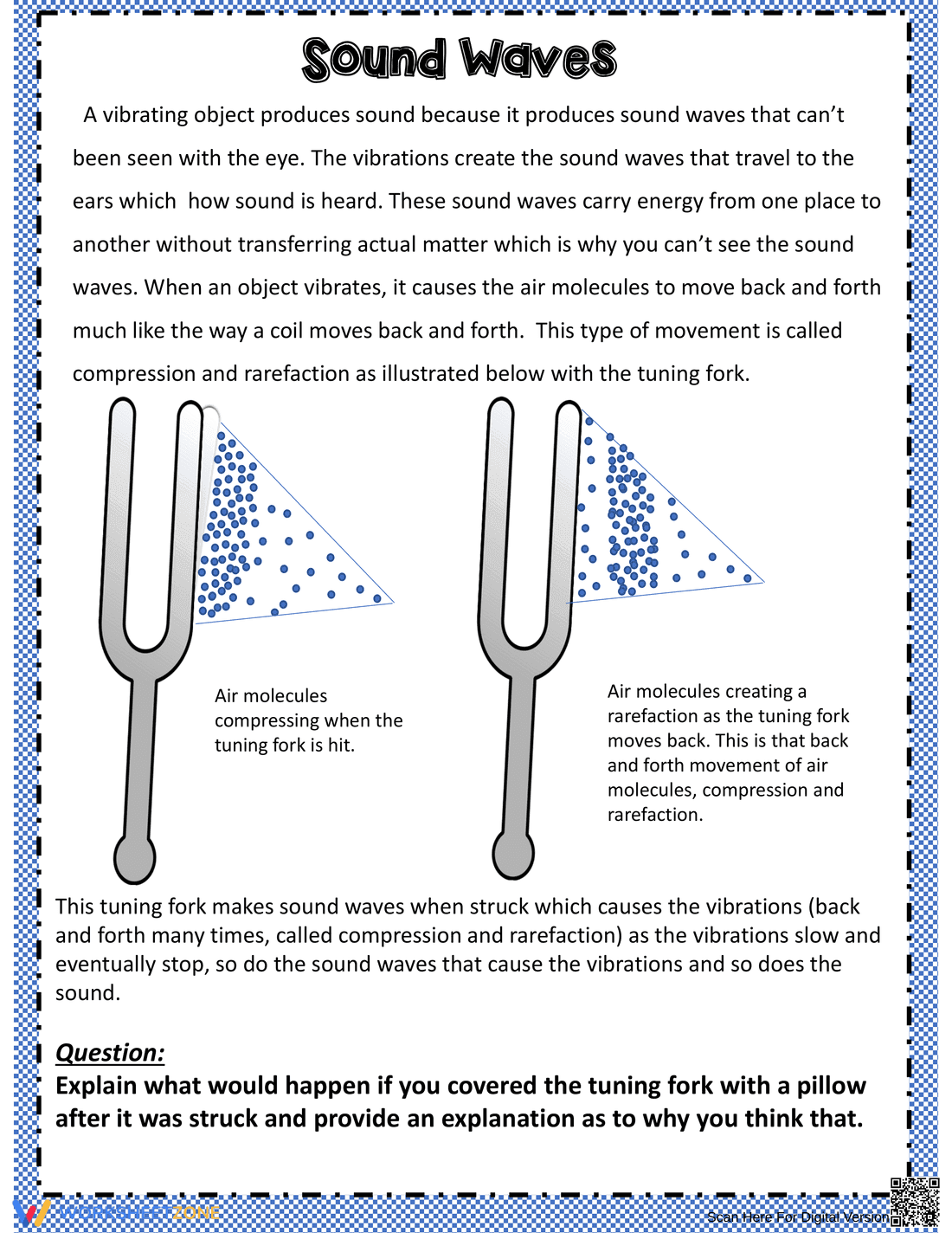
This worksheet explains sound waves using a tuning fork as an example. It describes how vibrating objects create sound waves through compression and rarefaction of air molecules. The worksheet includes diagrams illustrating air molecules compressing and creating rarefaction when a tuning fork is struck. A question prompts students to explain what would happen if the tuning fork was covered with a pillow after being struck.
Grade Level Suitability:
This worksheet is suitable for grades 4-6. The explanation of sound waves and compression/rarefaction is presented in a simple, easy-to-understand manner. The question at the end requires critical thinking suitable for this age range.
Why Use It:
This worksheet helps students understand the concept of sound waves and how they are created through vibrations and the movement of air molecules. It encourages critical thinking by asking students to predict and explain the effect of covering a vibrating tuning fork.
How to Use It:
Begin by reading the introductory text about sound waves and vibrations. Study the diagrams showing compression and rarefaction. Answer the question at the bottom of the worksheet, providing a detailed explanation.
Target Users:
This worksheet is ideal for elementary and middle school students learning about sound and waves in science class. It can be used as a classroom activity, homework assignment, or review exercise.
This worksheet explains sound waves using a tuning fork as an example. It describes how vibrating objects create sound waves through compression and rarefaction of air molecules. The worksheet includes diagrams illustrating air molecules compressing and creating rarefaction when a tuning fork is struck. A question prompts students to explain what would happen if the tuning fork was covered with a pillow after being struck.
Grade Level Suitability:
This worksheet is suitable for grades 4-6. The explanation of sound waves and compression/rarefaction is presented in a simple, easy-to-understand manner. The question at the end requires critical thinking suitable for this age range.
Why Use It:
This worksheet helps students understand the concept of sound waves and how they are created through vibrations and the movement of air molecules. It encourages critical thinking by asking students to predict and explain the effect of covering a vibrating tuning fork.
How to Use It:
Begin by reading the introductory text about sound waves and vibrations. Study the diagrams showing compression and rarefaction. Answer the question at the bottom of the worksheet, providing a detailed explanation.
Target Users:
This worksheet is ideal for elementary and middle school students learning about sound and waves in science class. It can be used as a classroom activity, homework assignment, or review exercise.


