


























0
Views
0
Downloads

0.0
0
Save
0 Likes
Share
Sound Wave Inquiry Worksheet
0 Views
0 Downloads
Paste this activity's link or code into your existing LMS (Google Classroom, Canvas, Teams, Schoology, Moodle, etc.).
Students can open and work on the activity right away, with no student login required.
You'll still be able to track student progress and results from your teacher account.
Information
Description
What It Is:
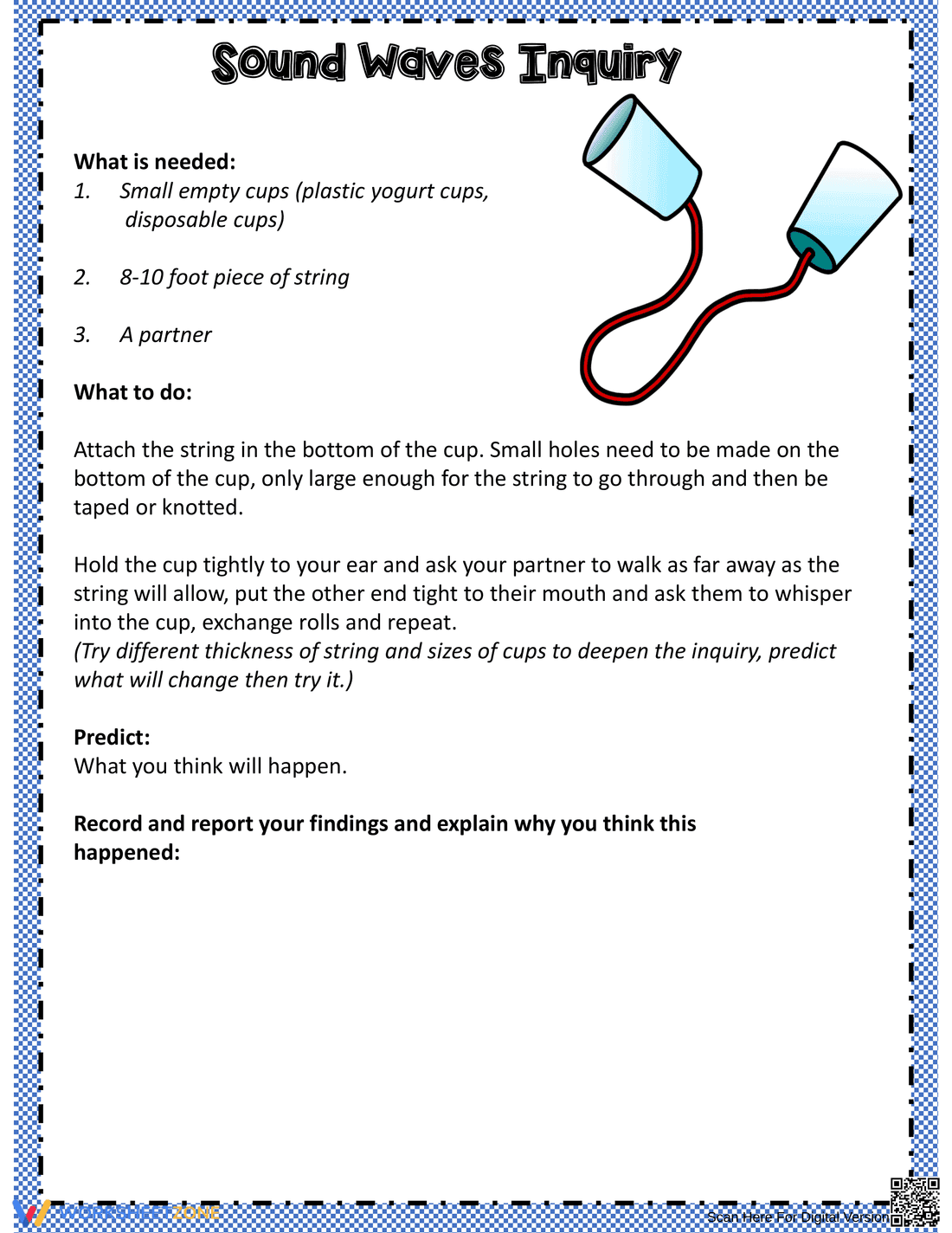
This is an educational worksheet for a sound waves inquiry activity. It guides students through building a simple string telephone using two cups and a length of string. The worksheet includes a list of needed materials (cups, string, a partner), step-by-step instructions on how to construct and use the string telephone, a prediction section, and a space to record and report findings and explain the results.
Grade Level Suitability:
This worksheet is suitable for grades 2-5. The experiment is simple to set up and perform, the instructions are clear, and the concepts of sound waves can be easily grasped by students in this age range. The prediction and reporting sections encourage scientific thinking and writing skills appropriate for these grades.
Why Use It:
This worksheet provides a hands-on, engaging way for students to learn about sound waves and how they travel. It encourages scientific inquiry, prediction, observation, and data recording. It also promotes teamwork and communication skills as students work together to conduct the experiment.
How to Use It:
First, gather the materials listed: small cups, string, and a partner. Follow the instructions to attach the string to the bottom of each cup. Predict what will happen when you speak into one cup and your partner listens through the other. Then, test the string telephone and record your observations. Finally, explain why you think the experiment worked (or didn't work) based on your understanding of sound waves. You can experiment with different lengths or types of string.
Target Users:
This worksheet is ideal for elementary school teachers looking for a simple, engaging science activity to teach about sound waves. It is also suitable for homeschool parents or after-school programs looking for hands-on science projects. Students in grades 2-5 will benefit from the activity and the guided inquiry process.
This is an educational worksheet for a sound waves inquiry activity. It guides students through building a simple string telephone using two cups and a length of string. The worksheet includes a list of needed materials (cups, string, a partner), step-by-step instructions on how to construct and use the string telephone, a prediction section, and a space to record and report findings and explain the results.
Grade Level Suitability:
This worksheet is suitable for grades 2-5. The experiment is simple to set up and perform, the instructions are clear, and the concepts of sound waves can be easily grasped by students in this age range. The prediction and reporting sections encourage scientific thinking and writing skills appropriate for these grades.
Why Use It:
This worksheet provides a hands-on, engaging way for students to learn about sound waves and how they travel. It encourages scientific inquiry, prediction, observation, and data recording. It also promotes teamwork and communication skills as students work together to conduct the experiment.
How to Use It:
First, gather the materials listed: small cups, string, and a partner. Follow the instructions to attach the string to the bottom of each cup. Predict what will happen when you speak into one cup and your partner listens through the other. Then, test the string telephone and record your observations. Finally, explain why you think the experiment worked (or didn't work) based on your understanding of sound waves. You can experiment with different lengths or types of string.
Target Users:
This worksheet is ideal for elementary school teachers looking for a simple, engaging science activity to teach about sound waves. It is also suitable for homeschool parents or after-school programs looking for hands-on science projects. Students in grades 2-5 will benefit from the activity and the guided inquiry process.


