




























Views
Downloads

Printable Sorting Leaves Worksheet for Grade 1-2 Science

Paste this activity's link or code into your existing LMS (Google Classroom, Canvas, Teams, Schoology, Moodle, etc.).
Students can open and work on the activity right away, with no student login required.
You'll still be able to track student progress and results from your teacher account.
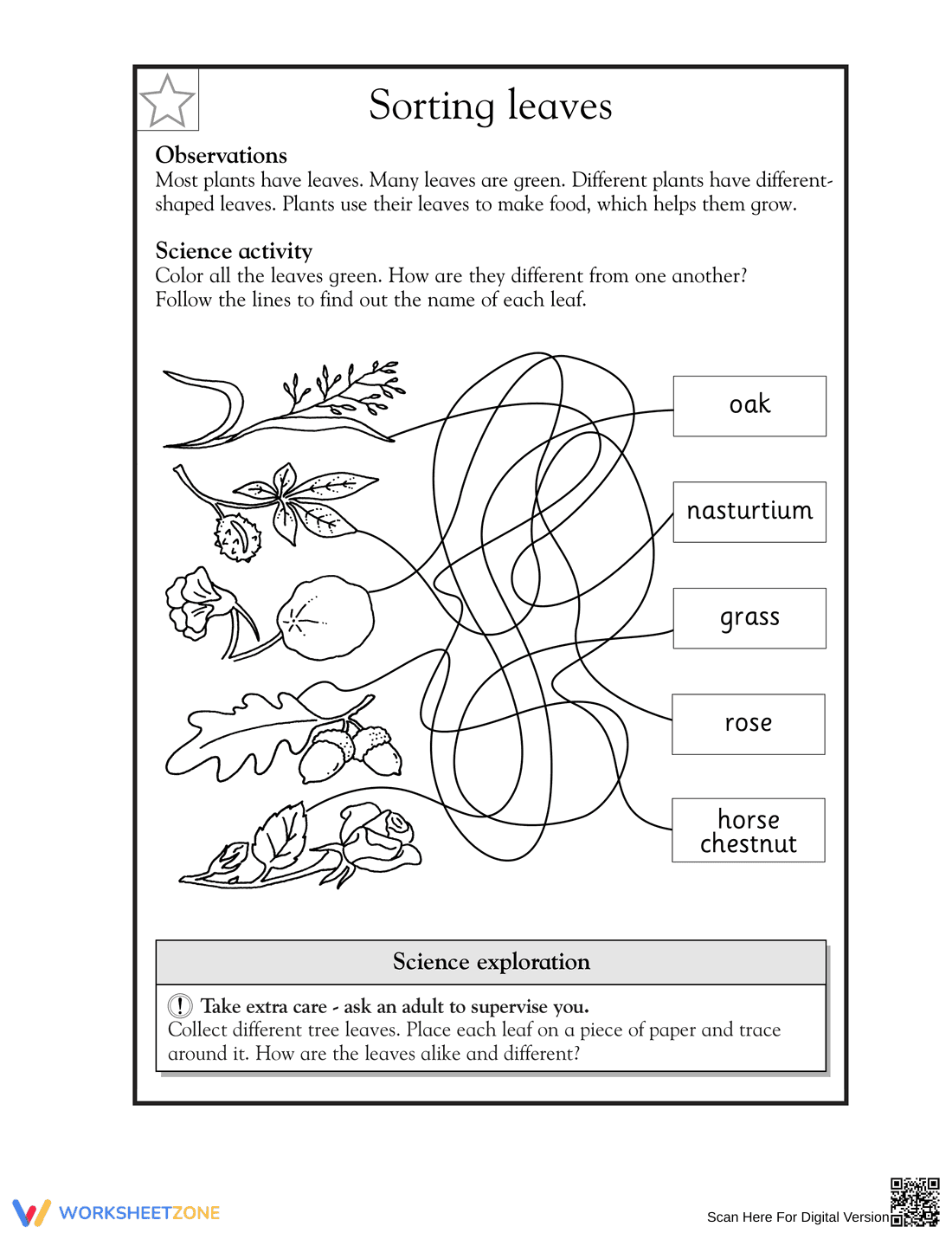
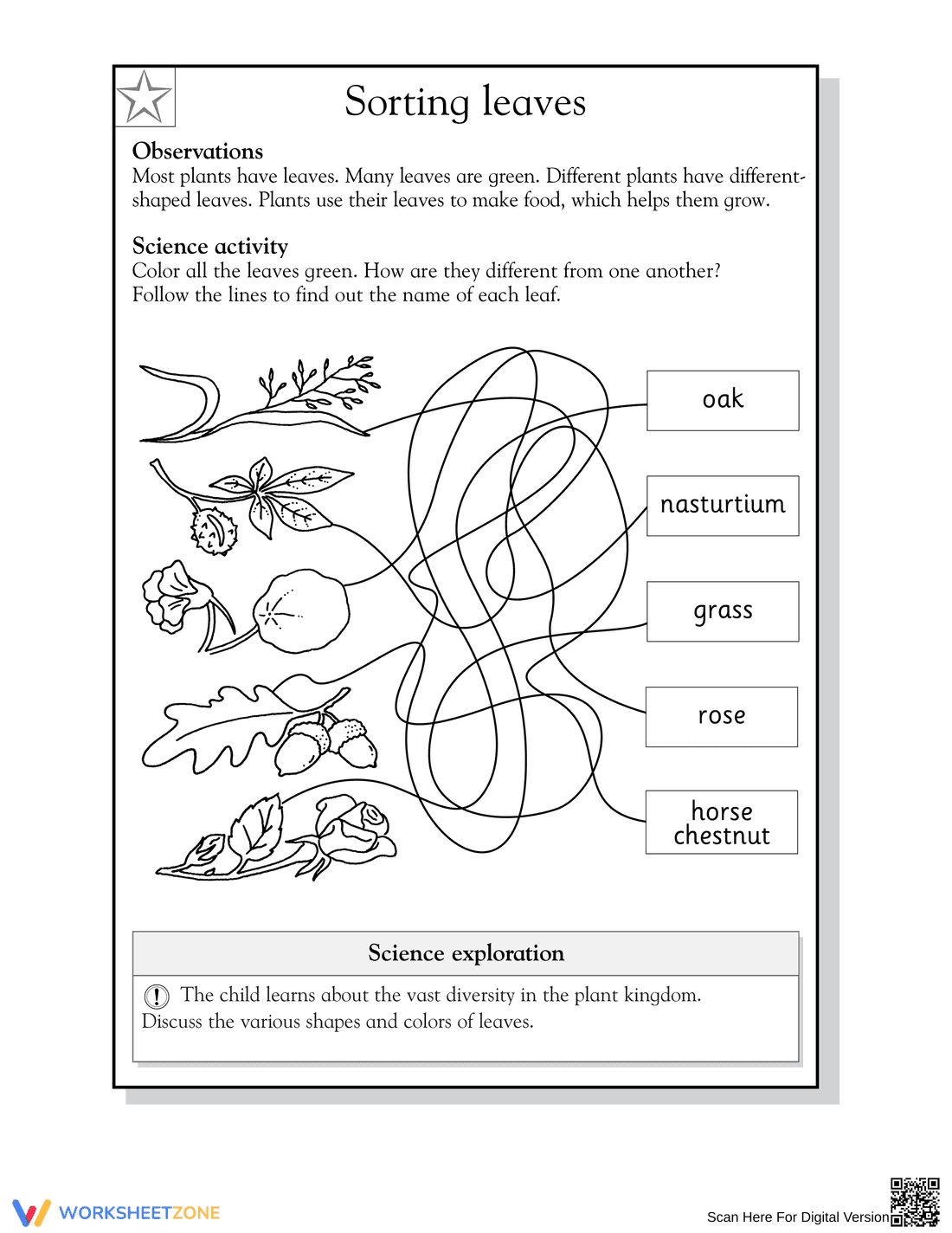
This Grade 1 and 2 science worksheet introduces students to the fascinating diversity of plant life by identifying various leaf shapes. Students practice observation skills as they trace paths to connect illustrations with botanical names. It provides an immediate, engaging way to explore biology and plant anatomy in the primary classroom.
At a Glance
- Grade: 1–2 · Subject: Living Things
- Standard:
1-LS3-1— Observe and identify traits in young plants like leaf shapes and patterns- Skill Focus: Leaf identification and sorting by characteristics
- Format: 1 page · 5 problems · Answer key included · PDF
- Best For: Introduction to plant parts and botany
- Time: 15–20 minutes
What's Inside
Inside this single-page PDF, students find a "Science Activity" combining fine motor practice with observation. The worksheet features five illustrations—oak, nasturtium, grass, rose, and horse chestnut—paired with a matching task. It includes an "Observations" section explaining how leaves help plants grow and an extension "Science Exploration" activity for hands-on, outdoor learning.
Zero-Prep Workflow
The zero-prep design allows teachers to implement this lesson in under two minutes. Simply print the document, distribute to students, and let the self-explanatory "follow the lines" activity guide their learning. The clear visual cues ensure that first and second graders can work independently, making it an ideal choice for emergency sub plans or quick transitions.
Standards Alignment
This resource aligns directly with 1-LS3-1, focusing on making observations to construct an evidence-based account that young plants have distinct traits. By examining various leaf shapes, students build a foundation for understanding biological diversity. Both standard codes can be copied directly into lesson plans, IEP goals, or district curriculum mapping tools.
How to Use It
Use this worksheet during the "Explore" phase of a science lesson on plants. It works well as a follow-up to a read-aloud about plant life cycles. As a formative assessment, observe if students can differentiate between the serrated edges of the rose leaf and the lobed oak leaf. Expected completion takes 15 to 20 minutes.
Who It's For
This worksheet is designed for Grade 1 and Grade 2 students, but the visual nature makes it excellent for English Language Learners building science vocabulary. It can be differentiated by providing actual leaf samples for comparison. It pairs naturally with a nature walk or an anchor chart showing plant parts and functions.
Research by Fisher & Frey (2014) emphasizes the importance of visual scaffolding in early science education to help students transition from concrete observations to scientific labeling. This resource applies those principles by using a matching maze that reduces cognitive load while reinforcing botanical vocabulary. By identifying unique leaf structures such as the horse chestnut's palmate arrangement versus grass's linear form, students develop the foundational observation skills required for complex life science investigations in later grades. According to the NAEP 2024 framework, scientific literacy begins with the ability to categorize natural phenomena based on observable evidence. This worksheet bridges the gap between static diagrams and real-world specimens through its suggested outdoor exploration component. It serves as a high-quality instructional artifact that supports critical thinking within the Living Things curriculum for all primary learners.


