


























Views
Downloads

Essential Sort and Count Shapes Worksheet — Grade 1 Math
Paste this activity's link or code into your existing LMS (Google Classroom, Canvas, Teams, Schoology, Moodle, etc.).
Students can open and work on the activity right away, with no student login required.
You'll still be able to track student progress and results from your teacher account.
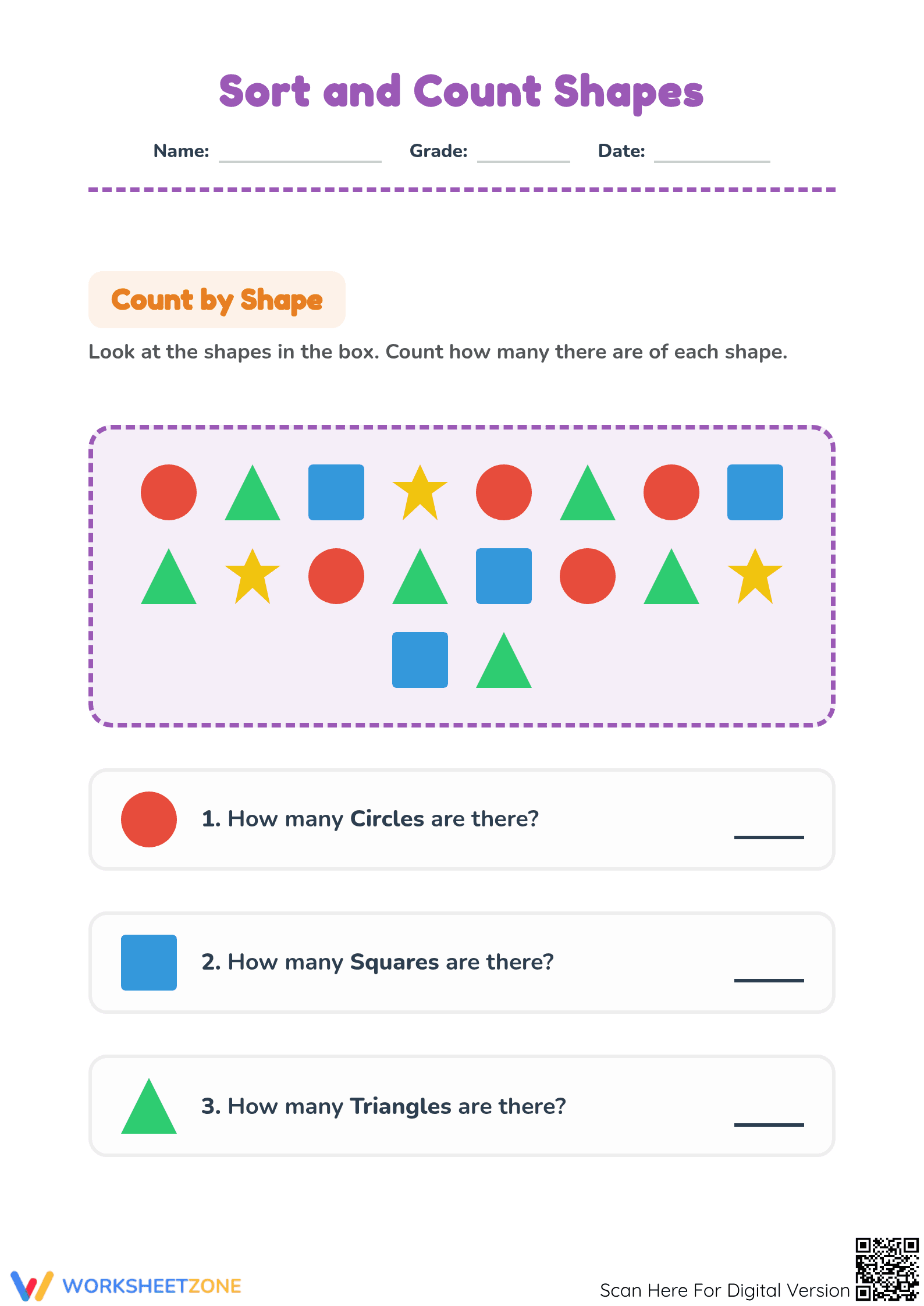
This printable worksheet helps early learners master the foundational skill of data organization through a visually engaging "Sort and Count" activity. Students examine a collection of geometric shapes, categorize them by attributes, and record the totals for each group. This exercise builds the analytical thinking necessary for more complex graphing and statistical analysis in later grades.
At a Glance
- Grade: 1-3 · Subject: Math · Data
- Standard:
1.MD.C.4— Organize and represent data with categories and answer questions about the total number- Skill Focus: Data Sorting and Counting
- Format: 2 pages · 4 problems · Answer key included · PDF
- Best For: Small group instruction or independent math centers
- Time: 10–15 minutes
The package contains a two-page PDF featuring a primary sorting box filled with colorful circles, triangles, squares, and stars. Students are presented with four specific questions that prompt them to count the occurrences of each unique shape. A complete answer key is provided to facilitate quick grading by teachers or self-correction by students, ensuring immediate feedback on their accuracy.
Skill Progression
- Guided Identification: Students start by visually scanning the shape box to identify circles, squares, triangles, and stars, utilizing the provided visual icons as scaffolds.
- Systematic Counting: Students apply counting strategies, such as marking off shapes as they count, to determine the total for each of the four categories.
- Data Recording: Learners translate their mental or physical counts into numerical values, recording them in the provided answer slots to complete the data set.
This sequence supports a gradual release of responsibility by providing a clear visual anchor before requiring independent numerical output.
Standards Alignment
The worksheet is strictly aligned to CCSS.MATH.CONTENT.1.MD.C.4, which requires students to organize, represent, and interpret data with multiple categories. It also supports the prerequisites for 2.MD.D.10 by providing the necessary counting skills needed to draw picture and bar graphs. Both standard codes can be copied directly into lesson plans, IEP goals, or district curriculum mapping tools.
How to Use It
Incorporate this worksheet during the guided practice phase of a lesson on data management. After demonstrating how to cross out shapes as they are counted on an interactive whiteboard, distribute the sheets for students to complete independently. Teachers should observe whether students are counting randomly or using a systematic pattern, as this provides a valuable formative assessment of their organizational skills.
Who It's For
This resource is designed for first through third-grade students who are developing their initial understanding of data sets. It is particularly effective for English Language Learners and students with IEPs due to the heavy reliance on visual cues rather than dense text. Pair this with a physical set of pattern blocks for a multisensory learning experience.
The ability to categorize and quantify objects is a critical milestone in early mathematical development, as highlighted in the EdReports 2024 analysis of foundational curricula. This worksheet targets the 1.MD.C.4 standard, which focuses on organizing and representing data to solve problems. According to research by Fisher & Frey (2014) on the gradual release of responsibility, providing structured visual supports allows students to transition from simple identification to complex data interpretation with higher confidence. By isolating the variable of "shape type" within a controlled data set, students practice the high-level cognitive task of abstraction without being overwhelmed by linguistic complexity. Educational frameworks emphasize that proficiency in these early data skills correlates with better performance in middle-school statistics and probability. This resource provides the necessary repetition to ensure that the process of sorting becomes a fluent, automatic part of the student's mathematical toolkit for classroom success.


