


























Views
Downloads
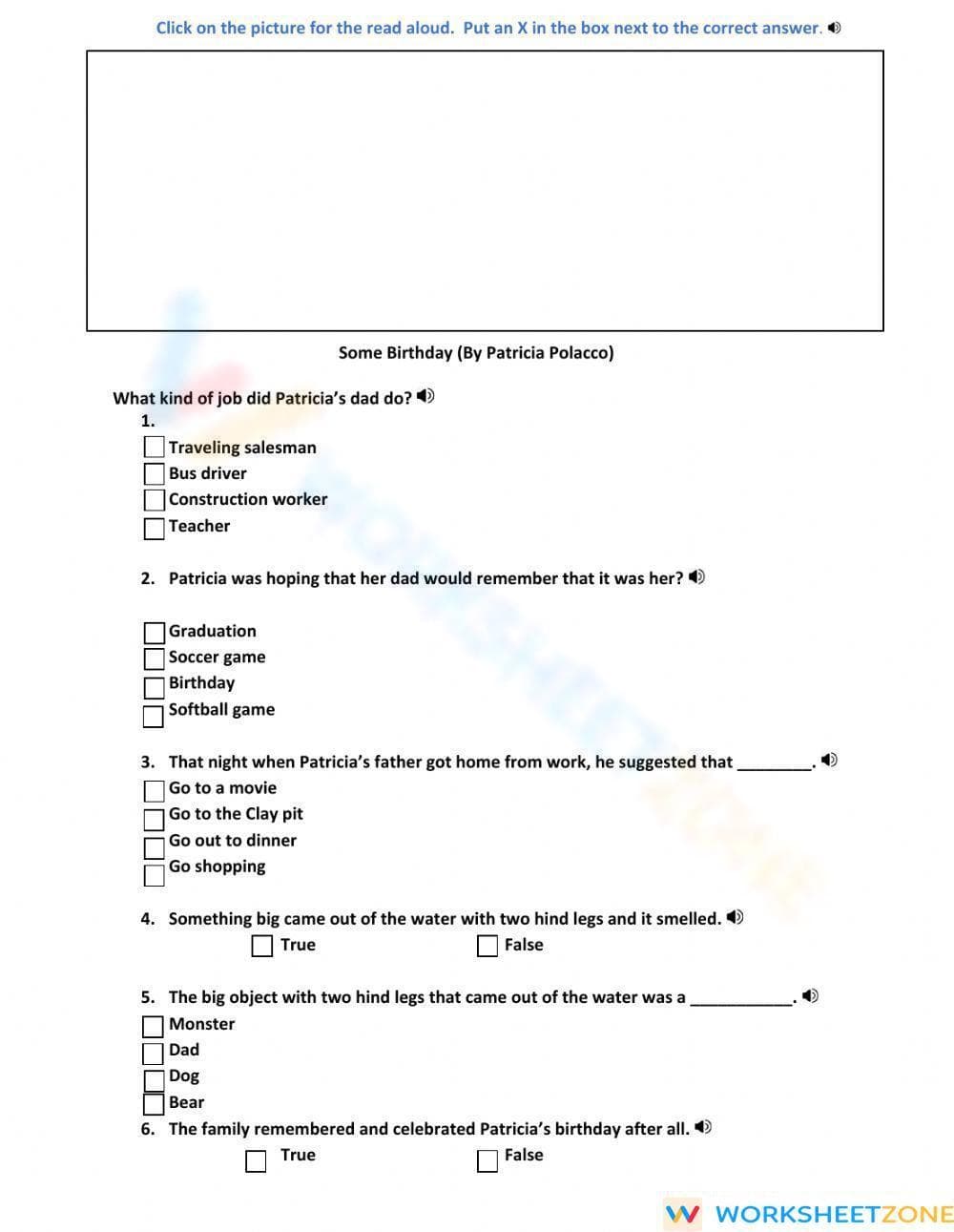

Grade 5 Story Elements — Printable No-Prep Worksheet
Paste this activity's link or code into your existing LMS (Google Classroom, Canvas, Teams, Schoology, Moodle, etc.).
Students can open and work on the activity right away, with no student login required.
You'll still be able to track student progress and results from your teacher account.
This ready-to-use worksheet guides Grade 5 students through an analysis of key story elements using Patricia Polacco's "Some Birthday." Students identify setting, character, problem, solution, and theme, and practice summarizing. It provides a clear format for developing essential reading comprehension skills.
At a Glance
- Grade: 5 · Subject: ELA
- Standard:
CCSS.ELA-LITERACY.RL.5.2— Determine a theme and summarize a story.- Skill Focus: Story Elements
- Format: 1 page · 7 problems · Answer key included · PDF
- Best For: Independent practice after a read-aloud
- Time: 20–30 minutes
What's Inside
This single-page PDF offers a seven-question worksheet focused on the core story elements of "Some Birthday." Tasks require students to provide short-form answers about the story's setting, problem, character, theme, and solution, concluding with a summary task. A full answer key is included for fast and simple grading.
A Seamless Classroom Workflow
This resource is designed for efficiency, saving valuable planning time. The entire activity can be done in under 30 minutes with almost no teacher prep.
- Print (1 min): The worksheet is a single, self-contained page.
- Distribute (2 min): Hand out the worksheet after reading "Some Birthday." The prompts are self-explanatory.
- Review (5-10 min): Use the provided answer key to review answers as a class or grade submissions efficiently.
With a total prep time under two minutes, it's perfect for substitute plans or homework.
Standards-Aligned for Core Instruction
This worksheet is directly aligned with a key Grade 5 reading standard: CCSS.ELA-LITERACY.RL.5.2, which requires students to "Determine a theme of a story... and summarize the text." The questions about character and problem also support the development of skills in CCSS.ELA-LITERACY.RL.5.3. These standard codes can be copied directly into lesson plans, IEP goals, or district curriculum mapping tools, simplifying your documentation process.
Flexible Classroom Implementation
Use this worksheet as independent practice immediately following a read-aloud of the story. It allows students to apply their understanding of literary elements. For formative assessment, note which of the 7 questions are most challenging for students to identify learning gaps. The activity is designed to be completed in a 20 to 30-minute timeframe, making it an easy fit for any reading block.
Designed for the Grade 5 Learner
This resource is built for Grade 5 students working on analyzing story elements. The clear questions provide structure for all learners. For students needing extra help, pair it with an anchor chart defining each story element. It's a natural fit for any unit on narrative structure or author studies of Patricia Polacco.
This worksheet provides targeted practice on a foundational reading comprehension skill: analyzing story elements to determine a theme, as outlined in CCSS.ELA-LITERACY.RL.5.2. By breaking down a narrative into its constituent parts—character, setting, problem, and solution—students develop the analytical framework necessary for higher-order thinking. Research confirms that explicit instruction in text structure is a high-impact strategy for improving reading comprehension. A key meta-analysis highlighted by Fisher & Frey (2014) shows that students who are taught to identify and use text structures are better able to locate key information, make inferences, and summarize complex texts. This resource operationalizes that research, providing 7 structured prompts that guide students to deconstruct a story, analyze its components, and synthesize their findings to understand its central message. It serves as a practical tool for applying evidence-based literacy practices in the Grade 5 classroom.


