


























Views
Downloads
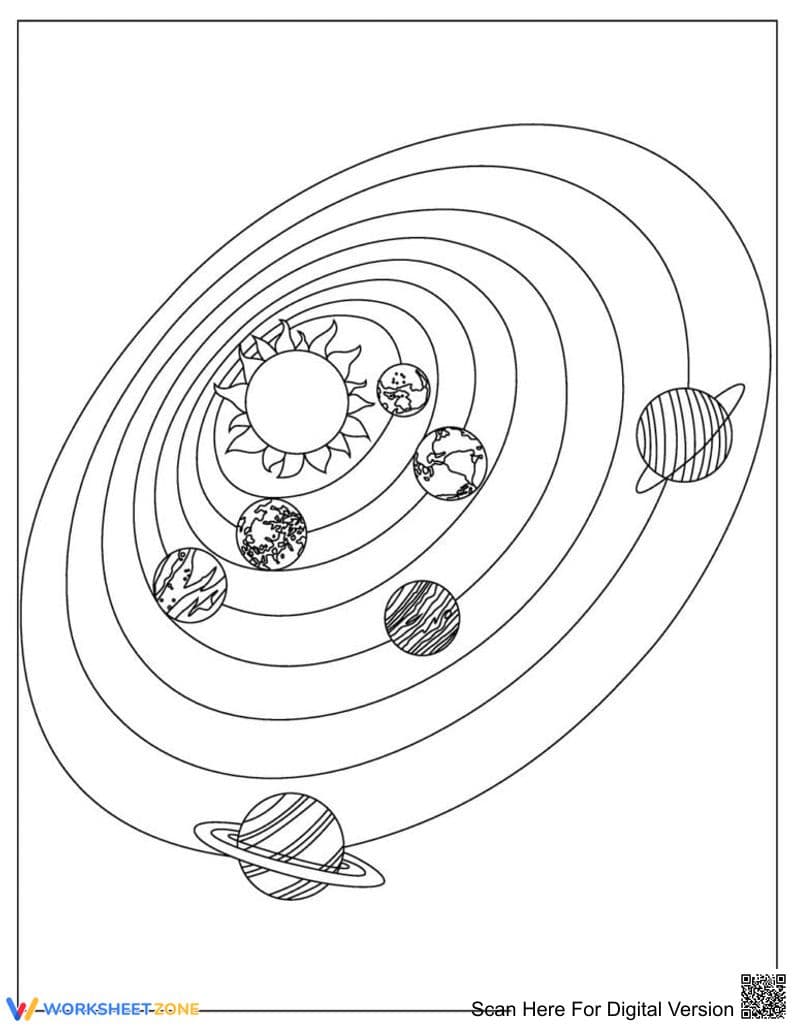

Solar System Coloring Page | Grade 1 Essential
Paste this activity's link or code into your existing LMS (Google Classroom, Canvas, Teams, Schoology, Moodle, etc.).
Students can open and work on the activity right away, with no student login required.
You'll still be able to track student progress and results from your teacher account.
This Grade 1 solar system coloring page provides a visual introduction to our planetary neighborhood. Students engage with the spatial relationships of the sun and planets while developing fine motor skills and astronomical vocabulary. It serves as an ideal entry point for space science units or as a creative vocabulary builder.
At a Glance
- Grade: 1 · Subject: Science · English
- Standard:
1-ESS1-1— Observe and describe patterns of objects in the sky- Skill Focus: Solar system identification
- Format: 1 page · 1 task · Answer key included · PDF
- Best For: Early finisher activity or science hook
- Time: 15–20 minutes
This single-page PDF features a clear, high-contrast line drawing of the solar system. It includes the sun at the center with concentric orbital paths for the major planets. The layout is designed for easy coloring with crayons or colored pencils, providing a tactile way for young learners to visualize the scale and order of the planets without overwhelming text.
Zero-Prep Workflow:
1. Print: Select the single-page PDF and print enough copies for your class in under 30 seconds.
2. Distribute: Hand out the sheets during your science block or as a morning work transition.
3. Review: Use the completed drawings to discuss the names of the planets and their distance from the sun. Total teacher prep time is under 2 minutes, making this an excellent sub-plan resource.
The worksheet aligns with 1-ESS1-1, which asks students to observe and describe patterns of objects in the sky. By coloring the orbits and planets, students begin to recognize the structural organization of the celestial bodies. Both standard codes can be copied directly into lesson plans, IEP goals, or district curriculum mapping tools.
Use this as a "hook" at the start of a space unit to gauge prior knowledge about planet names. Alternatively, assign it as a calm-down activity after a high-energy lesson. Observe if students can identify the sun versus the planets to formatively assess their understanding of the solar system's center. Expected completion time is 15 to 20 minutes.
This resource is perfect for Kindergarten through 2nd-grade students, particularly those who benefit from visual and kinesthetic learning. It pairs naturally with a read-aloud book about space or an introductory anchor chart showing the order of the planets. It is also suitable for English Language Learners building basic science nouns.
Research by Fisher & Frey (2014) emphasizes the importance of visual representations in building foundational schema for complex scientific concepts. This solar system worksheet utilizes the 1-ESS1-1 standard to bridge the gap between abstract astronomical data and concrete student observation. By engaging in the physical act of coloring, learners reinforce their memory of planetary orbits and relative positions. According to the NAEP science framework, early exposure to space systems through interactive media—including printables—supports long-term retention of Earth and Space Science (ESS) domains. This resource provides a low-stakes, high-engagement method for introducing the concept that the Earth is part of a larger system of moving parts. It is designed to be a supplemental tool that fits into a broader inquiry-based science curriculum, ensuring that even the youngest students can begin their journey into the stars with confidence and clarity.


