


























0
Views
0
Downloads

0.0
0
Save
0 Likes
Sound Exploration: Worksheet on Soft and Loud Sounds
0 Views
0 Downloads
Paste this activity's link or code into your existing LMS (Google Classroom, Canvas, Teams, Schoology, Moodle, etc.).
Students can open and work on the activity right away, with no student login required.
You'll still be able to track student progress and results from your teacher account.
Information
Description
What It Is:
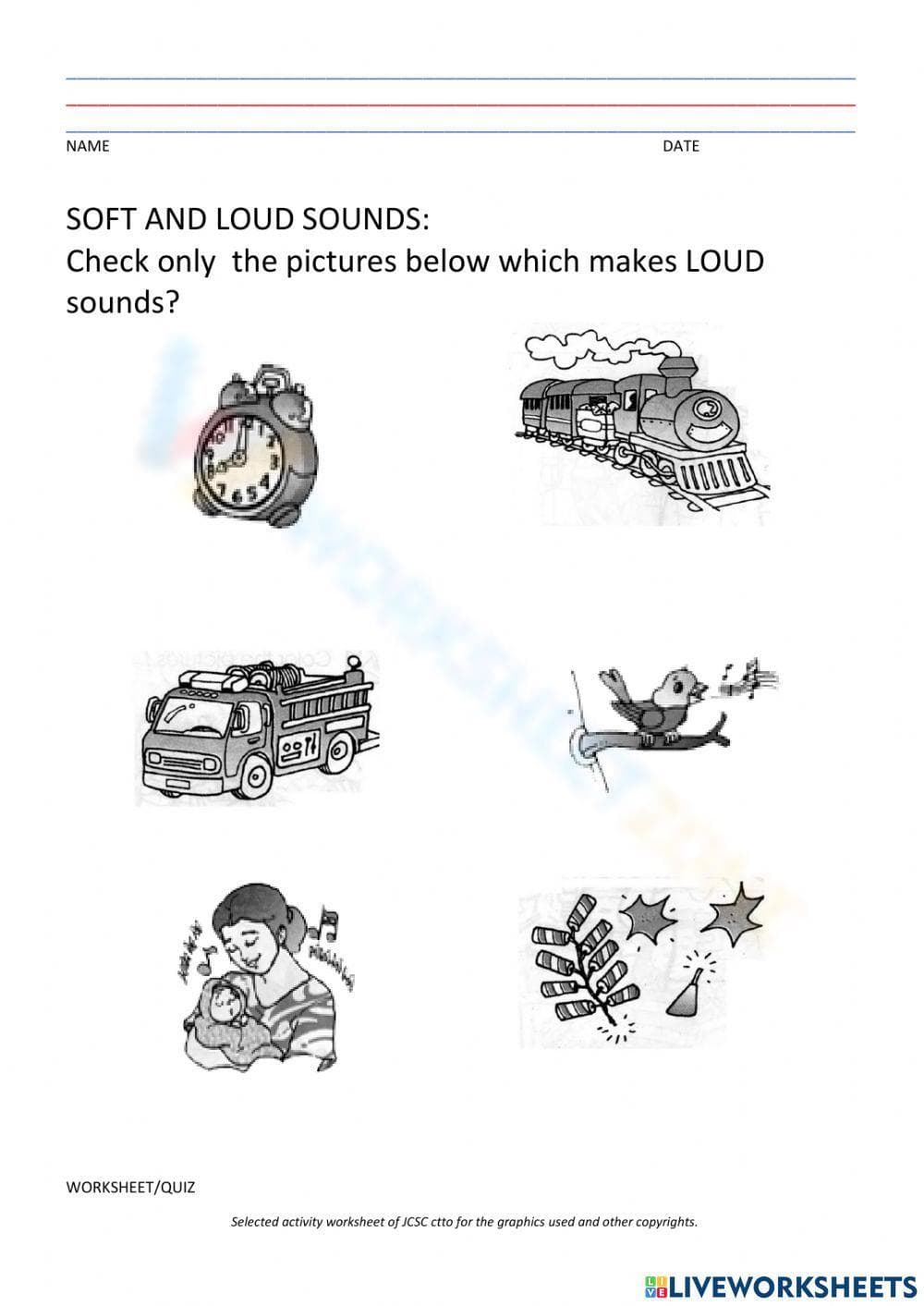
This is a worksheet focusing on identifying loud sounds. It features a title 'SOFT AND LOUD SOUNDS' and the instruction 'Check only the pictures below which makes LOUD sounds?'. The worksheet contains black and white illustrations of various objects and scenarios including an alarm clock, a train, a fire truck, a singing bird, a mother singing to a baby, and fireworks. Students are expected to identify which of these produce loud sounds.
Grade Level Suitability:
This worksheet is most suitable for preschool and kindergarten (Pre-K to K). The concept of loud versus soft sounds is a basic auditory discrimination skill typically introduced at this level. The simple illustrations and straightforward task make it accessible for young learners.
Why Use It:
This worksheet helps develop auditory discrimination skills, specifically the ability to distinguish between loud and soft sounds. It enhances vocabulary related to common sounds and encourages critical thinking as children analyze each picture and determine the sound level associated with it. It also reinforces visual recognition of common objects.
How to Use It:
Instruct the student to examine each picture carefully. Ask them to identify the object or scenario depicted. Then, ask them if the object or scenario typically makes a loud or soft sound. If the student identifies it as a loud sound, they should mark or check the box next to the picture.
Target Users:
This worksheet is designed for preschool and kindergarten students learning about sound discrimination. It is also suitable for students with auditory processing difficulties who need extra practice in differentiating between loud and soft sounds. Early childhood educators and parents can use this worksheet as a supplemental learning activity.
This is a worksheet focusing on identifying loud sounds. It features a title 'SOFT AND LOUD SOUNDS' and the instruction 'Check only the pictures below which makes LOUD sounds?'. The worksheet contains black and white illustrations of various objects and scenarios including an alarm clock, a train, a fire truck, a singing bird, a mother singing to a baby, and fireworks. Students are expected to identify which of these produce loud sounds.
Grade Level Suitability:
This worksheet is most suitable for preschool and kindergarten (Pre-K to K). The concept of loud versus soft sounds is a basic auditory discrimination skill typically introduced at this level. The simple illustrations and straightforward task make it accessible for young learners.
Why Use It:
This worksheet helps develop auditory discrimination skills, specifically the ability to distinguish between loud and soft sounds. It enhances vocabulary related to common sounds and encourages critical thinking as children analyze each picture and determine the sound level associated with it. It also reinforces visual recognition of common objects.
How to Use It:
Instruct the student to examine each picture carefully. Ask them to identify the object or scenario depicted. Then, ask them if the object or scenario typically makes a loud or soft sound. If the student identifies it as a loud sound, they should mark or check the box next to the picture.
Target Users:
This worksheet is designed for preschool and kindergarten students learning about sound discrimination. It is also suitable for students with auditory processing difficulties who need extra practice in differentiating between loud and soft sounds. Early childhood educators and parents can use this worksheet as a supplemental learning activity.


