


























Views
Downloads
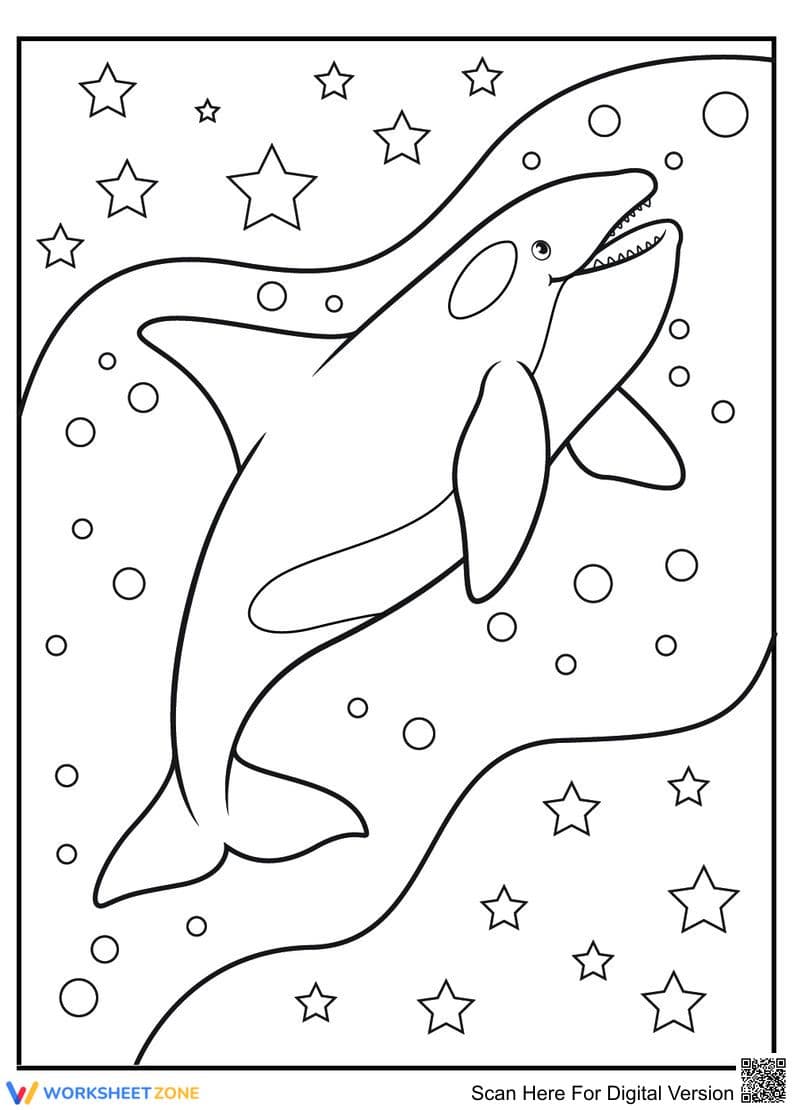

Smiley Whale Coloring Page | Printable Animal Activity
Paste this activity's link or code into your existing LMS (Google Classroom, Canvas, Teams, Schoology, Moodle, etc.).
Students can open and work on the activity right away, with no student login required.
You'll still be able to track student progress and results from your teacher account.
This Smiley Whale coloring page provides a creative outlet for young learners to develop fine motor control and artistic expression. By engaging with this high-interest marine animal illustration, students practice hand-eye coordination while exploring the natural world. It serves as a perfect supplemental activity for early childhood classrooms or home learning environments.
At a Glance
- Grade: K-2 · Subject: Arts & English
- Standard:
CCSS.ELA-LITERACY.SL.K.5— Add drawings or visual displays to descriptions to provide additional detail- Skill Focus: Fine motor development
- Format: 1 page · 1 task · No answer key needed · PDF
- Best For: Early finisher activity or ocean units
- Time: 15–20 minutes
Inside this resource, you will find a single-page, high-resolution PDF featuring a cheerful whale surrounded by bubbles and stars. The bold outlines are specifically designed for younger children who are still mastering the ability to color within the lines. There are no complex instructions, making it an ideal choice for independent work or a quiet-time activity.
The zero-prep workflow for this worksheet is designed for maximum efficiency. First, print the single-page PDF (30 seconds). Second, distribute the page along with crayons or colored pencils to your students (1 minute). Third, review the completed artwork to assess fine motor progress or use it as a prompt for a short verbal description of the scene (1 minute). Total teacher preparation time is under 2 minutes.
This activity aligns with `CCSS.ELA-LITERACY.SL.K.5`, which encourages students to "add drawings or other visual displays to descriptions as desired to provide additional detail." While primarily an artistic task, it supports the standard by allowing students to create a visual representation of a marine environment. This standard code can be copied directly into lesson plans, IEP goals, or district curriculum mapping tools.
Use this worksheet during a science unit on ocean life as a formative assessment of animal recognition. Alternatively, assign it as a "morning work" task to settle students as they arrive. Observe how students grip their coloring tools to identify those needing additional occupational therapy support. Expect completion within 15 to 20 minutes depending on the student's detail level.
This resource is tailored for Preschool through Grade 2 students, particularly those developing pencil grasp and spatial awareness. It pairs naturally with a read-aloud book about whales or an anchor chart detailing different types of sea creatures. It is also an excellent inclusion for a substitute folder or an emergency lesson plan kit.
The Smiley Whale coloring page is a practical application of fine motor skill development, which is a critical precursor to writing readiness in early childhood education. According to Fisher & Frey (2014), providing students with visual tasks that require precision helps bridge the gap between creative expression and academic literacy. This worksheet aligns with CCSS.ELA-LITERACY.SL.K.5 by fostering the ability to create visual displays that complement verbal or written descriptions. Research from the NAEP indicates that students who engage in regular artistic activities often show higher levels of engagement in core subjects like English and Science. By focusing on a single, high-interest subject like a whale, this resource reduces cognitive load while maximizing the opportunity for motor skill practice. Educators can use this 1-page PDF to support developmental milestones in a low-stakes, high-reward format that fits easily into any classroom schedule.


