


























Views
Downloads

Solar System Coloring Page | Essential Grade 1 Science
Paste this activity's link or code into your existing LMS (Google Classroom, Canvas, Teams, Schoology, Moodle, etc.).
Students can open and work on the activity right away, with no student login required.
You'll still be able to track student progress and results from your teacher account.
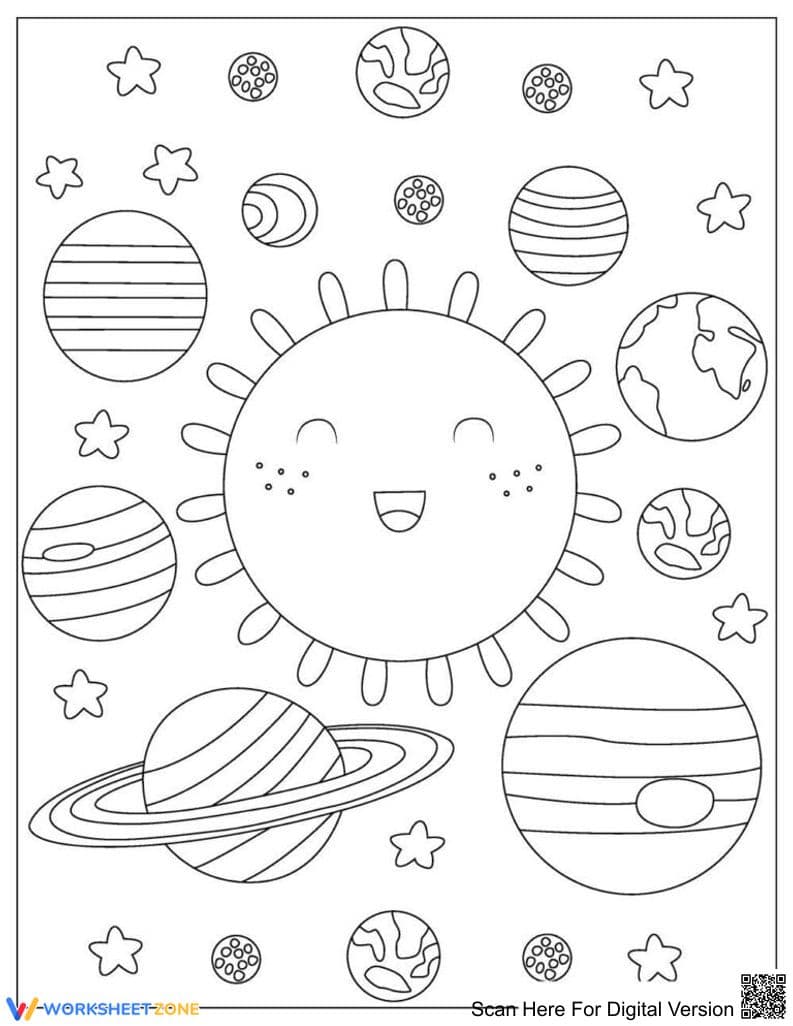
This Grade 1 solar system coloring worksheet provides a creative way for students to engage with celestial bodies. By coloring the smiley sun, ringed planets, and distant stars, learners develop a visual connection to the components of our universe. It serves as an excellent introductory activity for early space science units.
At a Glance
- Grade: 1 · Subject: Science
- Standard:
1-ESS1-1— Use observations of the sun, moon, and stars to describe patterns- Skill Focus: Solar System Identification
- Format: 1 page · 1 task · No answer key · PDF
- Best For: Early finisher activity or science hook
- Time: 15–20 minutes
Inside this single-page PDF, you will find a high-quality line-art illustration featuring a central sun with a friendly face, surrounded by various planets including Saturn with its rings and Earth-like spheres. The layout is designed with clear, bold lines to accommodate younger learners who are still refining their grip and control while exploring the cosmos.
Zero-Prep Workflow
The zero-prep workflow for this resource is designed for maximum efficiency in a busy classroom. First, print the single-page PDF (30 seconds). Second, distribute the sheets along with crayons or colored pencils to your students (1 minute). Third, review the names of the celestial bodies as a group while they work (5 minutes). Total teacher preparation time is under 2 minutes, making it an ideal sub plan or transition activity.
Standards Alignment
This resource aligns with `1-ESS1-1`, which requires students to use observations of the sun and stars to describe predictable patterns. While primarily an artistic tool, it supports the identification of the sun as a central figure in our sky and the variety of planetary bodies. Both standard codes can be copied directly into lesson plans, IEP goals, or district curriculum mapping tools.
How to Use It
Use this worksheet as a "hook" at the beginning of a lesson on the solar system to gauge prior knowledge of planet shapes. Alternatively, it works as a formative assessment tool; ask students to color the sun yellow and the ringed planet blue to check for specific identification skills. Expected completion time ranges from 15 to 20 minutes depending on the level of detail applied.
Who It's For
This worksheet is ideal for Grade 1 students, but its simple design makes it accessible for Kindergarteners or as a relaxing review for Grade 2. It pairs naturally with a read-aloud book about space or an introductory anchor chart showing the order of the planets. It is particularly helpful for students needing fine motor practice through engaging subject matter.
Research from Fisher & Frey (2014) emphasizes the importance of visual literacy and the use of non-linguistic representations to solidify new vocabulary in early childhood education. This solar system worksheet utilizes the 1-ESS1-1 standard to bridge the gap between abstract scientific concepts and concrete artistic expression. By engaging in the fine motor task of coloring, students create a mental map of the sun and planets, which aids in long-term retention of astronomical patterns. According to the NAEP framework, early exposure to science through integrated arts helps build the foundational interest necessary for later STEM success. This resource provides a low-stakes entry point for diverse learners to explore the cosmos while practicing the precision required for handwriting and detailed drawing. It is a practical, evidence-based addition to any primary classroom's science or fine motor toolkit, ensuring that 100% of students can participate regardless of their reading level.


