




























Views
Downloads
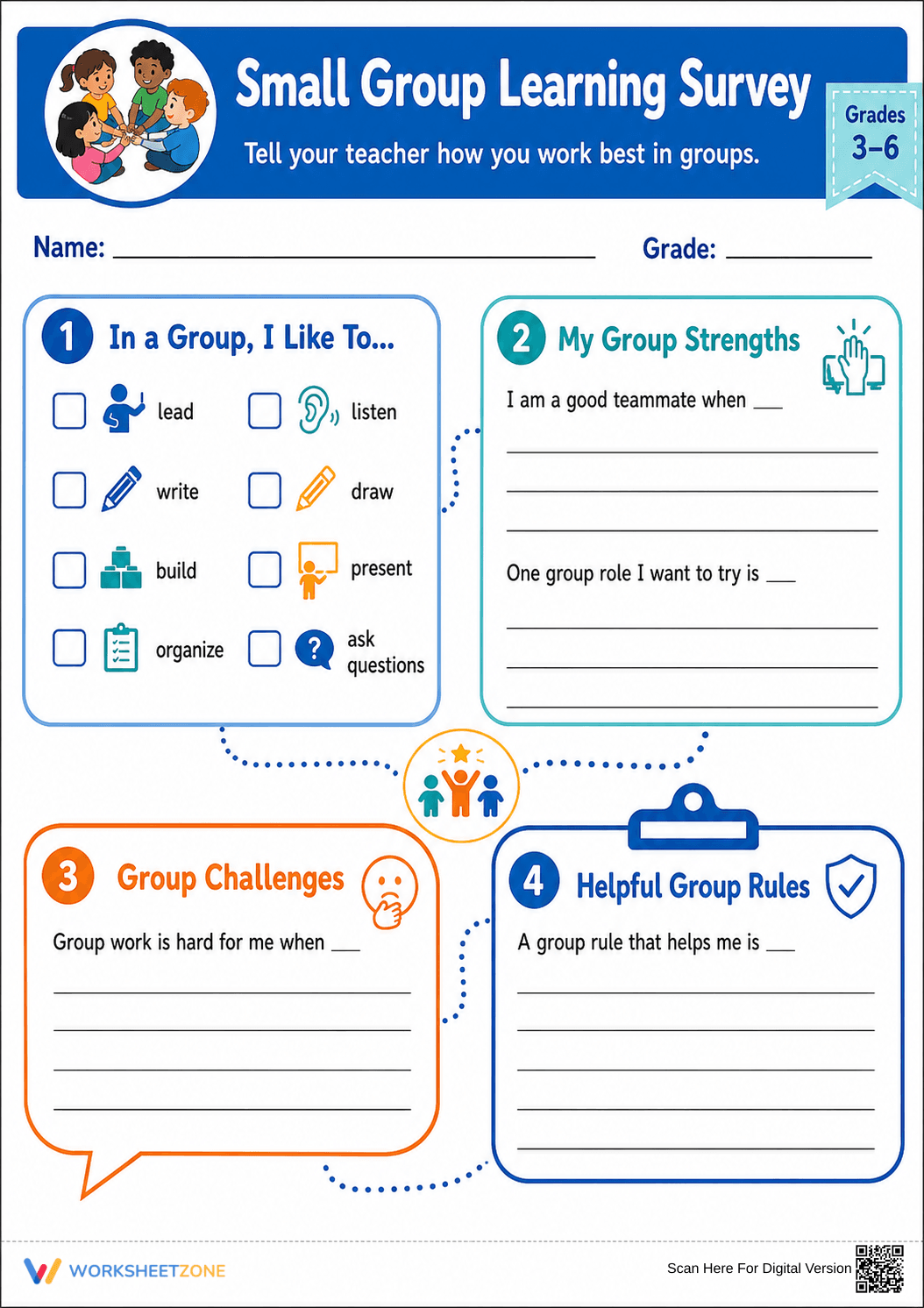

Small Group Learning Survey | Grade 3-6 Essential

Paste this activity's link or code into your existing LMS (Google Classroom, Canvas, Teams, Schoology, Moodle, etc.).
Students can open and work on the activity right away, with no student login required.
You'll still be able to track student progress and results from your teacher account.
This Grade 3-6 Small Group Learning Survey helps teachers understand how students collaborate and communicate during team projects. By identifying individual strengths and challenges, educators can form more effective, balanced groups that foster positive peer interactions. Students reflect on their preferred roles and the rules that help them succeed.
At a Glance
- Grade: 3-6 · Subject: ELA / SEL
- Standard:
CCSS.ELA-LITERACY.SL.4.1— Engage effectively in a range of collaborative discussions and projects- Skill Focus: Collaborative self-reflection
- Format: 1 page · 4 sections · No answer key needed · PDF
- Best For: Beginning of year or project launch
- Time: 10–15 minutes
This 1-page PDF features four distinct reflection zones designed with student-friendly icons and clear writing lines. It includes a role checklist (lead, listen, build, etc.), open-ended prompts for strengths and challenges, and a dedicated space for suggesting helpful group rules. The clean, organized layout ensures students stay focused on their self-assessment without unnecessary distractions.
Zero-Prep Workflow:
- Print: Select the single-page PDF and print enough copies for your class (30 seconds).
- Distribute: Hand out the surveys before starting a new collaborative unit or at the start of the semester (1 minute).
- Review: Quickly scan student responses to inform your group pairings and seating charts (5 minutes).
Total teacher prep time is under 2 minutes, making this an ideal tool for busy classroom transitions.
Standards Alignment
The primary standard is `CCSS.ELA-LITERACY.SL.4.1`, which requires students to engage effectively in a range of collaborative discussions and build on others' ideas. This survey supports the foundational self-awareness needed to meet these expectations. Both standard codes can be copied directly into lesson plans, IEP goals, or district curriculum mapping tools.
How to Use It
Use this survey during the first week of school to establish a classroom culture of communication. It also serves as a powerful formative tool before a major science or social studies project to ensure every student has a role that matches their comfort level. Expect students to complete the reflection in 10 to 15 minutes. Observe which students struggle to identify a strength as a prompt for future 1-on-1 coaching.
Who It's For
This resource is ideal for general education teachers in grades 3 through 6, as well as school counselors and special education providers focusing on social skills. It pairs naturally with a "Group Work Expectations" anchor chart or a direct instruction lesson on active listening and peer feedback.
According to research from Fisher & Frey (2014) on the gradual release of responsibility, successful collaborative learning requires students to understand their own contributions to a group dynamic. This worksheet addresses CCSS.ELA-LITERACY.SL.4.1 by prompting students to reflect on how they engage effectively in a range of collaborative discussions. By identifying specific roles like lead, listen, or organize, students develop the metacognitive awareness necessary for productive peer-to-peer interaction. Data from the RAND AIRS 2024 report suggests that structured self-reflection tools significantly improve student agency in middle-grade classrooms. This 1-page survey provides the necessary scaffolding for students to articulate their group work needs, allowing teachers to make data-informed decisions about team composition and classroom management. It is a practical, research-backed tool for fostering a collaborative learning environment that respects individual student needs while pushing for collective academic growth.


