




























Views
Downloads

Grade 1 Animal Coverings — Printable No-Prep Worksheet

Paste this activity's link or code into your existing LMS (Google Classroom, Canvas, Teams, Schoology, Moodle, etc.).
Students can open and work on the activity right away, with no student login required.
You'll still be able to track student progress and results from your teacher account.
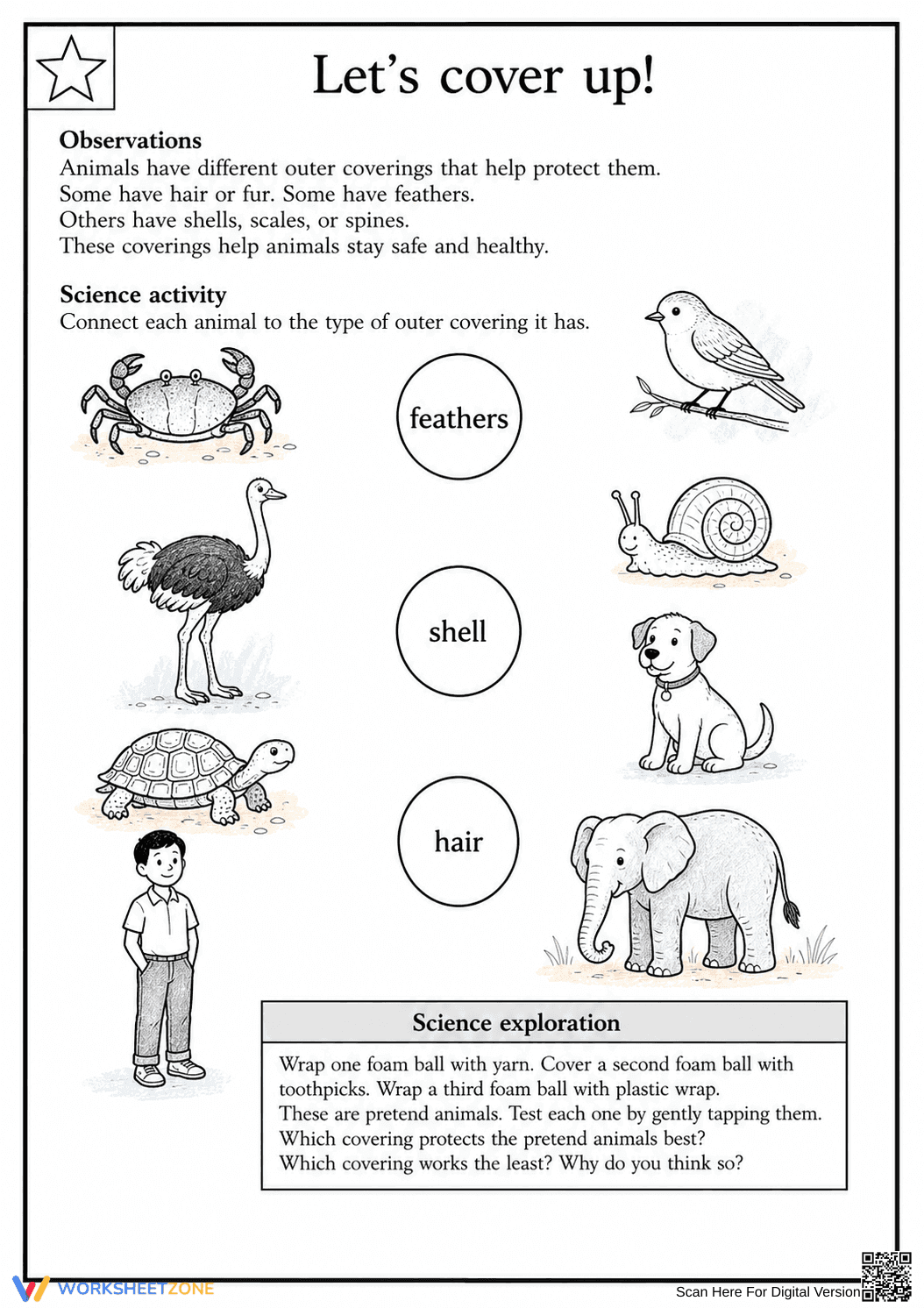
This Grade 1 science worksheet helps students identify and categorize animal outer coverings to understand biological protection. By connecting observable physical traits like feathers, shells, and hair to survival needs, learners build foundational knowledge of living things and their specialized external structures for defense.
At a Glance
- Grade: 1 · Subject: Science
- Standard:
1-LS1-1— Mimic how animals use external parts to survive- Skill Focus: Animal outer coverings and protection
- Format: 1 page · 8 problems · Answer key included · PDF
- Best For: Individual practice or science centers
- Time: 15–20 minutes
This single-page PDF contains a visual science activity where students match seven distinct subjects—including a crab, ostrich, elephant, and human—to their specific outer coverings. The resource features clear illustrations and categorized circles for feathers, shells, and hair. Additionally, the science exploration section provides a guided extension activity using simple household materials like yarn and toothpicks to simulate animal defense mechanisms.
This resource is designed for immediate classroom implementation with zero teacher setup required. Print (1 minute): Select the single page for your class size. Distribute (1 minute): Students can begin the matching activity independently after a brief introduction. Review (2 minutes): Use the included answer key for quick grading. Total preparation time is under two minutes, making it an ideal choice for last-minute sub plans.
This worksheet is primarily aligned to 1-LS1-1: "Use materials to design a solution to a human problem by mimicking how plants and/or animals use their external parts to help them survive, grow, and meet their needs." It specifically addresses how different types of skin, hair, and shells serve as protective barriers. Both standard codes can be copied directly into lesson plans, IEP goals, or district curriculum mapping tools.
Use this worksheet as a formative assessment during a unit on animal adaptations. Assign the matching activity during instruction to reinforce vocabulary. For a comprehensive lesson, use the exploration section as a small-group rotation task where students test different simulated skins. Observe if students can explain why a hard shell provides more protection than hair. Expected completion time is 15 to 20 minutes.
This resource is leveled for Grade 1 students but serves as an excellent remedial tool for Grade 2 learners reviewing basic biology. It provides visual scaffolding for English Language Learners through high-quality animal illustrations. Pair this worksheet with a non-fiction text about animal habitats or a classroom anchor chart displaying various animal coverings to maximize instructional impact.
The animal coverings worksheet targets fundamental biological classification skills aligned to 1-LS1-1, focusing on how students mimic how animals use external parts to survive. Research from the ScienceDirect TpT Analysis highlights that visual-heavy science worksheets significantly improve retention of categorical biological concepts among Grade 1 learners by reducing cognitive load during the initial acquisition of specialized vocabulary. By integrating a hands-on science exploration task alongside traditional matching, the resource adheres to the gradual release of responsibility model, moving students from basic identification to critical application. This multi-modal approach ensures that students not only recognize animal parts but also understand their functional utility in defense and environmental adaptation. Such structured practice is essential for building the prerequisite knowledge required for later grades' study of evolutionary traits and complex ecosystems.


