




























Views
Downloads
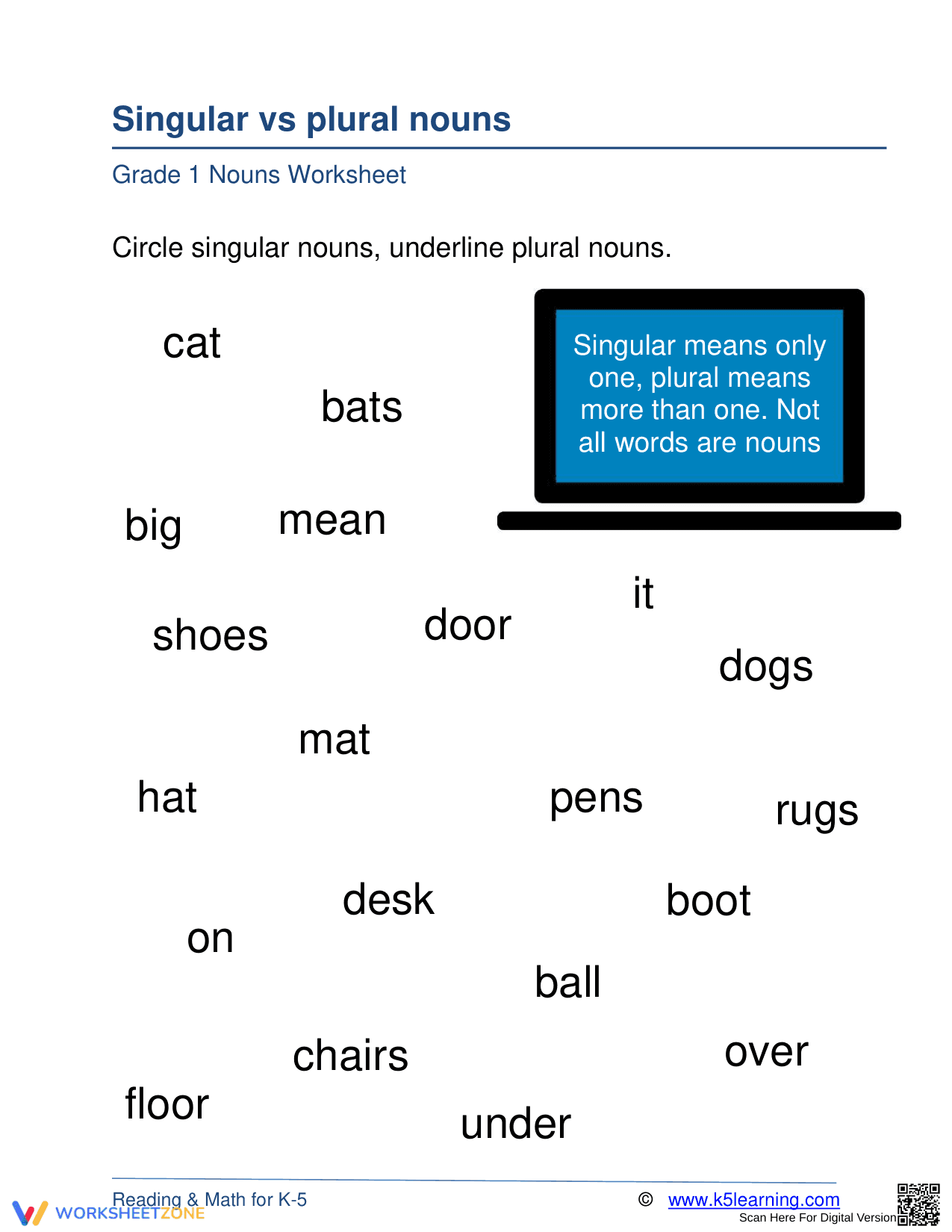
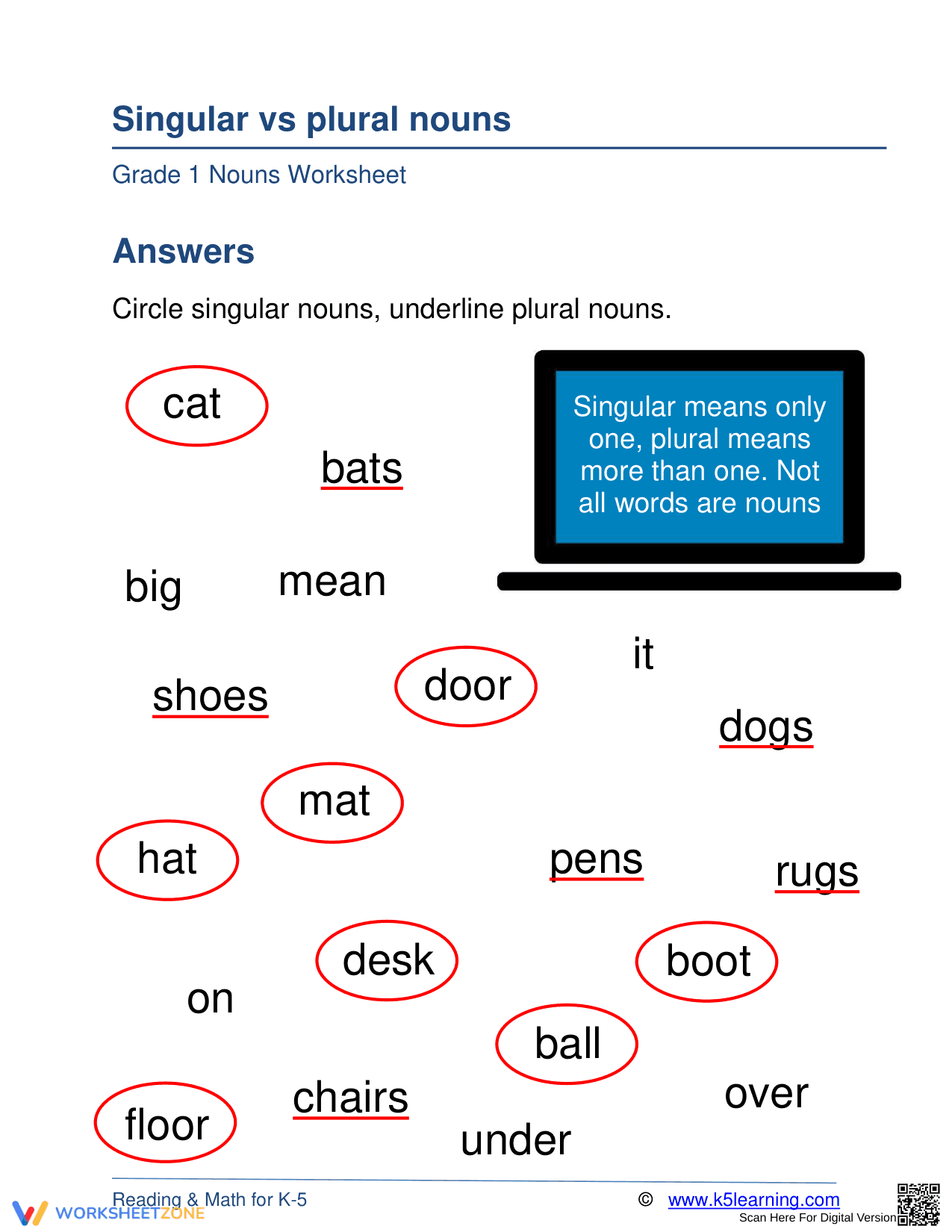

Grade 1 Singular/Plural Nouns — Printable No-Prep Worksheet

Paste this activity's link or code into your existing LMS (Google Classroom, Canvas, Teams, Schoology, Moodle, etc.).
Students can open and work on the activity right away, with no student login required.
You'll still be able to track student progress and results from your teacher account.
This Grade 1 English Language Arts worksheet provides immediate practice identifying singular and plural nouns. Students evaluate a mixed word bank, circling singular nouns and underlining plural nouns while ignoring other parts of speech. This targeted activity strengthens foundational grammar skills and reinforces early reading comprehension.
At a Glance
- Grade: 1 · Subject: ELA
- Standard:
CCSS.ELA-LITERACY.L.1.1.C— Identify and use singular and plural nouns- Skill Focus: Singular vs. Plural Nouns
- Format: 1 page · 20 problems · Answer key included · PDF
- Best For: Independent practice or morning work
- Time: 10–15 minutes
Inside this single-page resource, educators will find a straightforward noun sorting activity featuring 20 distinct words scattered across the page. The layout includes a helpful definition box reminding students that singular means one, plural means more than one, and not all words are nouns. Students must actively distinguish between nouns and other word classes like prepositions or adjectives before categorizing them. A complete answer key is provided for quick grading.
Zero-Prep Workflow
- Print (1 minute): Download the PDF and print a class set. The black-and-white design saves ink and requires no special formatting.
- Distribute (1 minute): Hand out the worksheet as students arrive or transition between subjects. The instructions are self-explanatory, requiring minimal teacher setup.
- Review (3 minutes): Use the included answer key to quickly check student work or project it on the board for self-correction.
Total teacher prep time is under two minutes, making this an excellent option for emergency sub plans, fast finisher folders, or spontaneous skill reinforcement.
Standards Alignment
This resource aligns directly with CCSS.ELA-LITERACY.L.1.1.C, requiring students to use singular and plural nouns correctly. By challenging learners to differentiate nouns from other parts of speech, it also supports broader vocabulary acquisition and language conventions. Both standard codes can be copied directly into lesson plans, IEP goals, or district curriculum mapping tools.
How to Use It
Deploy this worksheet during morning work to activate prior knowledge before a formal grammar lesson. Alternatively, use it as an independent practice station while the teacher conducts small group reading instruction. As a formative assessment tip, observe whether students mistakenly circle adjectives like "big" or "mean"—this indicates they need a quick reteach on the definition of a noun. Most first graders will complete this task within a 10 to 15-minute window.
Who It's For
This worksheet is designed primarily for first-grade students mastering basic parts of speech, though it serves as an effective review for second graders needing foundational support. The built-in definition box provides a natural scaffold for students who struggle with working memory. Pair this activity with a classroom anchor chart detailing the rules for adding "s" or "es" to make words plural.
Mastering basic grammar conventions, such as the distinction between singular and plural nouns, is a critical stepping stone for early literacy development. According to a 2024 report by EdReports 2024, explicit instruction in foundational language skills significantly improves reading comprehension and writing fluency in primary grades. When students can rapidly identify and use singular and plural nouns, as outlined in CCSS.ELA-LITERACY.L.1.1.C, they reduce cognitive load during independent reading tasks. This allows them to focus on meaning rather than decoding syntax. Regular, targeted practice with mixed word banks forces learners to actively apply definitions rather than relying on rote memorization. By integrating these brief, focused exercises into daily routines, educators ensure that students build the automaticity required for more complex sentence construction and advanced literacy tasks in subsequent grade levels.


