


























Views
Downloads

Essential Single Digit Subtraction Worksheet | Grade 2-3
Paste this activity's link or code into your existing LMS (Google Classroom, Canvas, Teams, Schoology, Moodle, etc.).
Students can open and work on the activity right away, with no student login required.
You'll still be able to track student progress and results from your teacher account.
Strengthen foundational math skills with this comprehensive single-digit subtraction practice set. Students will master the mechanics of subtracting numbers from 1 to 9 through a structured progression from visual models to abstract equations. This resource ensures that learners build the mental math fluency required for more complex arithmetic operations in higher grades.
At a Glance
- Grade: 2–3 · Subject: Math
- Standard:
2.OA.B.2— Fluently subtract within 20 using mental strategies.- Skill Focus: Single-digit subtraction fluency
- Format: 3 pages · 41 problems · Answer key included · PDF
- Best For: Independent practice and morning work
- Time: 20–30 minutes
What's Inside
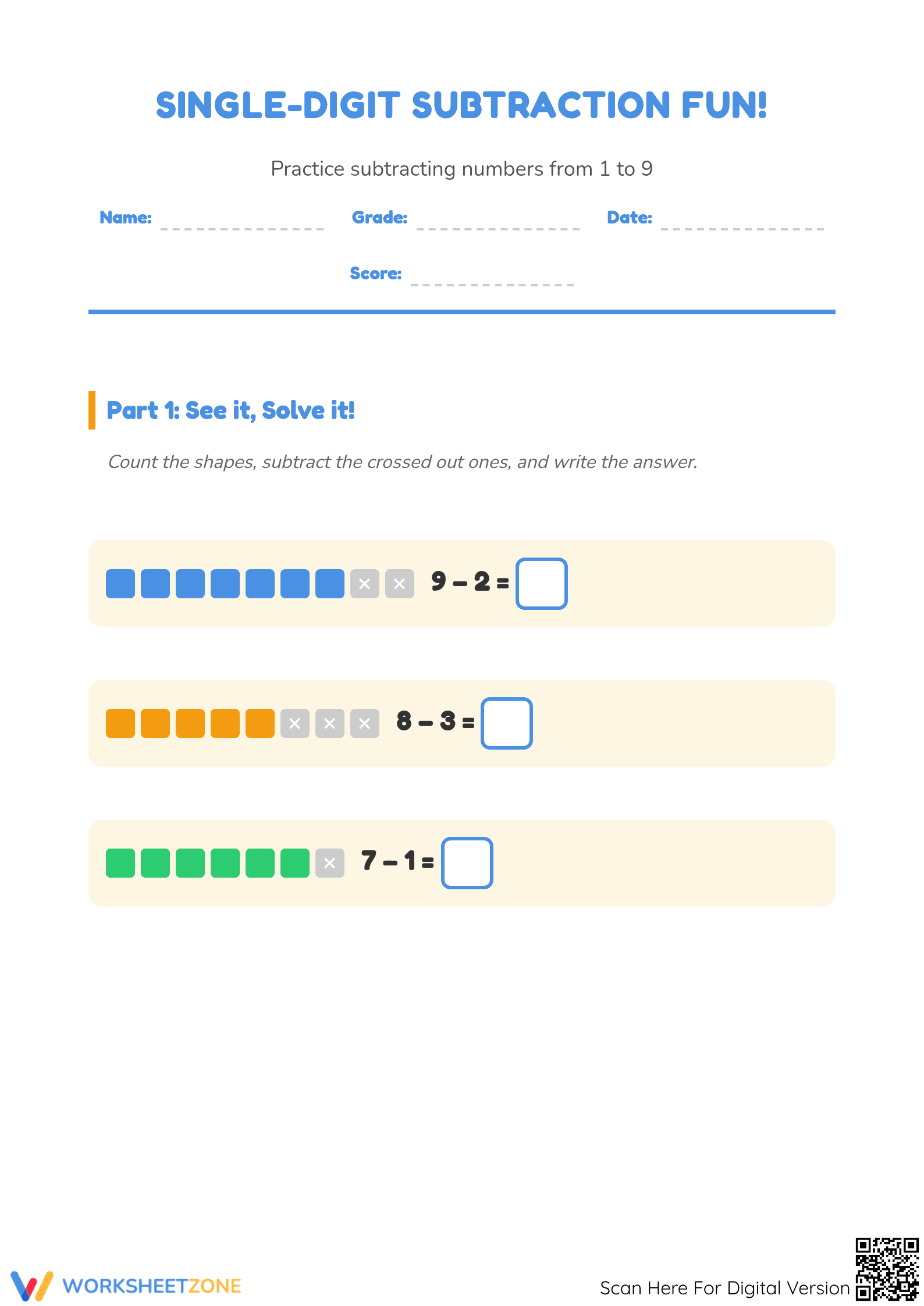
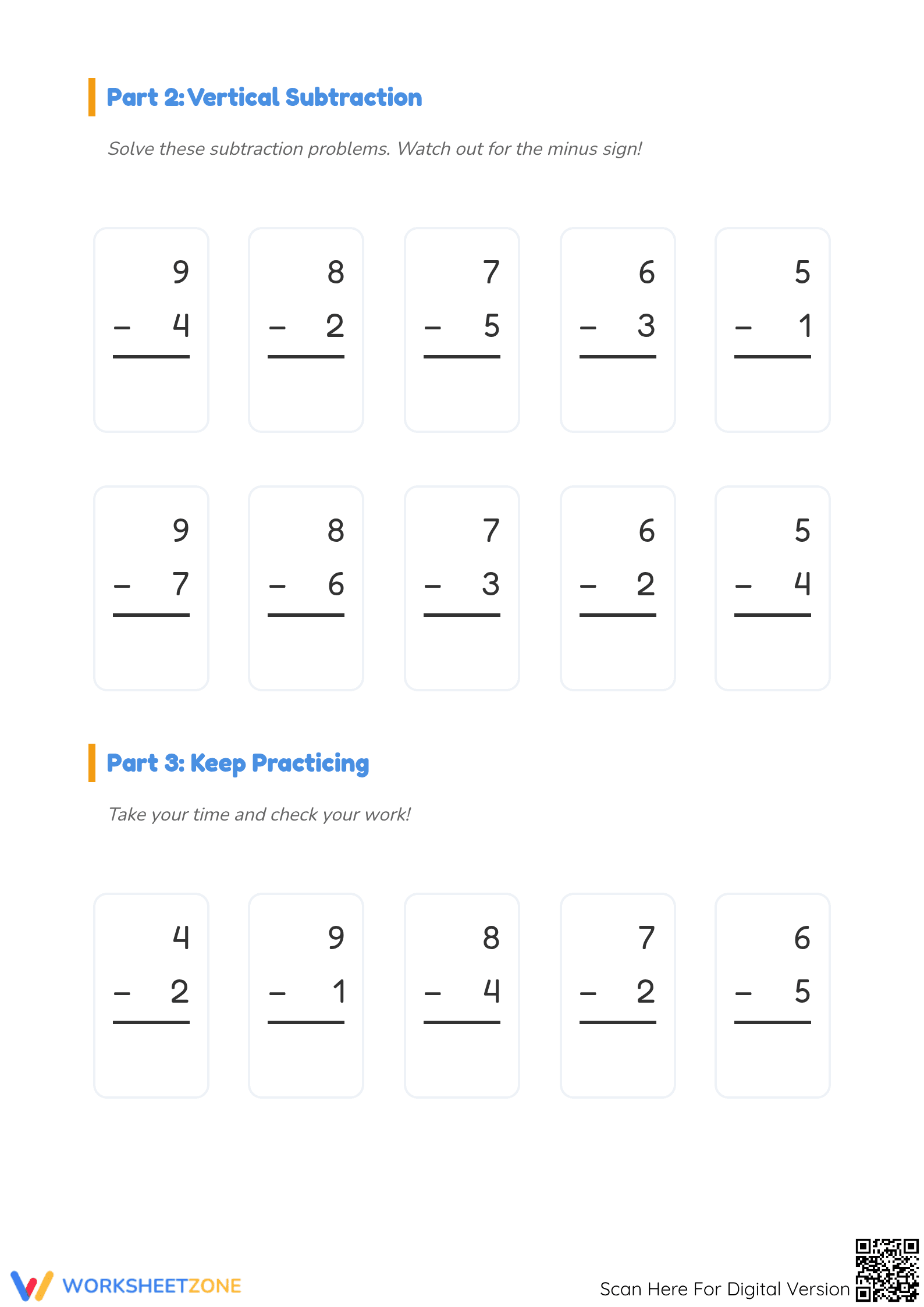
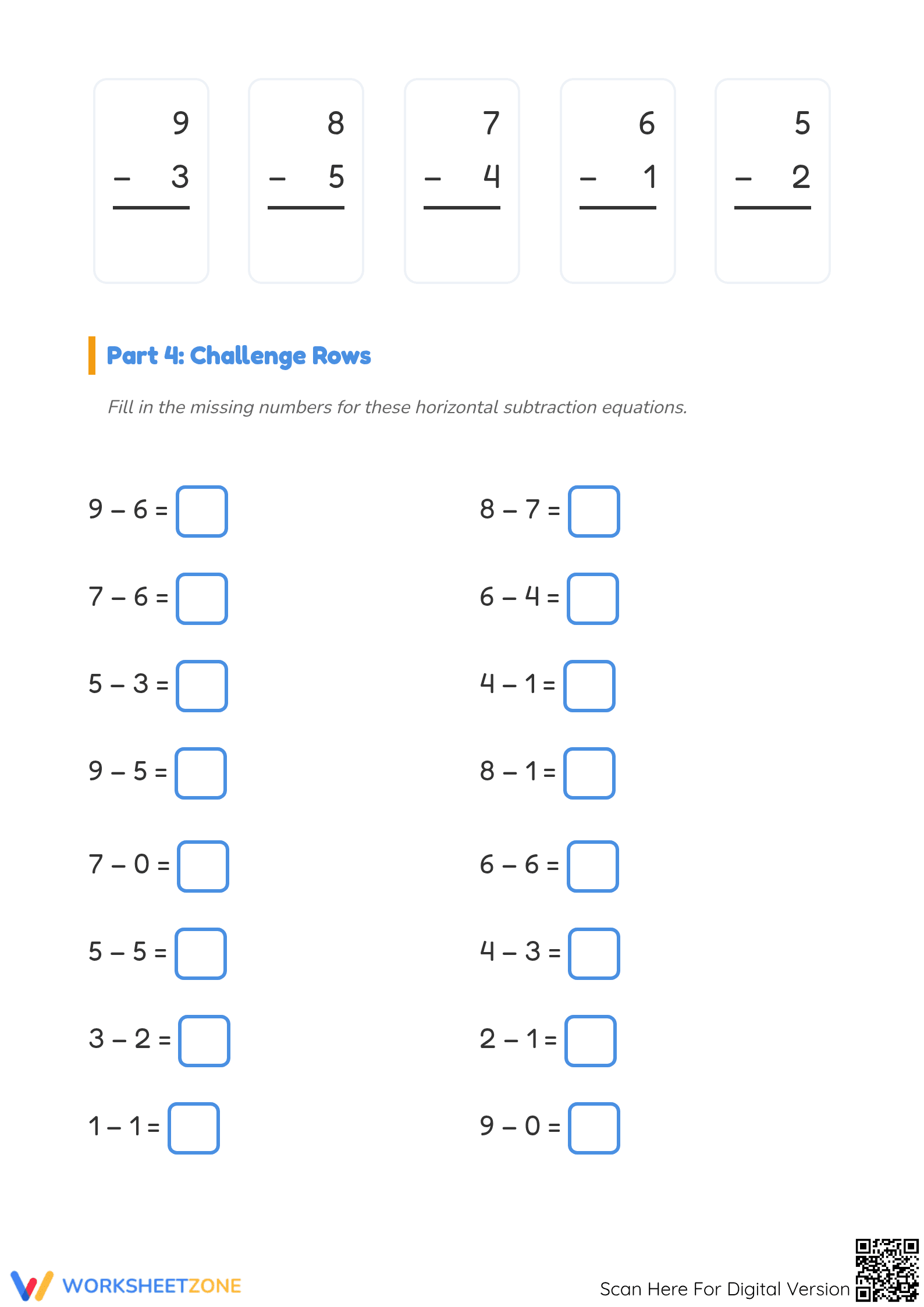
This three-page printable pack features four distinct sections designed to build confidence. It includes a visual counting task (Part 1), vertical calculation drills (Parts 2 and 3), and horizontal challenge equations (Part 4). With 41 problems in total, students receive ample practice. A complete answer key is provided to facilitate rapid grading and immediate feedback.
Zero-Prep Workflow
- Step 1: Print (30 seconds). Select the 3-page PDF and print enough copies for your entire class.
- Step 2: Distribute (1 minute). Hand out the worksheets during your math block, center time, or as a sub plan.
- Step 3: Review (30 seconds). Utilize the provided answer keys for instant self-correction or teacher review.
The total teacher preparation time for this resource is under 2 minutes, making it an ideal choice for busy classrooms or emergency sub folders.
Standards Alignment
Primary Standard: `2.OA.B.2` - Fluently add and subtract within 20 using mental strategies. By end of Grade 2, know from memory all sums of two one-digit numbers. This worksheet focuses specifically on the subtraction component of this fluency requirement. This standard code can be copied directly into lesson plans, IEP goals, or district curriculum mapping tools.
How to Use It
Assign this worksheet after a direct instruction lesson on basic subtraction facts to reinforce learning. It works exceptionally well as a formative assessment; observe if students are still relying on counting the visual blocks in Part 1 or if they can transition to mental recall for the Challenge Rows. Expected completion time is 20 to 30 minutes depending on student mastery.
Who It's For
This resource is tailored for Grade 2 and Grade 3 students who need to solidify their basic subtraction facts. It is particularly useful for students requiring extra repetition to achieve automaticity. Pair this with a number line anchor chart or a short video tutorial on subtraction strategies for a complete instructional experience.
According to Fisher & Frey (2014), the gradual release of responsibility is paramount for mathematical fluency. This worksheet employs this model by transitioning students from visual, scaffolded counting tasks to abstract vertical and horizontal equations. By mastering 2.OA.B.2, students develop the mental agility required for multi-digit computation. Research indicates that frequent, low-stakes practice with single-digit subtraction reinforces the base-ten understanding necessary for regrouping and advanced algebraic thinking in later elementary years. This resource provides 41 targeted opportunities for students to build confidence without cognitive overload. The transition from visual cues to abstract equations ensures that learners internalize the relationships between numbers. Educational analysts suggest that such focused drills are essential components of a balanced math curriculum, bridging the gap between conceptual introduction and automaticity in basic operations.


