


























Views
Plays

Sentence Structure Worksheet | Grade 3-5 Essential
Paste this activity's link or code into your existing LMS (Google Classroom, Canvas, Teams, Schoology, Moodle, etc.).
Students can open and work on the activity right away, with no student login required.
You'll still be able to track student progress and results from your teacher account.
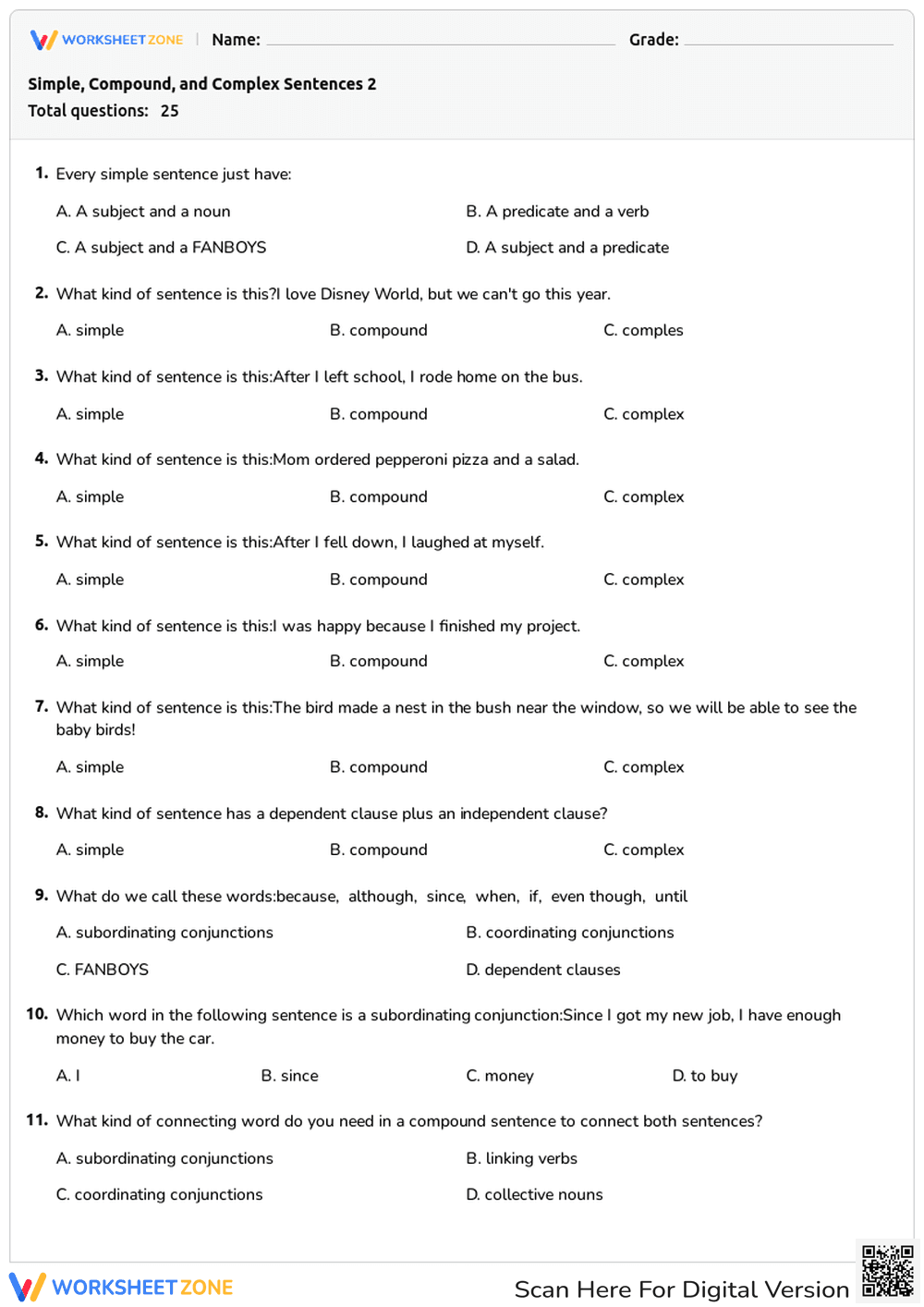
Students master the mechanics of sentence construction by identifying the differences between simple, compound, and complex structures. This worksheet provides immediate practice in recognizing independent and dependent clauses, as well as the coordinating and subordinating conjunctions that join them. By the end of the 25 tasks, learners will demonstrate improved grammatical accuracy and syntactic variety.
At a Glance
- Grade: 3-5 · Subject: ELA Grammar
- Standard:
CCSS.ELA-LITERACY.L.3.1.I— Produce and identify simple, compound, and complex sentences for clear communication- Skill Focus: Sentence Structure & Conjunctions
- Format: 3 pages · 25 problems · Answer key included · PDF
- Best For: Independent practice and formative assessment
- Time: 20–30 minutes
What's Inside
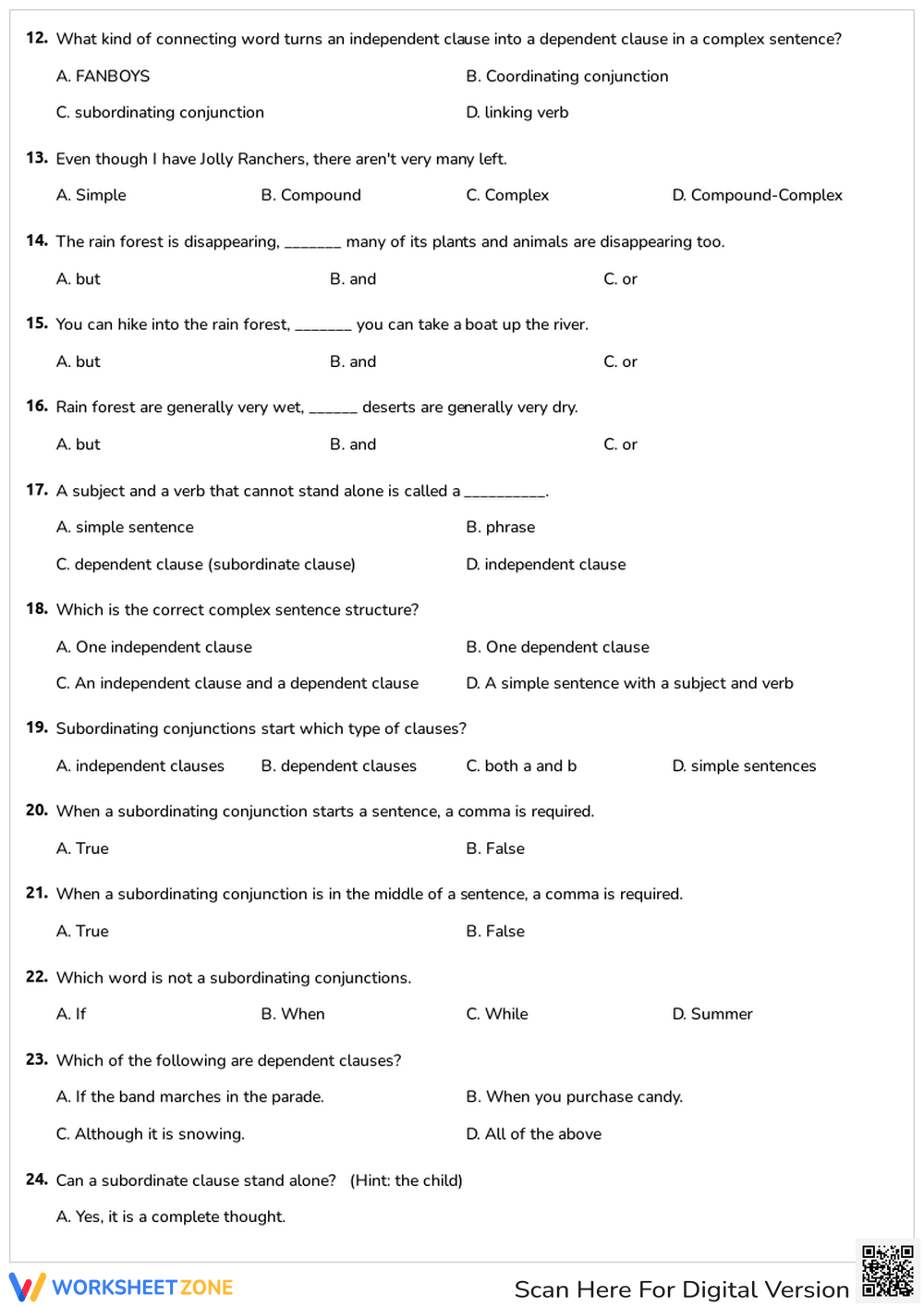
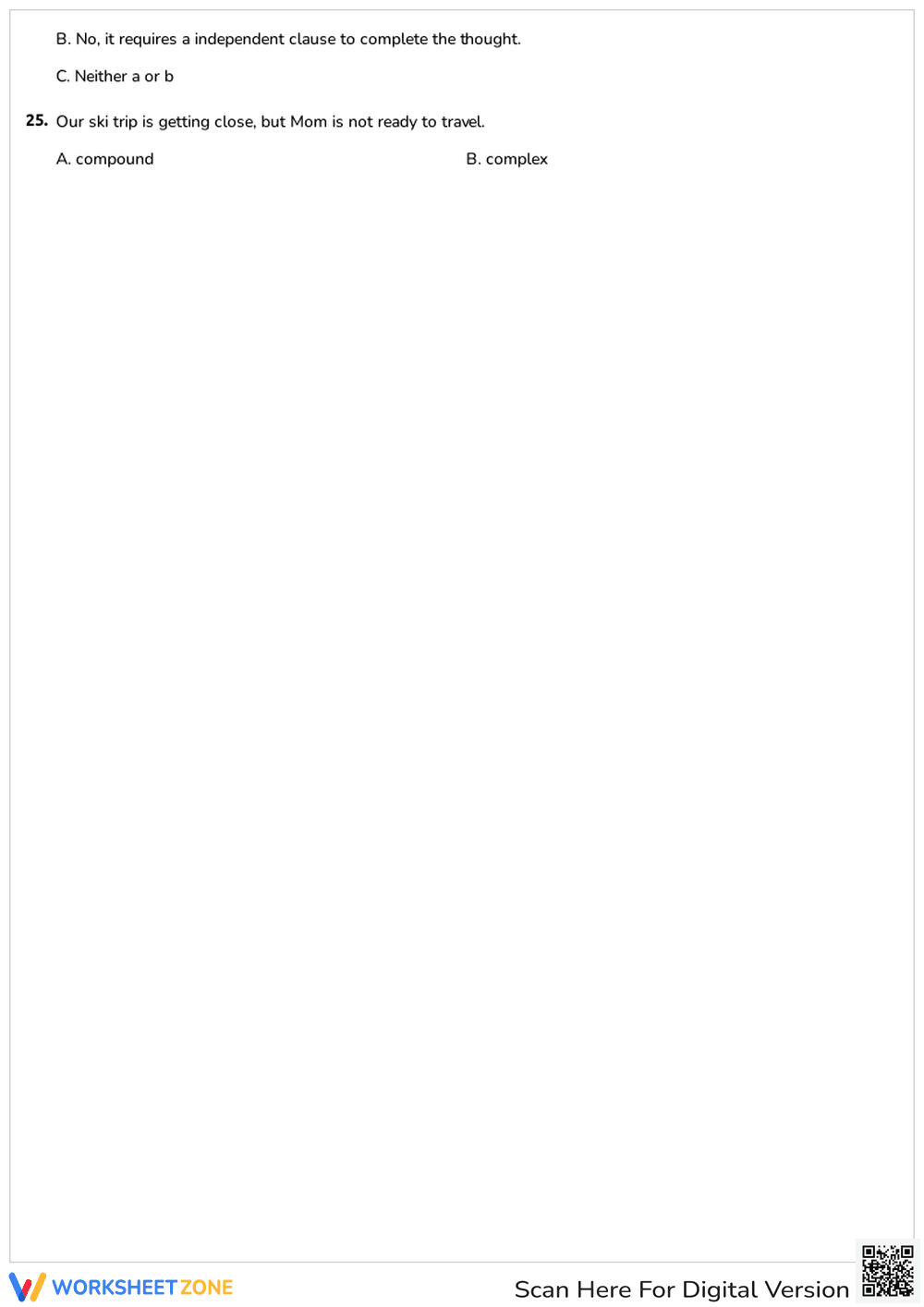
This comprehensive 3-page PDF contains 25 multiple-choice questions designed to test a student's grasp of sentence architecture. The first section focuses on definitions and basic identification of simple, compound, and complex sentences, with an introduction to compound-complex structures. The latter half challenges students to identify specific conjunctions like "since," "because," and "but." The layout is clean and distraction-free, featuring a dedicated space for student names and grades. A full answer key is provided to facilitate rapid grading or student self-correction.
Zero-Prep Workflow
This resource is designed for immediate classroom implementation with a total teacher prep time of under 2 minutes. First, print the three-page document for your class (1 minute). Second, distribute the worksheets as a quiet bell-ringer or independent practice activity (30 seconds). Finally, use the included answer key to review responses as a whole group or collect them for a quick formative data check. Its self-explanatory nature makes it an ideal candidate for emergency sub plans.
Standards Alignment
The primary focus is CCSS.ELA-LITERACY.L.3.1.I, which requires students to produce simple, compound, and complex sentences. This resource also supports CCSS.ELA-LITERACY.L.4.1.F by helping students recognize complete sentence structures to avoid fragments. Both standard codes can be copied directly into lesson plans, IEP goals, or district curriculum mapping tools.
How to Use It
Use this worksheet as a mid-unit check after introducing subordinating conjunctions. It serves as an excellent formative assessment tool; observe if students struggle specifically with the comma rules mentioned in questions 20 and 21. Expected completion time ranges from 20 to 30 minutes depending on the student's reading speed and prior knowledge of clause types.
Who It's For
This resource is tailored for general education students in grades 3 through 5, but it is also highly effective for ESL/ELL learners who need explicit practice with English syntax. It pairs naturally with a conjunction anchor chart or a direct instruction lesson on the "FANBOYS" acronym.
According to the RAND AIRS 2024 report on literacy instruction, explicit grammar practice in sentence identification significantly improves student writing quality by increasing syntactic complexity. This worksheet directly addresses CCSS.ELA-LITERACY.L.3.1.I by requiring students to distinguish between simple, compound, and complex sentences across 25 targeted tasks. Research from Fisher & Frey (2014) emphasizes that the gradual release of responsibility begins with identifying these structures before students can independently produce them in their own compositions. By isolating the role of coordinating and subordinating conjunctions, this resource provides the necessary scaffolding for mastery. Educators can use the resulting data to identify specific misconceptions regarding dependent clauses and comma usage. This evidence-based approach ensures that Grade 3-5 students develop the linguistic flexibility required for advanced academic writing and reading comprehension across all subject areas.


