


























Views
Downloads

Printable Nouns Worksheet | Grade 2 English Grammar
Paste this activity's link or code into your existing LMS (Google Classroom, Canvas, Teams, Schoology, Moodle, etc.).
Students can open and work on the activity right away, with no student login required.
You'll still be able to track student progress and results from your teacher account.
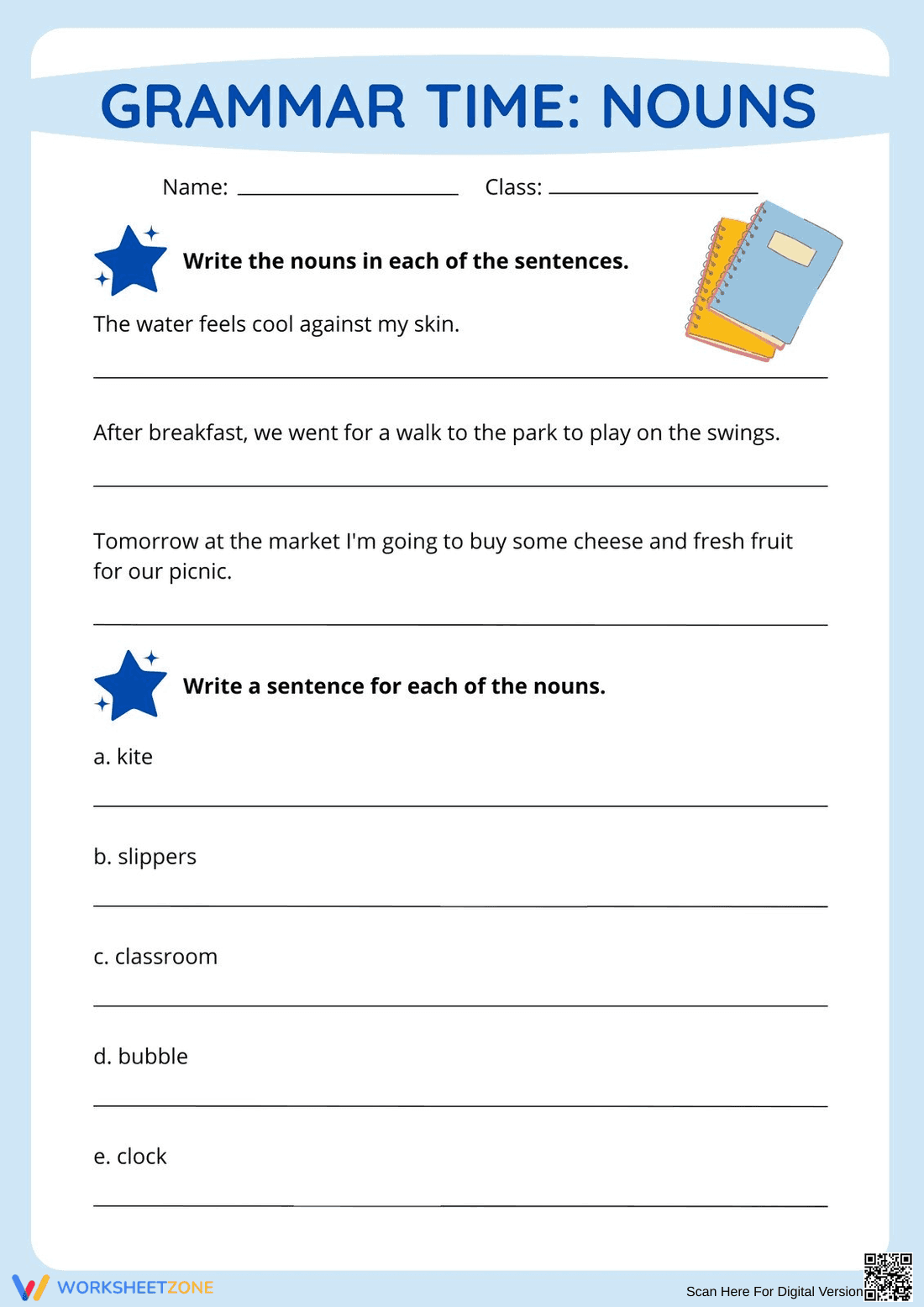
This Grade 2 English grammar worksheet provides a focused approach to mastering nouns through identification and application. Students first isolate nouns within descriptive sentences before transitioning to original sentence construction using specific concrete nouns. This dual-modality approach ensures that learners can both recognize parts of speech in context and deploy them accurately in their own writing.
At a Glance
- Grade: 2 · Subject: ELA
- Standard:
CCSS.ELA-LITERACY.L.2.1— Demonstrate command of standard English grammar and usage when writing- Skill Focus: Noun identification and application
- Format: 1 page · 8 problems · Answer key included · PDF
- Best For: Morning work or grammar reinforcement
- Time: 15–20 minutes
What's Inside: This single-page PDF features two distinct sections designed to build grammatical fluency. The first section contains 3 sentences where students must identify and extract all nouns. The second section provides 5 specific nouns—kite, slippers, classroom, bubble, and clock—and requires students to generate original sentences for each. A full answer key is provided for rapid grading.
Skill Progression
- Guided Practice: Students begin by identifying nouns in 3 pre-written sentences, allowing them to see how nouns function as subjects and objects in context.
- Supported Practice: The worksheet provides 5 specific concrete nouns as prompts, reducing the cognitive load of brainstorming while focusing on sentence structure.
- Independent Practice: Students move to independent production by writing 5 original sentences, demonstrating their ability to use nouns correctly in their own prose.
This sequence follows the gradual-release model, moving from recognition to active application of grammatical rules.
Standards Alignment
This resource is primarily aligned to CCSS.ELA-LITERACY.L.2.1, which requires students to demonstrate command of the conventions of standard English grammar and usage when writing. It specifically targets the identification and use of common nouns. This standard code can be copied directly into lesson plans, IEP goals, or district curriculum mapping tools.
How to Use It
This worksheet is ideal for use during the "independent practice" phase of a grammar lesson. After introducing the definition of a noun (person, place, or thing), assign this page to check for understanding. Teachers should observe students during the sentence-writing phase to ensure they are capitalizing the start of sentences and using end punctuation. Expected completion time is 15 to 20 minutes.
Who It's For
This resource is designed for 2nd-grade students but is also highly effective for 3rd-grade review or English Language Learners (ELL) who need targeted practice with parts of speech. It pairs naturally with a classroom anchor chart on nouns or a shared reading passage where students can hunt for additional examples.
According to research by Fisher & Frey (2014) on the gradual release of responsibility, structured grammar practice is most effective when it moves from recognition to production. This worksheet aligns with CCSS.ELA-LITERACY.L.2.1 by requiring students to demonstrate a command of standard English grammar through the identification and usage of nouns. By isolating the noun as a specific part of speech, students build the foundational linguistic awareness necessary for complex sentence structures. The inclusion of 8 distinct tasks allows for a quick yet comprehensive check for understanding, making it an ideal tool for formative assessment. Educational data from NAEP suggests that early mastery of parts of speech correlates with higher reading comprehension scores in later elementary years. This resource provides the necessary repetition to move noun identification from a conscious effort to an automated skill, supporting overall literacy development and writing fluency in young learners.


