


























Views
Downloads
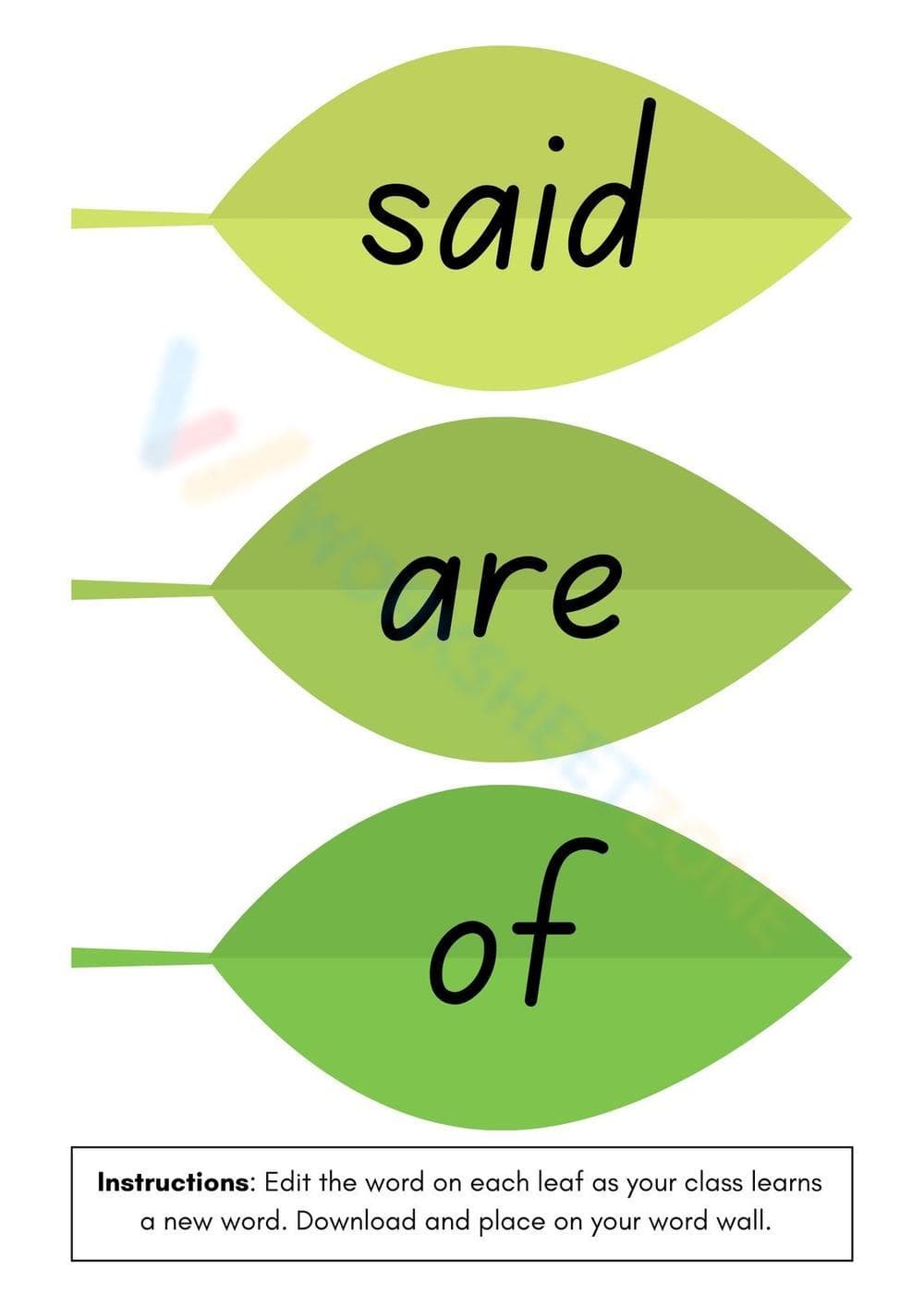

Printable Sight Words Word Wall | Grade K
Paste this activity's link or code into your existing LMS (Google Classroom, Canvas, Teams, Schoology, Moodle, etc.).
Students can open and work on the activity right away, with no student login required.
You'll still be able to track student progress and results from your teacher account.
This printable sight words word wall resource helps early readers build automaticity with high-frequency vocabulary. By displaying these visually appealing leaf-themed cards in the classroom, educators provide students with a constant environmental print reference to support daily reading and writing tasks.
At a Glance
- Grade: K · Subject: ELA
- Standard:
CCSS.ELA-LITERACY.RF.K.3.C— Read common high-frequency words by sight- Skill Focus: Sight word recognition
- Format: 1 page · 3 editable cards · No answer key needed · PDF
- Best For: Classroom environment setup
- Time: 5–10 minutes
This single-page PDF features three large, leaf-shaped templates containing the high-frequency words "said," "are," and "of." The text is fully editable, allowing teachers to customize the vocabulary as the class learns new terms throughout the academic year. The clear, bold font ensures readability from a distance, making these cards ideal for whole-group instruction or independent writing reference.
This resource is designed for immediate classroom implementation with minimal teacher setup:
- Print (1 minute): Generate the required number of pages based on your current vocabulary list.
- Distribute (1 minute): Cut out the leaf shapes and place them directly on your display board.
- Review (0 minutes): The self-explanatory design requires no advanced teacher study.
Total teacher prep time is under two minutes, making this an excellent addition to a substitute teacher plan or a quick classroom environment update.
This resource aligns directly with CCSS.ELA-LITERACY.RF.K.3.C: Read common high-frequency words by sight (e.g., the, of, to, you, she, my, is, are, do, does). It also supports foundational spelling skills as students reference the display during independent writing blocks. Both standard codes can be copied directly into lesson plans, IEP goals, or district curriculum mapping tools.
Teachers can utilize these editable cards during whole-group phonics instruction by introducing one new leaf per day. Before direct instruction, display the blank leaf and write the target term together. During independent writing time, encourage students to locate specific terms on the wall to verify their spelling. As a formative assessment observation tip, watch to see which students independently look up at the display when attempting to write high-frequency vocabulary. Expected setup and review time ranges from five to ten minutes per week.
This printable is designed primarily for Kindergarten and first-grade students developing foundational reading skills. It serves as an excellent visual scaffold for English Language Learners (ELLs) and students requiring additional environmental print support. Pair these leaf cards with a seasonal anchor chart or a direct instruction lesson on irregular spelling patterns to maximize student retention.
Establishing a robust classroom environment with accessible text is a critical component of early literacy instruction. This resource targets CCSS.ELA-LITERACY.RF.K.3.C, ensuring students can read common high-frequency words by sight. According to Fisher & Frey (2014), interactive and co-created classroom displays significantly improve student engagement and vocabulary retention compared to static, pre-purchased posters. By allowing educators to edit and add words as they are introduced, this word wall tool transforms passive decoration into an active learning scaffold. Students who frequently reference environmental print demonstrate higher accuracy in independent writing and faster automaticity during oral reading fluency checks. Integrating these customizable visual aids into daily routines provides the repeated exposure necessary for mastering irregular terms that cannot be easily decoded, ultimately building a stronger foundation for comprehensive reading comprehension.


