


























Views
Downloads
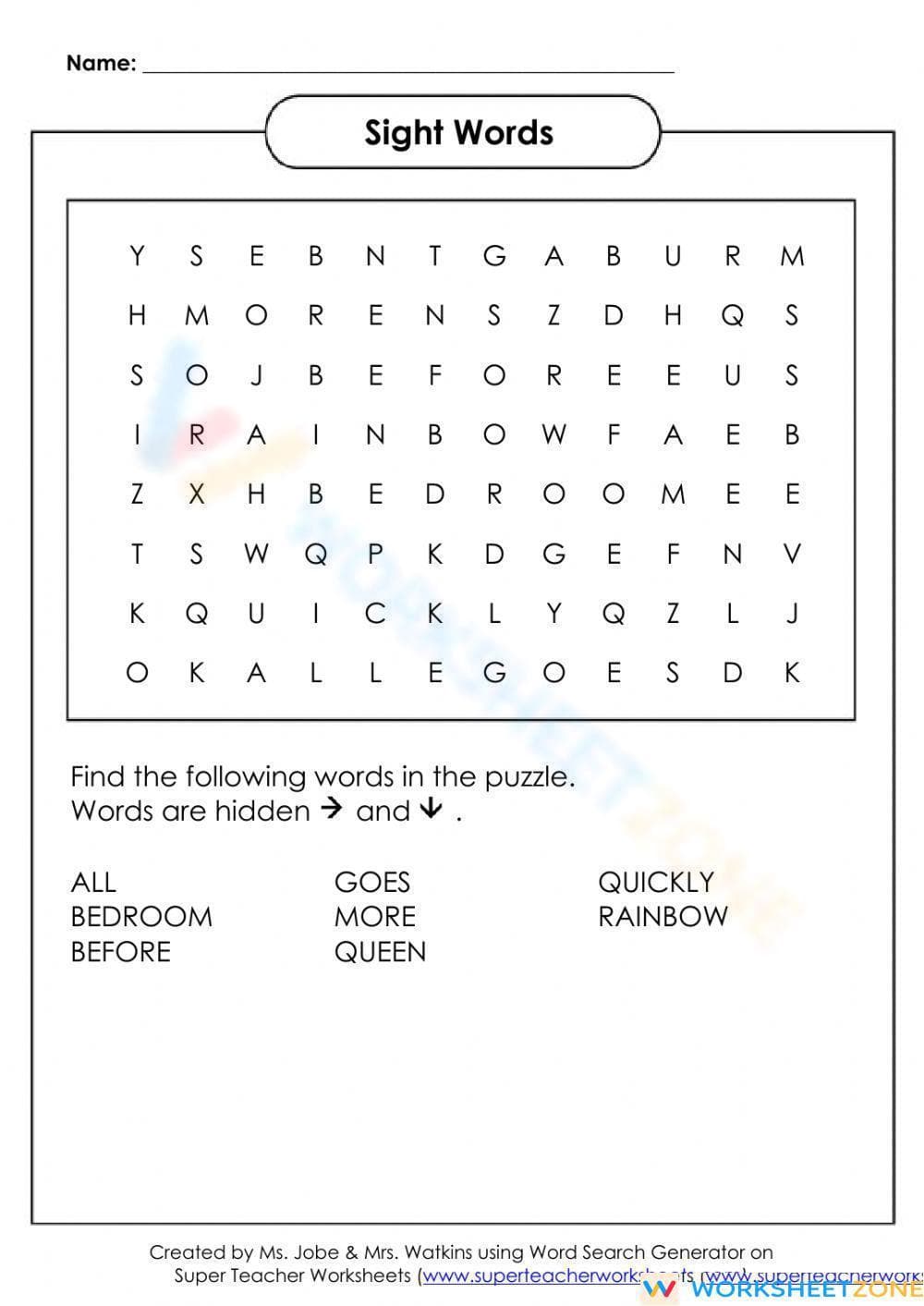

Essential Sight Word Wordsearch | Grade 1 Printable
Paste this activity's link or code into your existing LMS (Google Classroom, Canvas, Teams, Schoology, Moodle, etc.).
Students can open and work on the activity right away, with no student login required.
You'll still be able to track student progress and results from your teacher account.
This Grade 1 sight word wordsearch worksheet provides a focused and engaging way for students to reinforce their recognition of high-frequency words. By searching for hidden vocabulary terms like 'quickly' and 'before', learners strengthen their visual discrimination and spelling skills. This printable resource offers an immediate, structured activity to support early literacy and reading fluency.
At a Glance
- Grade: Grade 1 · Subject: English Language Arts
- Standard:
CCSS.ELA-LITERACY.RF.1.3.G— Recognize and read grade-appropriate irregularly spelled words in text- Skill Focus: Sight word recognition & spelling
- Format: 1 page · 8 problems · Answer key included · PDF
- Best For: Literacy centers and early finisher activities
- Time: 10–15 minutes
What's Inside
This single-page PDF features a clear, high-contrast word search grid containing eight essential sight words. The vocabulary list includes words such as 'all', 'bedroom', 'before', 'goes', 'more', 'queen', 'quickly', and 'rainbow', catering to transitional readers. The worksheet layout is designed for clarity, minimizing distractions for early learners during independent practice.
Zero-Prep Workflow
The zero-prep workflow for this resource is designed for maximum teacher efficiency. First, print the single-page document (30 seconds). Second, distribute the worksheets to your literacy groups or as a morning work assignment (30 seconds). Third, review the completed puzzles using the included answer key or have students compare their findings in pairs (60 seconds). This entire process requires less than two minutes of total preparation time, making it an ideal choice for busy classrooms or sub-plan needs.
Standards Alignment
This worksheet is primarily aligned to `CCSS.ELA-LITERACY.RF.1.3.G`, which requires students to recognize and read grade-appropriate irregularly spelled words. By identifying these words within a jumbled grid, students must attend to the specific letter sequences of each term. This practice also supports `CCSS.ELA-LITERACY.L.1.2.E`, focusing on using conventional spelling for words with common patterns. Both standard codes can be copied directly into lesson plans.
How to Use It
This resource is perfect as a warm-up activity during your daily ELA block or as a quiet formative assessment after direct instruction on high-frequency words. For a formative observation, note which students find words horizontally before searching vertically, as this often indicates their scanning efficiency and reading directionality awareness. It fits easily into rotation-based learning models.
Who It's For
This puzzle is designed for Grade 1 students, though it is also appropriate for Kindergarteners requiring a challenge or Preschool learners with advanced phonemic awareness. It works well as a supplementary resource alongside a guided reading passage or as a follow-up to an anchor chart session focusing on 'tricky' words. The clear layout supports students with diverse learning needs.
According to the RAND AIRS 2024 report, high-frequency word recognition is a foundational pillar of early reading proficiency, significantly impacting long-term comprehension outcomes. This sight word wordsearch leverages the cognitive benefits of pattern recognition to assist students in orthographic mapping—the process of forming letter-sound connections to bond the spellings, pronunciations, and meanings of specific words in memory. By engaging with `CCSS.ELA-LITERACY.RF.1.3.G` through a gamified puzzle format, learners reduce the cognitive load associated with decoding common but irregularly spelled terms. This allows for greater fluency when encountering these words in connected text. Research by Fisher & Frey (2014) emphasizes the importance of repetitive, low-stress exposure to vocabulary in varied contexts to ensure mastery. This resource provides that essential exposure, serving as a reliable tool for classroom teachers and interventionists seeking to bridge the gap between word recognition and reading speed in early childhood education settings.


