


























1 / 6
0
Views
0
Plays


0.0
0
Save
0 Likes
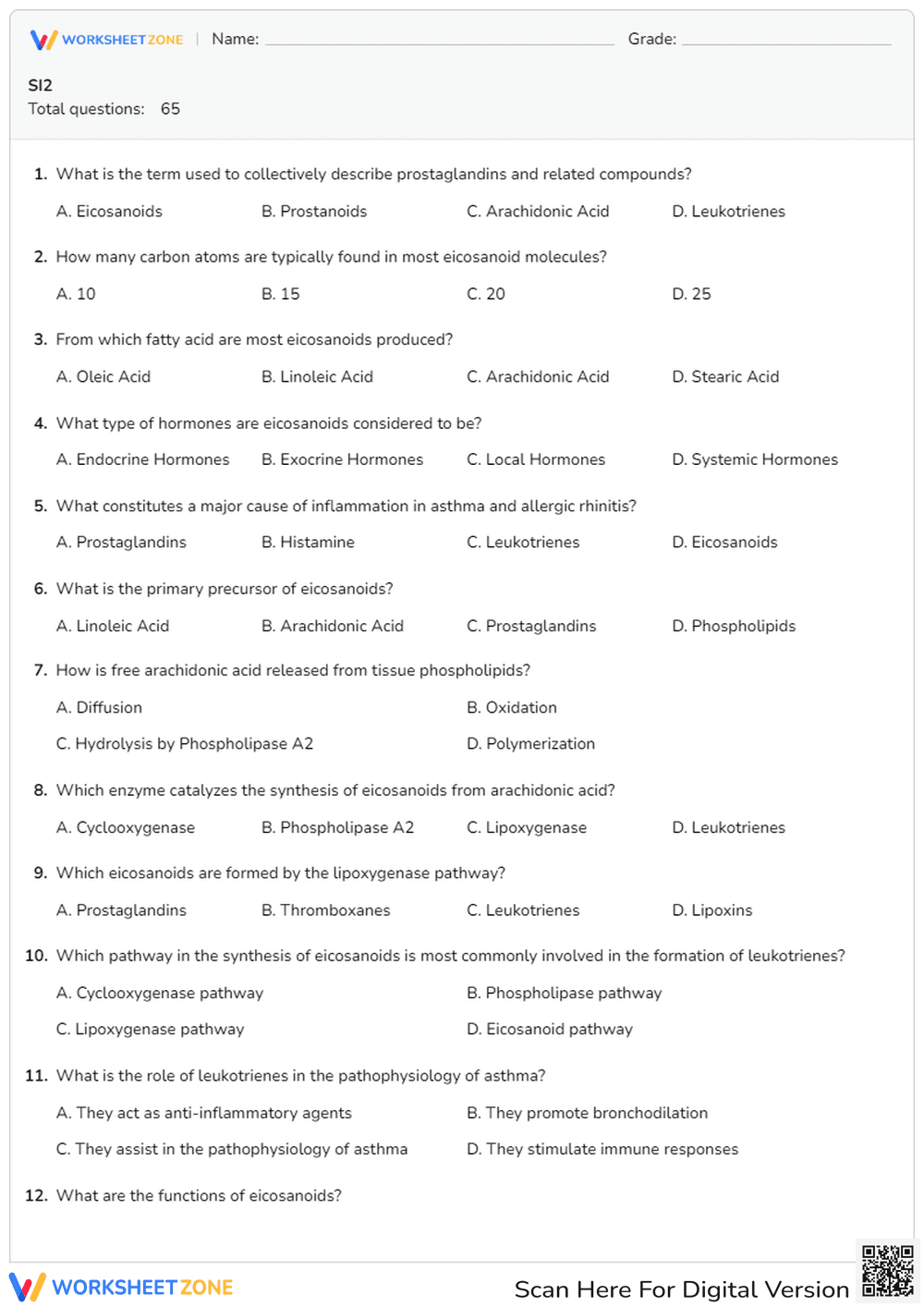
Understanding Eicosanoids: A Comprehensive Quiz
0 Views
0 Plays
Paste this activity's link or code into your existing LMS (Google Classroom, Canvas, Teams, Schoology, Moodle, etc.).
Students can open and work on the activity right away, with no student login required.
You'll still be able to track student progress and results from your teacher account.
Information
Description
What It Is:
This is a chemistry worksheet featuring the structural formula of a complex organic molecule. The structure includes a five-membered ring with a ketone group, multiple double bonds, a hydroxyl group (OH), a methyl ester (COOMe), and a terminal methyl group (Me). The molecule is labeled 'ent-2.'
Grade Level Suitability:
This worksheet is suitable for high school (grades 11-12) and undergraduate college level chemistry courses. It requires an understanding of organic chemistry nomenclature, functional groups, and structural representations.
Why Use It:
This worksheet can be used to practice identifying functional groups in organic molecules, understanding structural formulas, and potentially learning about stereochemistry or isomerism (implied by 'ent-2'). It helps students develop skills in visualizing and interpreting complex chemical structures.
How to Use It:
Students can use this worksheet to identify and label the different functional groups present in the molecule. They can also practice drawing the structure from a given name, or naming the structure if given. It could also be used to discuss stereoisomers.
Target Users:
This worksheet is targeted towards students studying organic chemistry, including high school AP chemistry students and college-level organic chemistry students. It is also beneficial for instructors teaching these topics.
This is a chemistry worksheet featuring the structural formula of a complex organic molecule. The structure includes a five-membered ring with a ketone group, multiple double bonds, a hydroxyl group (OH), a methyl ester (COOMe), and a terminal methyl group (Me). The molecule is labeled 'ent-2.'
Grade Level Suitability:
This worksheet is suitable for high school (grades 11-12) and undergraduate college level chemistry courses. It requires an understanding of organic chemistry nomenclature, functional groups, and structural representations.
Why Use It:
This worksheet can be used to practice identifying functional groups in organic molecules, understanding structural formulas, and potentially learning about stereochemistry or isomerism (implied by 'ent-2'). It helps students develop skills in visualizing and interpreting complex chemical structures.
How to Use It:
Students can use this worksheet to identify and label the different functional groups present in the molecule. They can also practice drawing the structure from a given name, or naming the structure if given. It could also be used to discuss stereoisomers.
Target Users:
This worksheet is targeted towards students studying organic chemistry, including high school AP chemistry students and college-level organic chemistry students. It is also beneficial for instructors teaching these topics.


