


























Views
Downloads
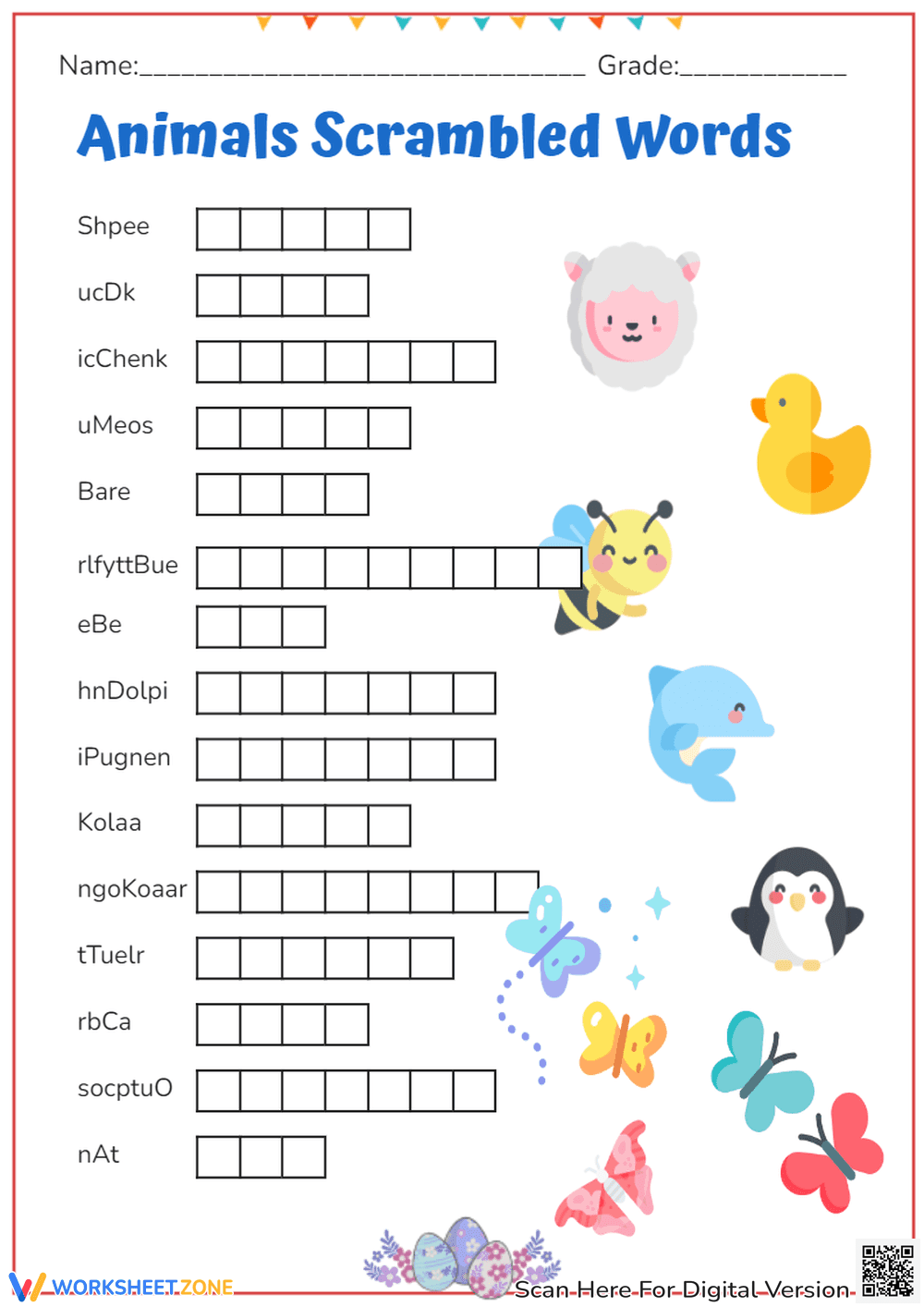

Animal Scramble Worksheet | Grade 1-2 Essential
Paste this activity's link or code into your existing LMS (Google Classroom, Canvas, Teams, Schoology, Moodle, etc.).
Students can open and work on the activity right away, with no student login required.
You'll still be able to track student progress and results from your teacher account.
This Grade 1-2 animal scrambled words worksheet helps students master spelling and letter-sound relationships through engaging vocabulary practice. By unscrambling 15 common animal names, learners strengthen their phonemic awareness and orthographic processing. It provides a clear, structured format for independent practice or a quick literacy center activity.
At a Glance
- Grade: 1-2 · Subject: ELA
- Standard:
CCSS.ELA-LITERACY.L.1.2— Demonstrate command of the conventions of standard English capitalization, punctuation, and spelling- Skill Focus: Animal vocabulary and spelling
- Format: 1 page · 15 problems · Answer key included · PDF
- Best For: Morning work or literacy centers
- Time: 10–15 minutes
This single-page PDF features 15 scrambled animal names ranging from simple three-letter words like "Ant" to more complex multi-syllabic words like "Butterfly" and "Kangaroo." Each task includes a letter-box scaffold to help students visualize word length. The worksheet is supported by colorful animal illustrations to provide visual cues for younger learners, ensuring that students can identify the target word before focusing on the mechanics of spelling.
The workflow for this resource is designed for maximum efficiency. First, print the single-page PDF (30 seconds). Next, distribute the sheets to students as a warm-up or transition activity (1 minute). Finally, review the correct spellings as a whole group or use the included answer key for rapid grading (1 minute). Total teacher preparation time is under 2 minutes, making it an ideal choice for emergency sub plans or unexpected schedule gaps.
The primary standard addressed is `CCSS.ELA-LITERACY.L.1.2`, which requires students to demonstrate command of standard English spelling patterns. By rearranging letters to form known words, students practice phonics and word recognition. This also supports `CCSS.ELA-LITERACY.L.2.2` as students progress to more complex animal names. Both standard codes can be copied directly into lesson plans, IEP goals, or district curriculum mapping tools.
Use this worksheet during the "You Do" phase of a lesson on animal classifications or as a formative assessment after a spelling unit. It works exceptionally well as a quiet transition activity after recess. Observe if students are using the visual icons to identify the animal before attempting the scramble, which indicates strong context-clue usage. Completion typically takes 10 to 15 minutes depending on the student's familiarity with the vocabulary.
This resource is ideal for first and second-grade students, English Language Learners (ELLs) needing vocabulary support, and special education students working on fine motor skills and letter sequencing. It pairs naturally with an animal-themed anchor chart or a primary science unit on living things. The clear layout ensures that students are not overwhelmed by visual clutter while they work.
According to the RAND AIRS 2024 report, structured word-level tasks like scrambling and unscrambling letters significantly improve orthographic mapping in early readers. This worksheet targets `CCSS.ELA-LITERACY.L.1.2` by requiring students to manipulate letter sequences to form 15 distinct animal names. Research from Fisher & Frey (2014) suggests that combining visual cues with spelling practice helps solidify vocabulary acquisition in the primary grades. By engaging with words like "Dolphin" and "Octopus," students build the foundational spelling skills necessary for reading fluency. This resource provides a high-utility, low-stakes environment for students to test their knowledge of common spelling patterns. The inclusion of letter boxes serves as a critical scaffold, ensuring that learners can self-correct based on word length, a key component of self-regulated learning in early ELA instruction.


