


























Views
Downloads
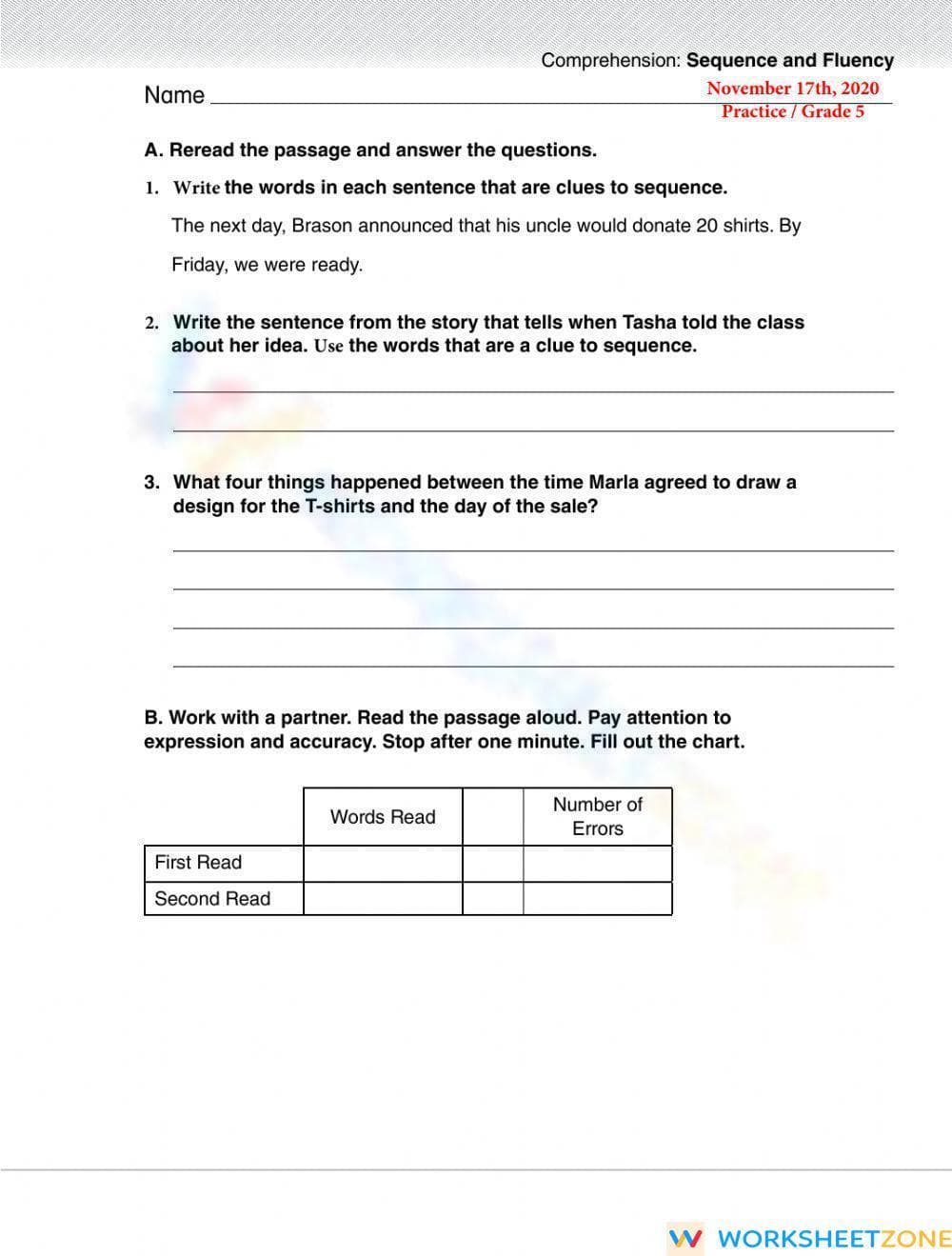

Essential Grade 5 Sequence and Fluency ELA Worksheet
Paste this activity's link or code into your existing LMS (Google Classroom, Canvas, Teams, Schoology, Moodle, etc.).
Students can open and work on the activity right away, with no student login required.
You'll still be able to track student progress and results from your teacher account.
This Essential Grade 5 Sequence and Fluency ELA Worksheet helps students master the structural logic of informational texts while building reading stamina. By identifying chronological signal words and tracking oral reading progress, learners bridge the gap between decoding and deep comprehension. This dual-purpose tool ensures students can both explain event relationships and read with professional accuracy.
At a Glance
- Grade: 5 · Subject: English Language Arts (ELA)
- Standard:
RI.5.3— Explain interactions between events or ideas based on specific text information- Skill Focus: Sequence Identification & Reading Fluency
- Format: 1 page · 5 problems · Answer key included · PDF
- Best For: Daily reading practice and fluency monitoring
- Time: 15–20 minutes
What's Inside
This single-page resource features two distinct sections designed to streamline classroom instruction. Section A focuses on sequence comprehension, requiring students to extract clue words and synthesize event timelines from a provided passage. Section B is a fluency partner-work chart where students record "Words Read" and "Number of Errors" across two timed reads. This structured layout supports both written analysis and oral reading assessment without requiring additional recording sheets.
Zero-Prep Workflow
This printable worksheet is designed for immediate classroom deployment with a target teacher prep time of under 2 minutes. Step 1: Print the sheet (10 seconds). Step 2: Distribute for independent or partner work (30 seconds). Step 3: Use the provided answer key for rapid checking (60 seconds). Its self-contained nature makes it an ideal choice for emergency sub plans or daily bell-ringer activities.
Standards Alignment
The primary focus of this worksheet is `RI.5.3`, which requires students to explain the relationships or interactions between two or more individuals, events, ideas, or interests in a text. Additionally, it supports `RF.5.4` by providing a dedicated framework for practicing oral reading accuracy and expression. Both standard codes can be copied directly into lesson plans, IEP goals, or district curriculum mapping tools.
How to Use It
Assign this worksheet during the "Independent Practice" phase of a lesson on chronological text structures. It works well as a "Fluency Friday" rotation where students pair up to time each other's reading. Teachers should observe students during the fluency check to identify specific phonics gaps or expression issues. Completion typically takes 15 to 20 minutes depending on the length of the external passage used.
Who It's For
This resource is tailored for Grade 5 students but serves as an effective scaffold for Grade 6 learners needing fluency support or an extension for Grade 4 students. It is particularly beneficial for English Language Learners (ELLs) who need explicit practice with sequence transition words like "the next day" or "by Friday." Pair this with a short narrative passage for maximum impact.
According to research from Fisher & Frey (2014), structured practice in identifying text cohesive devices—such as the sequence clues targeted in this RI.5.3 worksheet—is vital for developing independent reading proficiency. Their work emphasizes that students must move beyond decoding to understand the logical progression of ideas. Furthermore, the inclusion of a fluency tracking chart aligns with NAEP findings that oral reading fluency is a significant predictor of overall comprehension scores in the upper elementary grades. By combining chronological analysis with accuracy monitoring, this worksheet addresses two critical pillars of the ELA framework. This data-driven approach ensures that Grade 5 students develop the technical skills necessary for complex text analysis. Teachers can use the resulting fluency data to inform intervention placements or to document progress toward specific literacy benchmarks while maintaining alignment with state and national standards.


