


























Views
Downloads

Essential Sentences Chart | Grade 1-3 ELA Printable
Paste this activity's link or code into your existing LMS (Google Classroom, Canvas, Teams, Schoology, Moodle, etc.).
Students can open and work on the activity right away, with no student login required.
You'll still be able to track student progress and results from your teacher account.
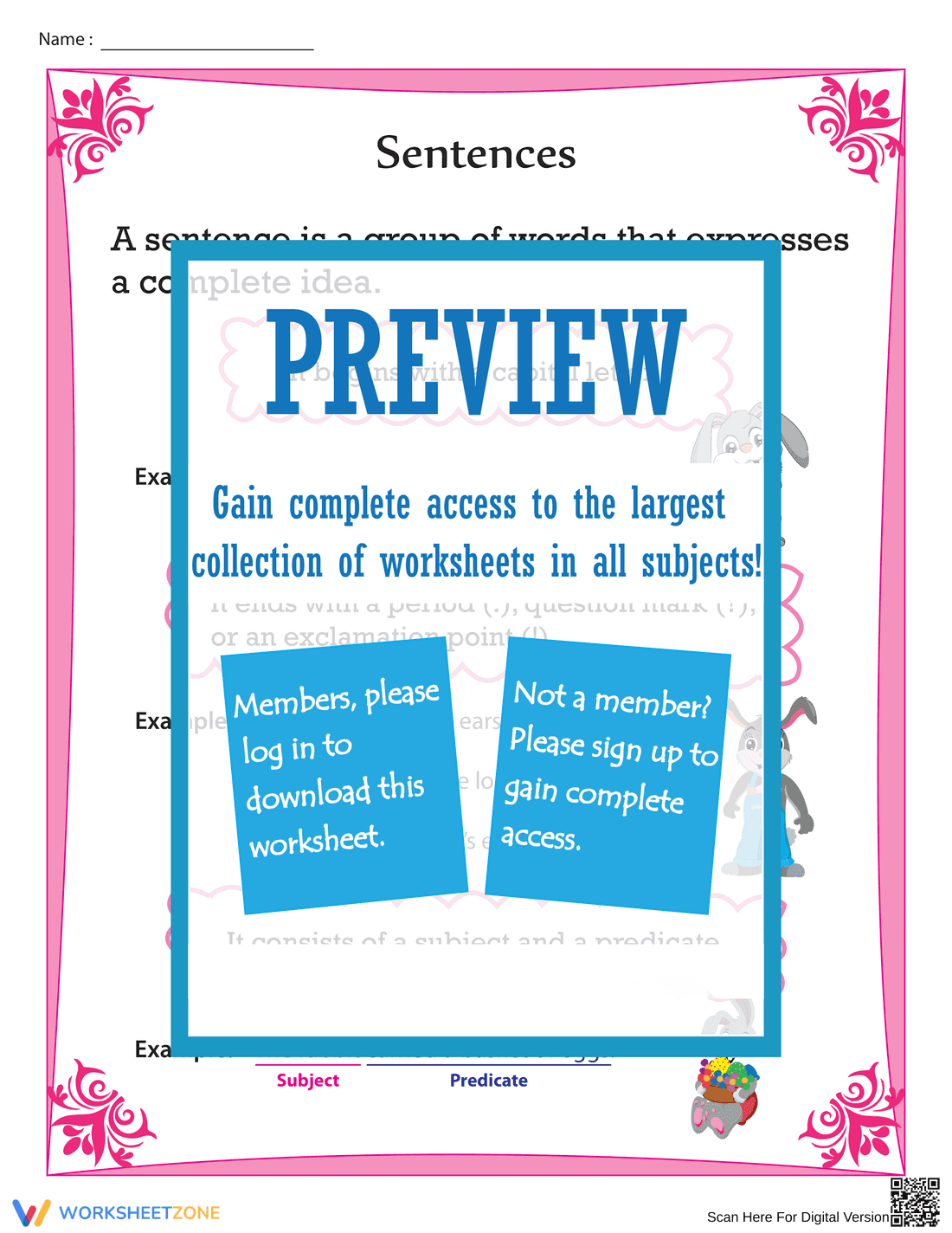
Sentence writing is the cornerstone of early literacy. This anchor chart provides a visual blueprint for Grade 1 through Grade 3 students, distilling complex grammatical concepts into actionable rules. By using this resource, students establish a mental framework for sentence construction that supports long-term writing development and clarity across the ELA curriculum.
At a Glance
- Grade: 1-3 · Subject: ELA
- Standard:
CCSS.ELA-LITERACY.L.1.1.J— Produce and expand complete sentences with correct capitalization, punctuation, and subject-predicate structure- Skill Focus: Sentence definition, starting capitalization, ending punctuation, and subject-predicate
- Format: 1 printable page · Color-coded reference chart · Engaging visual examples · PDF
- Best For: Writing workshops, daily grammar review, and independent reference
- Time: 5–10 minutes
This single-page reference tool breaks down sentence construction into manageable parts. It includes a clear definition of a sentence, emphasizing the expression of a complete idea. The visual layout highlights three critical components: starting capital letters, ending punctuation marks, and the essential subject-predicate relationship. Each rule features relatable examples that ensure concepts remain grounded in context for young learners.
Zero-Prep Workflow
The Zero-Prep Workflow is designed for immediate integration. First, print the chart (30 seconds). Second, display it on a wall or distribute it for student writing folders (1 minute). Third, review the examples during a mini-lesson (5 minutes). Total teacher preparation time is under two minutes, making it ideal for writing workshops or substitute teacher plans.
Standards Alignment
Aligned to CCSS.ELA-LITERACY.L.1.1.J, this chart supports students as they produce complete sentences. It also addresses CCSS.ELA-LITERACY.L.1.2.B regarding end punctuation. Both standard codes can be copied directly into lesson plans, IEP goals, or district curriculum mapping tools to ensure instructional alignment and support data-driven teaching practices.
How to Use It
Use this chart as a permanent writing center anchor. One formative-assessment tip is to observe students during self-editing; if they hesitate, point to the punctuation section to prompt correction. Students typically require 5–10 minutes of interaction to grasp the rules during a dedicated writing session.
Who It's For
This resource is tailored for students in Grades 1–3, including English Language Learners who benefit from visual cues. It serves as an excellent companion to narrative writing passages or lessons on parts of speech. Differentiation is supported as students refer to the subject-predicate section while their writing grows more complex.
The CCSS.ELA-LITERACY.L.1.1.J standard requires students to produce and expand complete sentences, a skill that is fundamental to academic success across all subjects. According to the RAND AIRS 2024 report, visual scaffolds like anchor charts significantly improve the retention of grammatical rules among early writers by providing a consistent point of reference during the independent writing process. This sentences chart provides that essential support, defining a sentence as a group of words that expresses a complete idea while highlighting the necessity of capital letters and appropriate punctuation. By explicitly modeling the subject-predicate relationship with clear examples, the resource helps students move beyond simple word lists to structured, coherent thoughts. This focused practice on sentence fundamentals is not just a grammar exercise; it is a critical step in developing the fluency required for more advanced composition and text analysis in later grades.


