


























Views
Plays


Printable Run-On Sentences Quiz | Grade 6 ELA
Paste this activity's link or code into your existing LMS (Google Classroom, Canvas, Teams, Schoology, Moodle, etc.).
Students can open and work on the activity right away, with no student login required.
You'll still be able to track student progress and results from your teacher account.
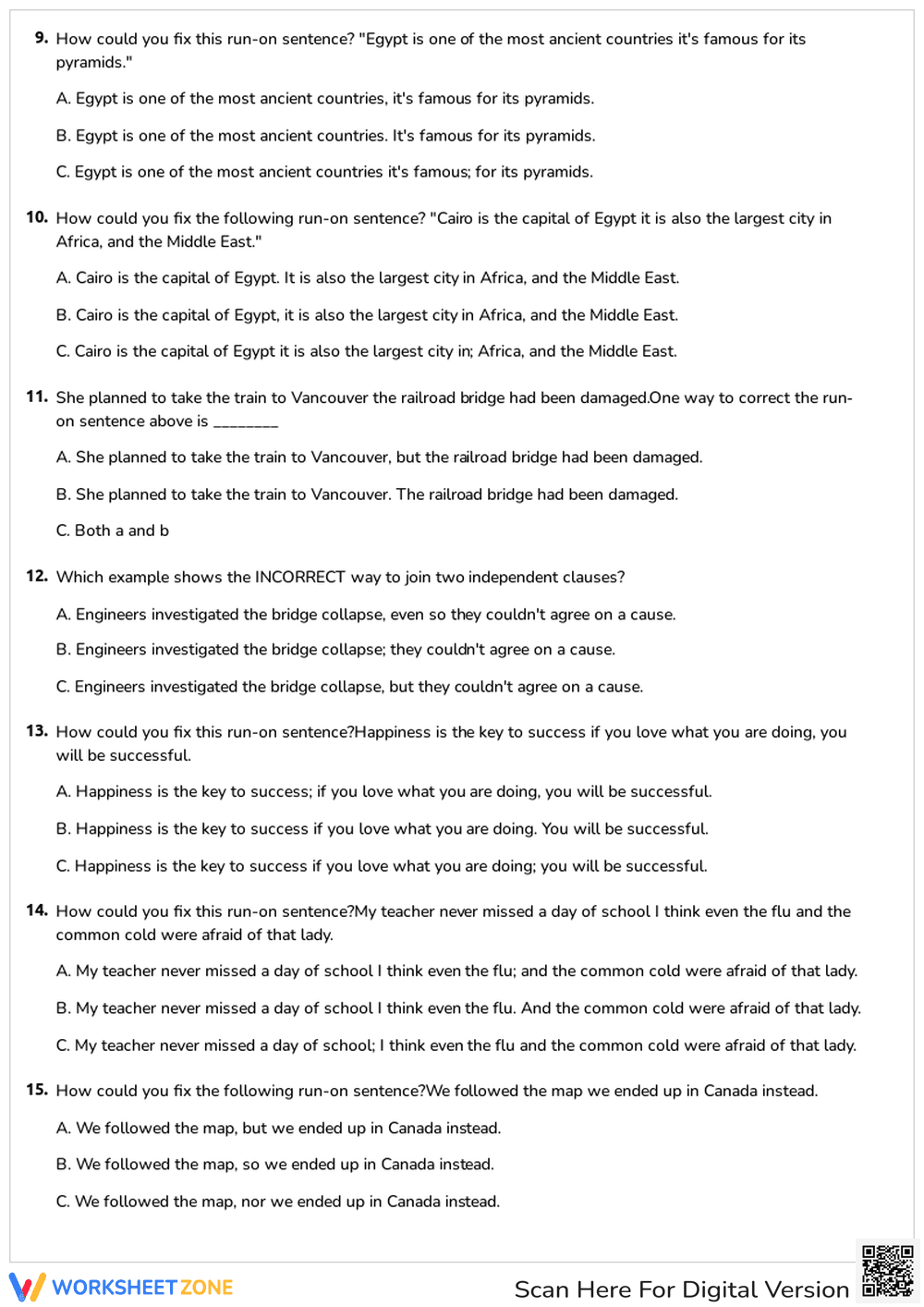
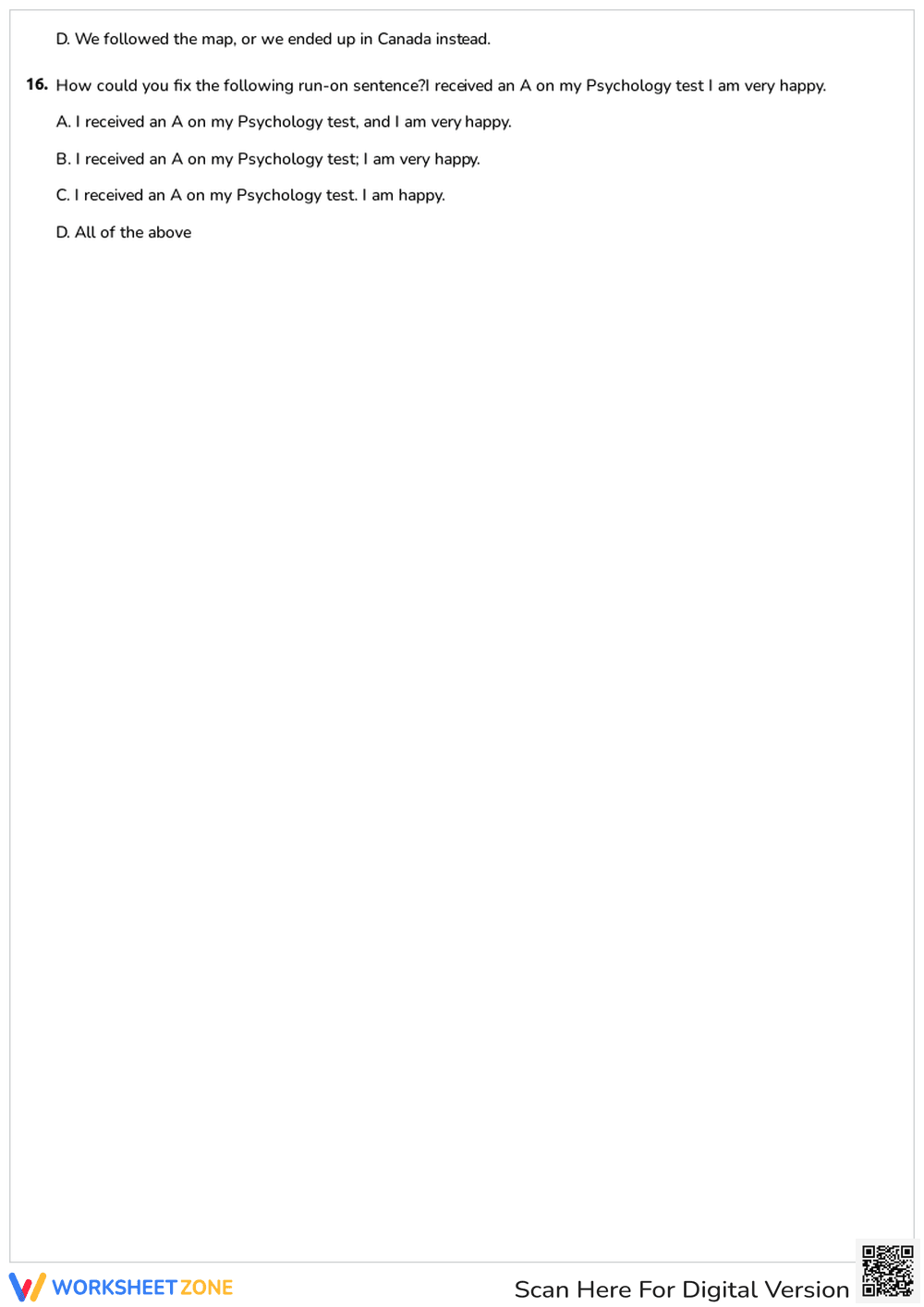
This Grade 6 grammar worksheet gives students targeted practice identifying and correcting run-on sentences. By evaluating independent clauses and selecting appropriate conjunctions or punctuation, students strengthen sentence structure skills and improve writing clarity. The multiple-choice format provides immediate feedback on common errors.
At a Glance
- Grade: 6 · Subject: ELA
- Standard:
CCSS.ELA-LITERACY.L.6.1— Demonstrate command of standard English grammar conventions- Skill Focus: Identifying and correcting run-on sentences
- Format: 3 pages · 16 problems · Answer key included · PDF
- Best For: Formative assessment or independent practice
- Time: 15–20 minutes
What's Inside
This comprehensive quiz features 16 multiple-choice questions across three pages. Students encounter various task types, including defining independent clauses, identifying run-ons, and choosing correct punctuation to fix improperly joined clauses. The straightforward layout minimizes distractions, while the included answer key ensures quick grading.
Zero-Prep Workflow
Designed for maximum efficiency, this resource requires virtually no teacher setup:
- Print (1 minute): Simply print the three-page PDF. The black-and-white design is ink-friendly and copies perfectly.
- Distribute (1 minute): Hand out the quiz as a bell-ringer, independent practice assignment, or formal assessment.
- Review (3 minutes): Use the provided answer key to grade submissions rapidly or project it for whole-class review.
With a total teacher prep time of under two minutes, this worksheet is an ideal addition to any emergency sub plan or busy instructional week.
Standards Alignment
This resource is strictly aligned to CCSS.ELA-LITERACY.L.6.1: "Demonstrate command of the conventions of standard English grammar and usage when writing or speaking." It also supports CCSS.ELA-LITERACY.L.6.2 by reinforcing proper punctuation use, such as commas and semicolons, to separate independent clauses. Both standard codes can be copied directly into lesson plans, IEP goals, or district curriculum mapping tools.
How to Use It
This worksheet is highly versatile. Use it after direct instruction on coordinating conjunctions to measure initial comprehension, or assign it as a Friday grammar quiz. As a formative assessment observation tip, monitor which questions students miss; if many struggle with semicolons, plan a targeted mini-lesson. Expected completion time is 15 to 20 minutes.
Who It's For
This resource is primarily designed for Grade 6 and Grade 7 general education students mastering sentence boundaries. It is also highly effective for older students needing foundational grammar intervention or English Language Learners practicing complex sentence structures. For differentiation, teachers can cross out a few multiple-choice options to reduce the cognitive load for struggling readers. Pair this quiz with a classroom anchor chart detailing coordinating conjunctions and semicolon rules.
Mastering sentence boundaries is a critical component of middle school literacy development. Aligned with CCSS.ELA-LITERACY.L.6.1, this resource helps students demonstrate command of standard English grammar conventions by explicitly teaching them how to identify and correct run-on sentences. According to Fisher & Frey (2014), providing students with structured, multiple-choice formative assessments allows educators to quickly identify specific misconceptions regarding independent clauses and punctuation rules. When students practice evaluating various sentence structures in a controlled format, they develop the metacognitive skills necessary to edit their own independent writing effectively. This targeted practice directly reduces the frequency of fused sentences and comma splices in longer composition tasks. By integrating this 16-question assessment into regular weekly instruction, teachers can ensure students build the robust syntactic awareness required for advanced high school writing and beyond.


