


























Views
Plays

Essential Ending Punctuation Practice | Grade 3-4 ELA
Paste this activity's link or code into your existing LMS (Google Classroom, Canvas, Teams, Schoology, Moodle, etc.).
Students can open and work on the activity right away, with no student login required.
You'll still be able to track student progress and results from your teacher account.
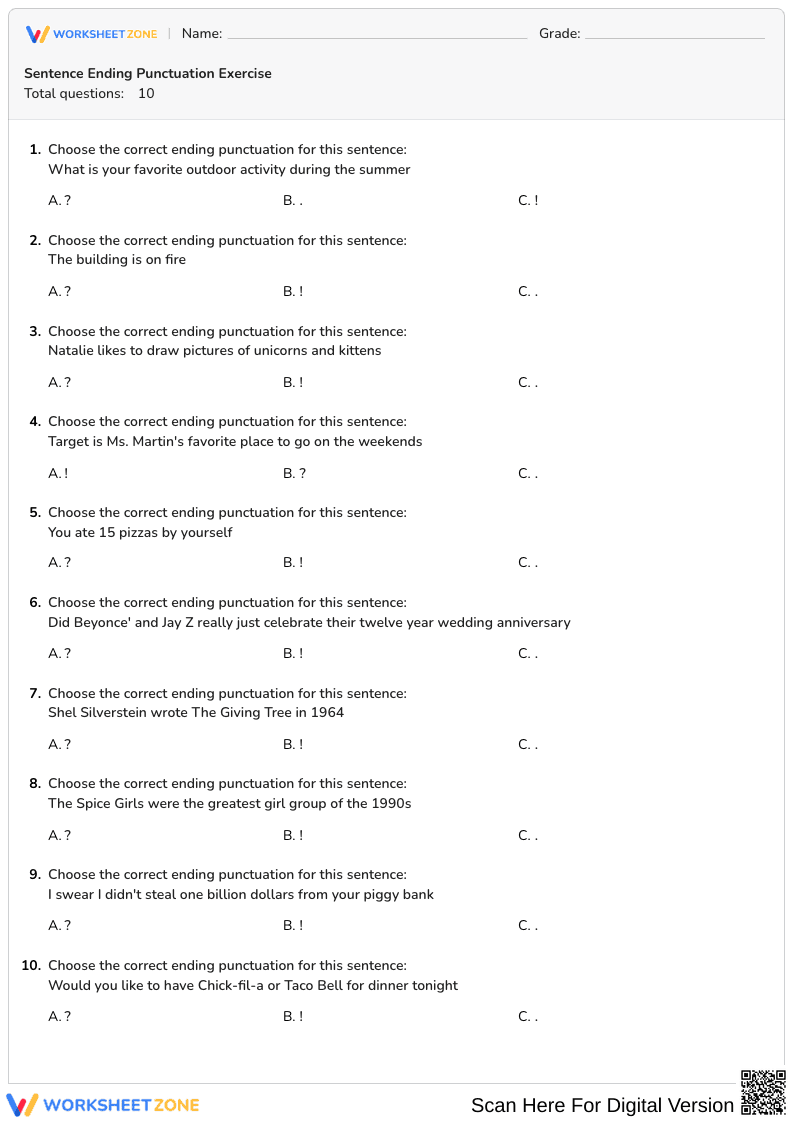
This Grade 3 and 4 grammar worksheet provides immediate practice for students learning to distinguish between different sentence types. By selecting the appropriate terminal punctuation for 10 unique sentences, learners demonstrate their understanding of declarative, interrogative, and exclamatory structures. This resource ensures students can accurately signal the end of a thought in written English.
At a Glance
- Grade: 3-4 · Subject: ELA Grammar
- Standard:
CCSS.ELA-LITERACY.L.3.2— Use correct punctuation including terminal marks to signal sentence intent- Skill Focus: Ending Punctuation (Periods, Question Marks, Exclamation Points)
- Format: 1 page · 10 problems · Answer key included · PDF
- Best For: Quick formative assessment or morning work
- Time: 10–15 minutes
The worksheet features 10 multiple-choice questions designed for clarity and ease of use. Each item presents a complete sentence missing its final mark, followed by three options: a period, a question mark, or an exclamation point. The single-page layout is clean and distraction-free, featuring a dedicated space for student names and grades. A comprehensive answer key is provided to facilitate rapid grading or student self-correction.
This resource is designed for a zero-prep classroom environment. Teachers can follow a simple three-step workflow: Print the single-page PDF (30 seconds), distribute the copies to the class (1 minute), and review the answers using the provided key (5 minutes). Because the instructions are self-explanatory, this worksheet functions perfectly as an emergency sub plan or a quiet transition activity between core lessons.
This activity aligns directly with CCSS.ELA-LITERACY.L.3.2, which requires students to demonstrate command of the conventions of standard English punctuation. Specifically, it targets the ability to choose the correct mark to end a sentence based on its purpose. It also supports CCSS.ELA-LITERACY.L.4.2 by reinforcing foundational mechanics. Both standard codes can be copied directly into lesson plans, IEP goals, or district curriculum mapping tools.
Use this worksheet as an exit ticket after a direct instruction lesson on sentence types. As students work through the 10 items, walk around the room to observe if they are pausing to hear the sentence's tone before choosing a mark. Alternatively, assign it as a bell-ringer activity to settle the class. Most students will complete the exercise within 10 to 15 minutes, making it an efficient check for understanding.
This resource is ideal for third and fourth-grade students who are refining their mechanics. It is particularly helpful for English Language Learners (ELLs) who are learning the melodic cues of English sentences. Pair this worksheet with a punctuation anchor chart or a short reading passage to help students see these marks in a broader literary context.
Effective punctuation instruction is a cornerstone of literacy development, as terminal marks provide the essential prosodic cues necessary for reading comprehension. According to the Fisher & Frey (2014) framework for gradual release of responsibility, structured practice with discrete skills like ending punctuation allows students to internalize mechanical rules before applying them to complex composition tasks. This worksheet targets CCSS.ELA-LITERACY.L.3.2 by isolating the decision-making process for periods, question marks, and exclamation points across 10 varied sentence examples. Research from EdReports 2024 emphasizes that high-quality instructional materials must provide explicit opportunities for students to practice conventions in isolation to reduce cognitive load during the drafting phase of writing. By mastering these terminal marks, students build the foundational fluency required for more advanced syntactic structures. This resource serves as a reliable tool for verifying that Grade 3 and 4 learners have achieved the necessary mastery of basic sentence boundaries.


