




























Views
Downloads
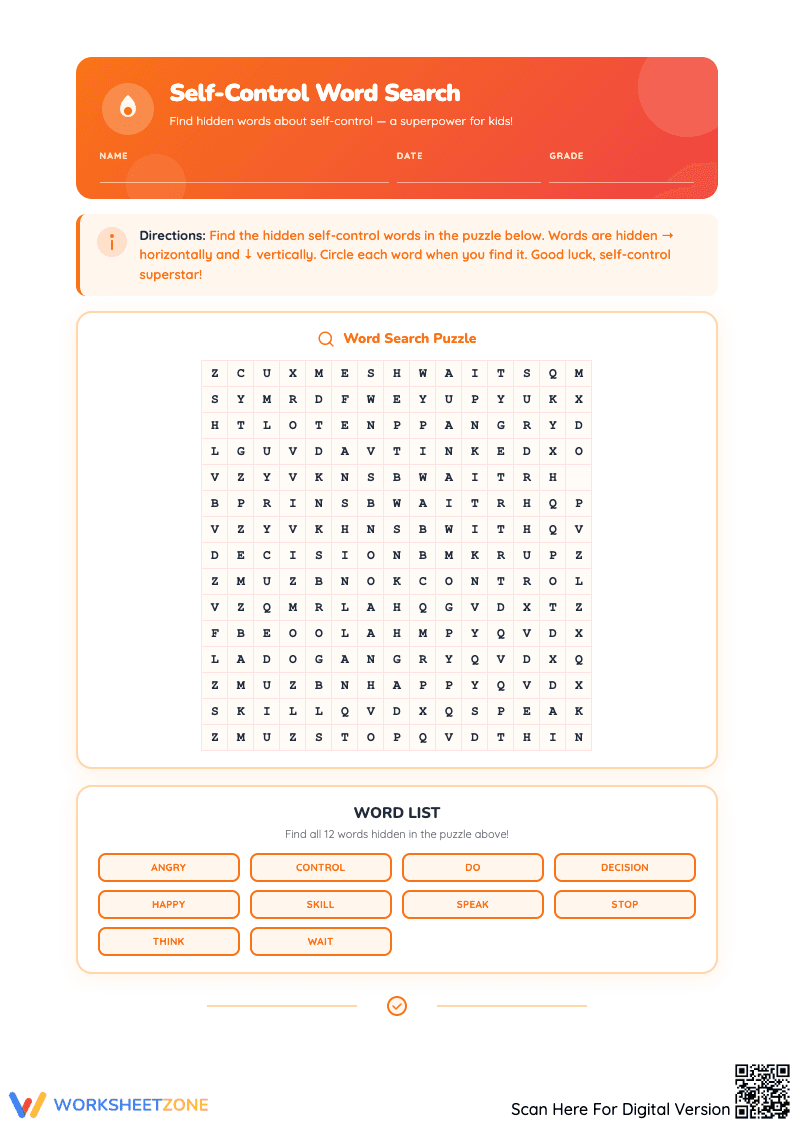
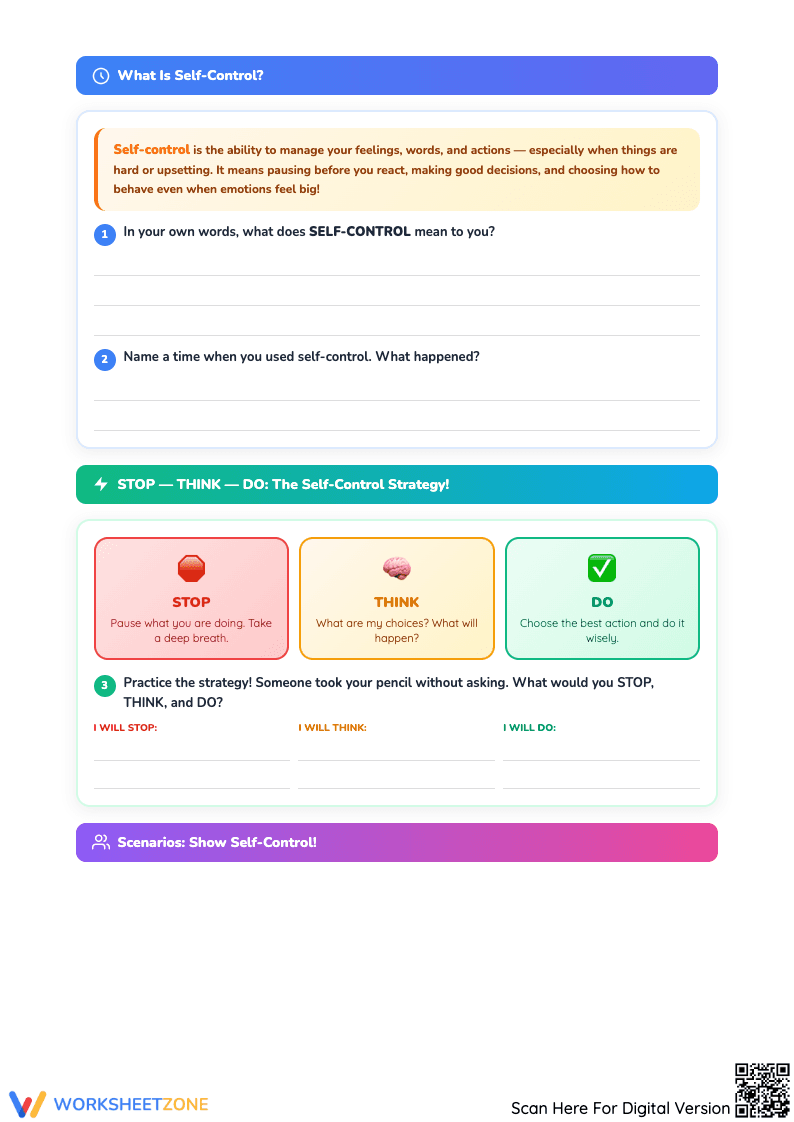
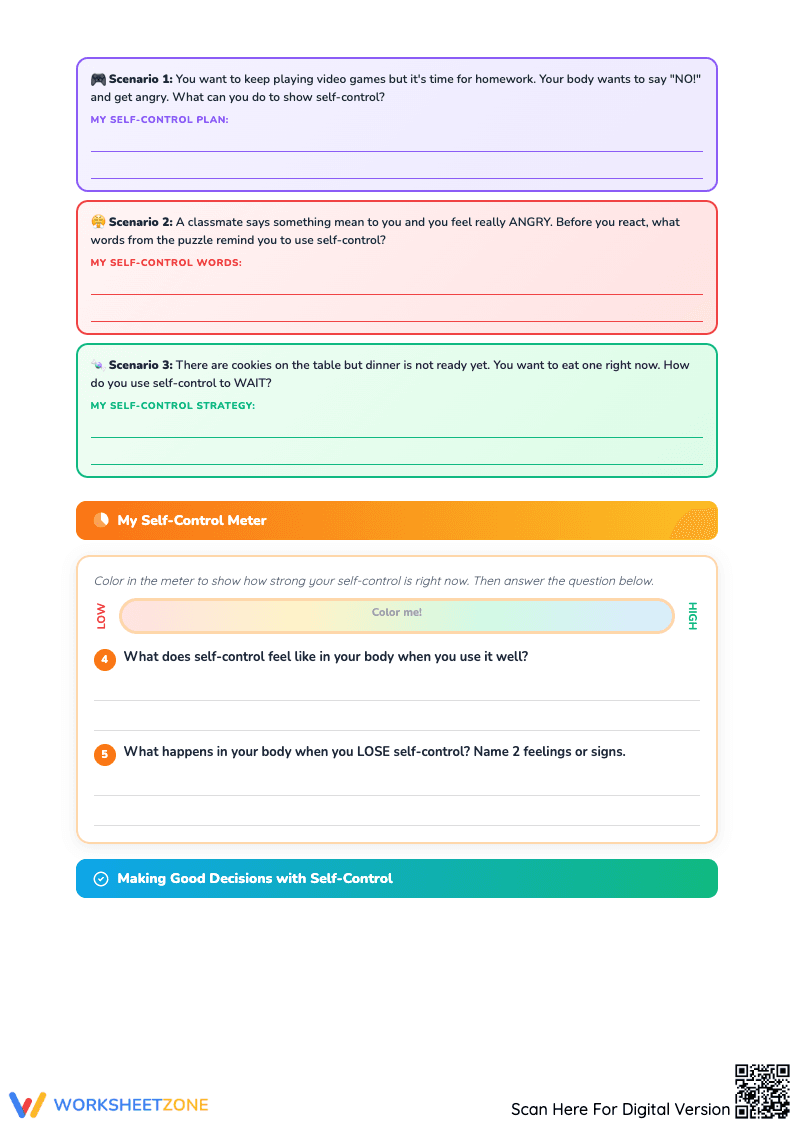
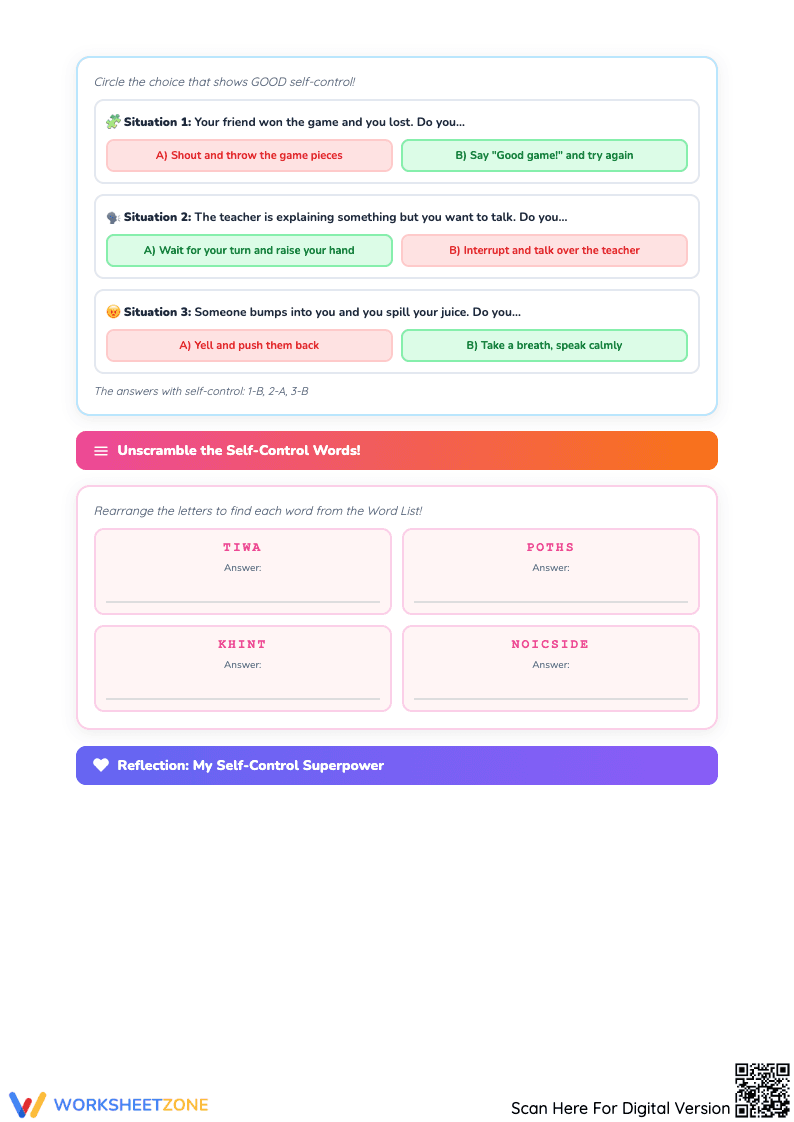

Essential Self-Control Worksheet Packet | Grade 5-6

Paste this activity's link or code into your existing LMS (Google Classroom, Canvas, Teams, Schoology, Moodle, etc.).
Students can open and work on the activity right away, with no student login required.
You'll still be able to track student progress and results from your teacher account.
This Grade 5-6 social-emotional learning packet provides a comprehensive toolkit for mastering self-regulation. Students engage with vocabulary, real-world scenarios, and reflective tracking to internalize the "Stop-Think-Do" methodology. By completing these 5 pages, learners develop the specific language and behavioral frameworks necessary to manage big emotions and make responsible choices in the classroom.
At a Glance
- Grade: 5-6 · Subject: Social Skills
- Standard:
CCSS.ELA-LITERACY.L.5.6— Acquire and use academic vocabulary related to self-regulation and behavior- Skill Focus: Emotional regulation & decision-making
- Format: 5 pages · 25 problems · Answer key included · PDF
- Best For: Morning meetings or small group SEL
- Time: 30–45 minutes
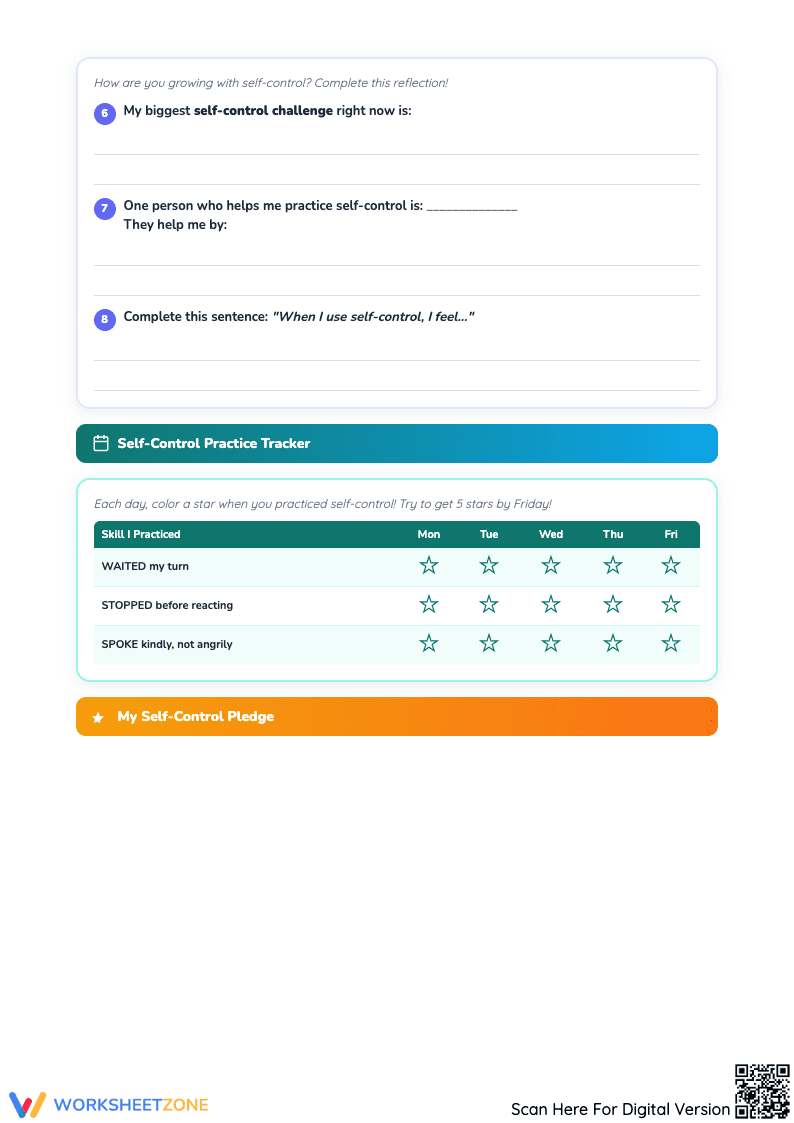
This 5-page PDF contains a diverse array of activities designed to keep students engaged while reinforcing core behavioral concepts. It begins with a 12-word search and vocabulary unscramble to build familiarity with self-control terminology. The packet then transitions into cognitive work, featuring the "Stop-Think-Do" strategy guide, three detailed social scenarios for analysis, a "Self-Control Meter" for physical awareness, and a weekly practice tracker to ensure long-term skill application.
Zero-Prep Workflow
- Print: Select the 5-page PDF and print enough copies for your cohort (30 seconds).
- Distribute: Hand out the packets during a transition or morning meeting (1 minute).
- Review: Use the built-in answer cues and scenario prompts to facilitate a 5-minute closing discussion (5 minutes).
Total teacher preparation time is under 2 minutes, making this an ideal resource for substitute folders or unexpected schedule changes.
Standards Alignment
The primary alignment is CCSS.ELA-LITERACY.L.5.6, which focuses on acquiring and using grade-appropriate general academic and domain-specific words and phrases. By identifying and defining terms like "decision," "control," and "wait," students build the linguistic foundation for behavioral success. Additionally, the scenario-based reflections support CCSS.ELA-LITERACY.SL.5.1.B, encouraging students to follow agreed-upon rules for discussions and carry out assigned roles. Both standard codes can be copied directly into lesson plans, IEP goals, or district curriculum mapping tools.
How to Use It
Assign this packet as a standalone unit during a dedicated SEL block or break it into daily 10-minute segments across a full week. For a formative assessment, observe student responses to the "Self-Control Meter" on page 3; this provides immediate insight into their current emotional state and self-awareness levels. Completion typically ranges from 30 to 45 minutes if done in one sitting.
Who It's For
This resource is tailored for upper elementary and middle school students, particularly those in Grade 5 and Grade 6 who are navigating increased social complexity. It is highly effective for Tier 1 classroom instruction, small group counseling sessions, or as a targeted intervention for students with specific IEP goals related to emotional regulation. Pair this with a direct instruction lesson on impulse control or a classroom anchor chart.
This 5-page instructional resource leverages the "Stop-Think-Do" cognitive-behavioral framework to improve student self-regulation. According to the RAND AIRS 2024 report on social-emotional learning, explicit instruction in behavioral vocabulary and scenario-based rehearsal significantly reduces classroom disruptions and improves peer-to-peer interactions. By integrating 25 distinct tasks—ranging from vocabulary acquisition via word searches to longitudinal tracking through a weekly practice log—this worksheet aligns with evidence-based practices for developing executive function. The inclusion of CCSS.ELA-LITERACY.L.5.6 ensures that the behavioral intervention remains grounded in academic language standards, facilitating a dual-purpose learning environment. Research from Fisher & Frey (2014) suggests that such multi-modal approaches, which combine linguistic puzzles with reflective writing and real-world application, lead to higher retention of social skills among learners in the 10-12 age range. This packet serves as a robust tool for data collection in behavioral intervention plans.


