


























Views
Downloads

Grade 2 Plant Life Cycle — Printable Science Worksheet
Paste this activity's link or code into your existing LMS (Google Classroom, Canvas, Teams, Schoology, Moodle, etc.).
Students can open and work on the activity right away, with no student login required.
You'll still be able to track student progress and results from your teacher account.
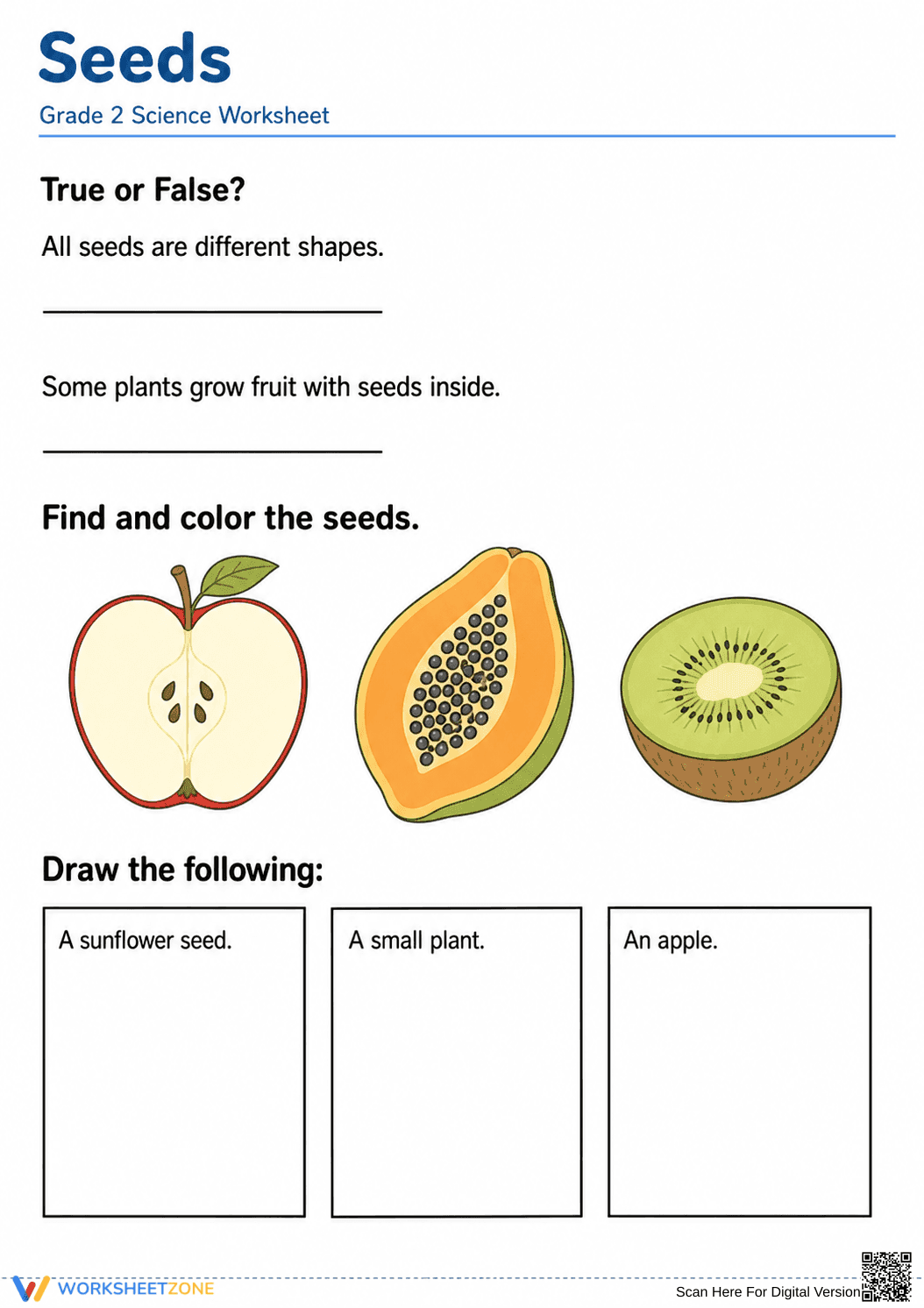
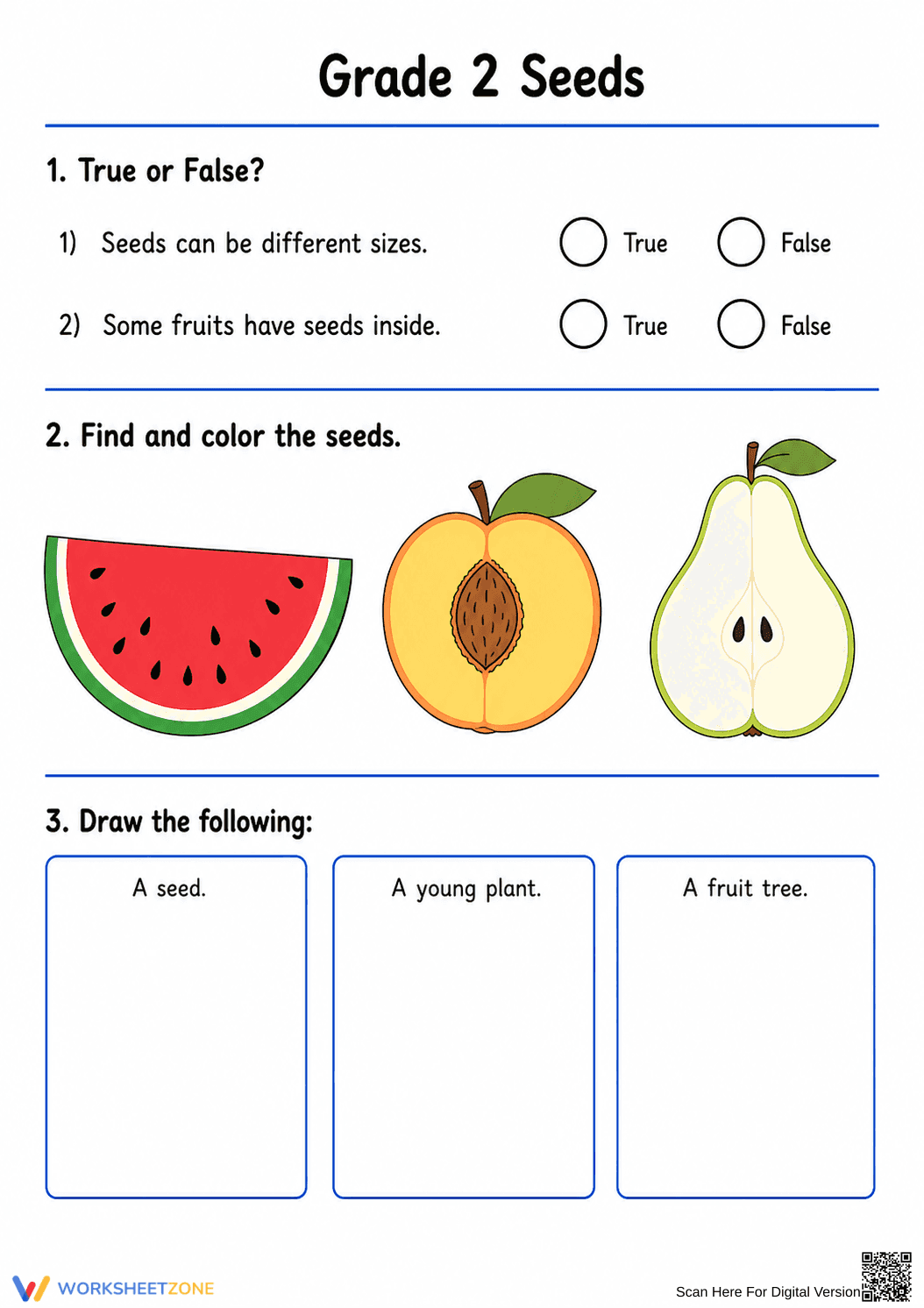
This Grade 2 science worksheet helps students identify the physical characteristics of seeds and understand their vital role in the plant life cycle. By engaging with multiple modalities—including true/false inquiry, visual identification, and creative drawing—students solidify their understanding of how plants grow and produce fruit.
At a Glance
- Grade: 2 · Subject: Science
- Standard:
2-LS2-2— Develop a simple model that mimics seed dispersal- Skill Focus: Seed Identification & Life Cycle
- Format: 2 pages · 6 problems · Answer key included · PDF
- Best For: Independent practice or introductory science lesson
- Time: 15–20 minutes
What's Inside
Inside this resource is a structured two-page worksheet designed for second-graders. It features two true/false questions to test basic knowledge, a coloring activity highlighting seed locations within various fruit cross-sections, and a drawing section focused on illustrating the stages of plant growth. A comprehensive answer key is included to ensure quick grading and immediate feedback.
Zero-Prep Workflow
This resource offers a completely zero-prep experience for busy educators. Print: Generate the PDF copies in seconds. Distribute: Hand out to students immediately with no prior setup required. Review: Check student work using the provided answer key in under two minutes total. This efficiency makes it an ideal choice for emergency sub plans, morning work, or independent science centers where teacher prep time must be minimal.
Standards Alignment
This worksheet is primarily aligned with the NGSS 2-LS2-2 standard, which focuses on developing simple models to understand plant processes, including seed-related functions and dispersal. Students demonstrate their understanding by observing how seeds are contained within fruits and illustrating the stages of plant growth. Both standard codes can be copied directly into lesson plans, IEP goals, or district curriculum mapping tools.
How to Use It
Use this worksheet as a summative assessment after a hands-on exploration of real fruits in the classroom, providing a perfect transition from concrete observation to abstract representation. During the lesson, observe students as they complete the drawing section; if they struggle to differentiate between the seed and the mature plant, it may indicate a need for further instruction on plant growth stages. The activity typically takes 15 to 20 minutes to complete.
Who It's For
This activity is tailored for second-grade students studying life science and living things. It is also highly effective for first-grade students ready for an extension or third-grade students requiring a quick review of plant anatomy. The visual nature of the coloring section makes it accessible for English Language Learners (ELLs) and students with varying reading levels. Pair this with a read-aloud about seed dispersal or a hands-on seed sorting lab.
Aligned to standard 2-LS2-2, this resource targets the essential skill of identifying seed structures and their developmental relationship to mature plants. Research from Fisher & Frey (2014) emphasizes the importance of visual literacy and drawing in early science education, noting that student-generated illustrations help bridge the gap between observation and conceptual understanding. By engaging in these 6 targeted tasks, learners develop a foundational mental model of plant biology that is critical for meeting more complex life science benchmarks in later elementary grades. This worksheet serves as a high-quality instructional material that supports the shift toward evidence-based observation required by modern state and national science frameworks. The inclusion of an answer key ensures that feedback is immediate, a key factor in student retention of new scientific vocabulary and biological concepts.


