


























Views
Downloads


Printable Seed Germination Worksheet | Grade K-2 Science
Paste this activity's link or code into your existing LMS (Google Classroom, Canvas, Teams, Schoology, Moodle, etc.).
Students can open and work on the activity right away, with no student login required.
You'll still be able to track student progress and results from your teacher account.
This primary science worksheet introduces young learners to the fascinating process of seed germination and plant growth. Students will identify essential elements plants need to survive, sequence the stages of a sprouting seed, and label basic plant parts, building foundational biology skills through engaging, age-appropriate activities.
At a Glance
- Grade: K–2 · Subject: Science
- Standard:
K-LS1-1— Identify what plants need to survive and grow- Skill Focus: Seed Germination and Plant Life Cycle
- Format: 2 pages · 4 activities · Answer key included · PDF
- Best For: Independent practice or science centers
- Time: 15–20 minutes
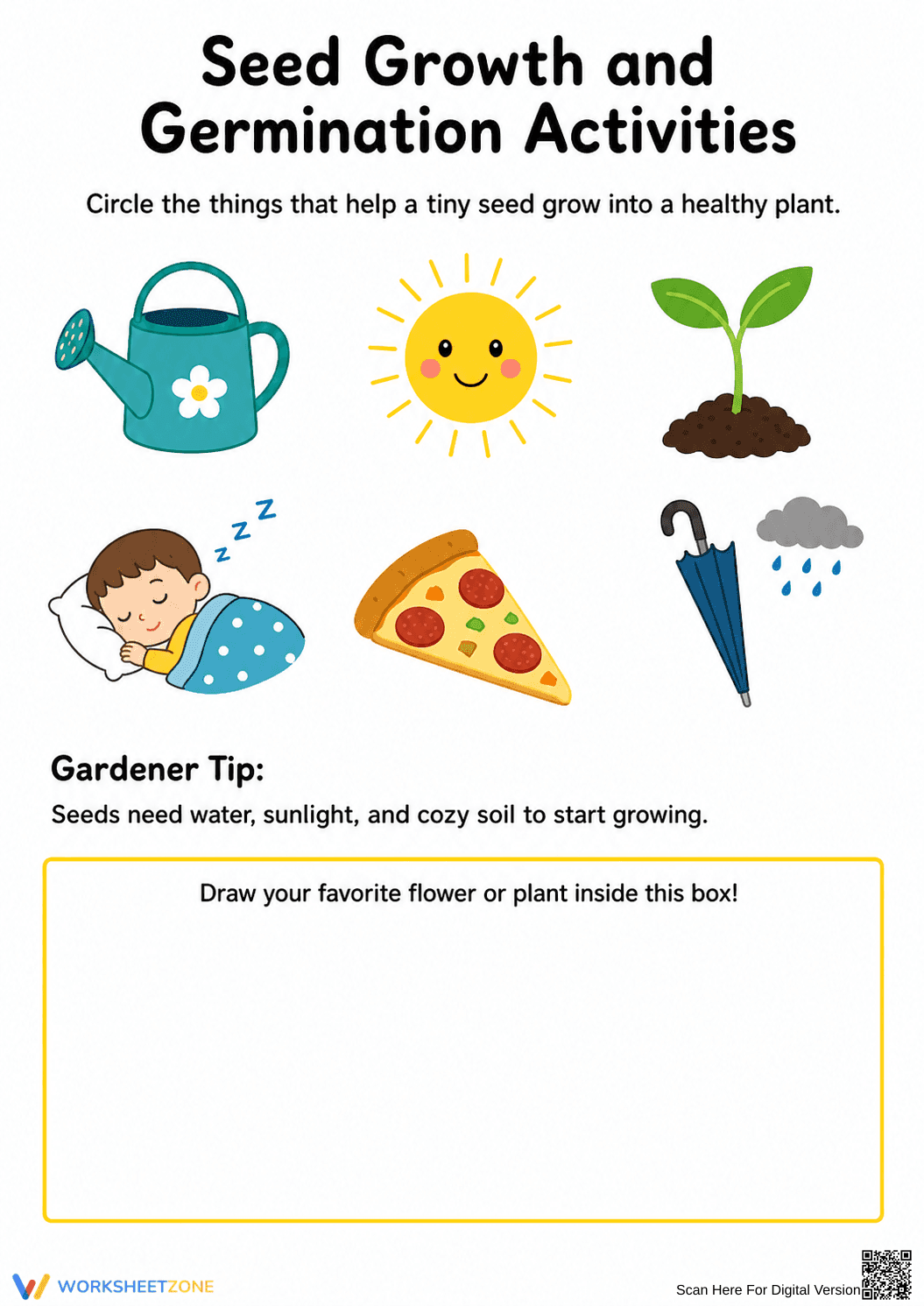
This two-page resource features four distinct task types designed for early childhood science. Page one includes a visual identification activity where students circle the items a seed needs to grow, followed by a creative drawing prompt. Page two challenges students to sequence four stages of seed growth using numbers and concludes with a vocabulary-building exercise to label the leaf, stem, and root of a young plant.
- Print (1 min): Simply print the two-page PDF. No special materials or complex teacher setup required.
- Distribute (1 min): Hand out to students along with pencils and crayons for the drawing section.
- Review (3 mins): Quickly check the sequencing and labeling sections using the included answer key.
With under two minutes of total teacher prep time, this resource is highly suitable for emergency sub plans or spontaneous science extensions.
Aligned to primary standard K-LS1-1: Use observations to describe patterns of what plants and animals need to survive. The activities specifically target the recognition of sunlight and water as essential growth factors. Both standard codes can be copied directly into lesson plans, IEP goals, or district curriculum mapping tools.
Deploy this worksheet during a spring science unit after a direct instruction lesson on how plants grow. It works beautifully as an independent science center activity or a whole-class guided practice session. As a formative assessment observation tip, watch how students sequence the growth stages on page two to gauge their understanding of chronological life cycles. Expected completion time ranges from 15 to 20 minutes.
This resource is primarily designed for Kindergarten through Grade 2 students. The clear visuals and simple vocabulary provide built-in differentiation for early readers and English Language Learners. It pairs perfectly with a hands-on seed planting activity or a read-aloud book about gardens.
Understanding the fundamental needs of living organisms is a critical stepping stone in early childhood science education. According to a comprehensive EdReports 2024 analysis of elementary science curricula, integrating visual sequencing tasks with foundational biology concepts significantly improves long-term retention of life cycle processes. This resource supports that pedagogical approach by aligning with K-LS1-1, helping students identify what plants need to survive and grow through interactive, multimodal activities. By combining identification, sequencing, and labeling tasks into a single cohesive lesson, educators can effectively bridge the gap between abstract biological concepts and concrete student understanding. The structured progression from recognizing basic needs like water and sunlight to identifying specific anatomical parts ensures a comprehensive introduction to botany for young learners.


