


























Views
Downloads

Printable Seed Anatomy Reference | Grade 4 Science
Paste this activity's link or code into your existing LMS (Google Classroom, Canvas, Teams, Schoology, Moodle, etc.).
Students can open and work on the activity right away, with no student login required.
You'll still be able to track student progress and results from your teacher account.
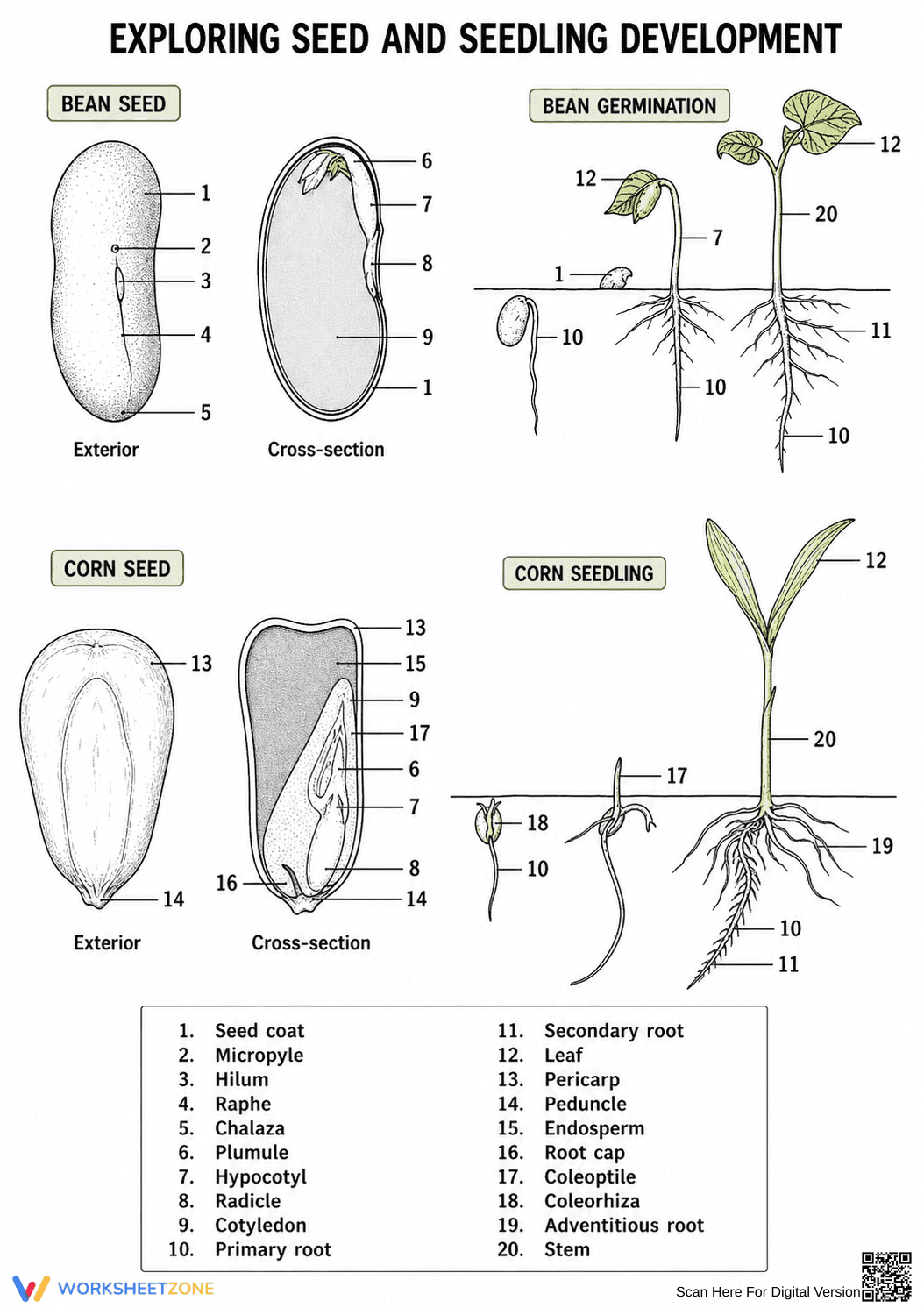
This Grade 4 science reference chart provides students with a detailed visual guide to seed and seedling anatomy. By examining the internal and external structures of both bean and corn seeds, learners will easily visualize the germination process and understand how specific plant parts support early growth and survival.
At a Glance
- Grade: 4 · Subject: Science
- Standard:
4-LS1-1— Identify internal and external plant structures.- Skill Focus: Seed anatomy and germination stages
- Format: 1 page · 20 labeled structures · No answer key needed · PDF
- Best For: Visual reference and study guide
- Time: 5–10 minutes
What's Inside
Inside this single-page printable, educators will find highly detailed, side-by-side diagrams of both dicot (bean) and monocot (corn) seeds. The chart illustrates the exterior views, cross-sections, and progressive germination stages for each plant type. A comprehensive key at the bottom clearly identifies 20 distinct anatomical structures, including the seed coat, cotyledon, radicle, and hypocotyl, making complex botanical vocabulary accessible for elementary learners.
Zero-Prep Workflow
This resource is designed for immediate classroom implementation.
- Print (1 minute): Generate high-quality copies of the PDF for individual student binders or enlarge it for a classroom anchor chart.
- Distribute (1 minute): Hand out the reference guide at the beginning of your plant biology unit or right before a seed dissection lab.
- Review (3 minutes): Briefly walk students through the numbered key, pointing out the differences between the bean and corn cross-sections.
Total teacher preparation requires under two minutes, making this an ideal, stress-free addition to any science lesson or emergency sub plan.
Standards Alignment
This visual guide is directly aligned to 4-LS1-1: Construct an argument that plants and animals have internal and external structures that function to support survival, growth, behavior, and reproduction. It also supports foundational knowledge for understanding diverse plant life cycles. Both standard codes can be copied directly into lesson plans, IEP goals, or district curriculum mapping tools.
How to Use It
Teachers can utilize this diagram as a visual scaffold before reading texts about plant life cycles. It also serves as an excellent companion during hands-on seed dissection labs, allowing students to cross-reference the real specimens on their desks with the labeled cross-sections on the page. For a quick formative assessment, cover the bottom key and ask students to verbally identify key structures like the primary root or cotyledon based on the numbered pointers. Expect students to spend 5 to 10 minutes initially analyzing the chart.
Who It's For
This resource is primarily designed for fourth-grade science students exploring plant biology and internal structures. The clear, numbered visual format provides excellent differentiation for English Language Learners (ELLs) and visual learners who benefit from seeing vocabulary terms directly mapped to detailed illustrations. It pairs perfectly with hands-on planting activities, interactive science notebooks, or direct instruction lessons on photosynthesis and germination.
Integrating clear visual models into science instruction is essential for helping students master complex biological concepts. This resource supports standard 4-LS1-1 by helping learners identify internal and external plant structures. According to a ScienceDirect TpT Analysis, providing explicit visual aids and labeled diagrams significantly reduces cognitive load, allowing students to focus on the functional relationships between different anatomical parts rather than struggling to decode text-heavy descriptions. By offering a side-by-side comparison of monocot and dicot germination, this chart bridges the gap between abstract botanical vocabulary and observable natural phenomena. Students can clearly trace the developmental pathway from a dormant seed to a thriving seedling, reinforcing their understanding of how specific structures like the endosperm and radicle contribute to early survival.


