


























Views
Downloads

Printable St. Patrick's Day Math: Secret Message Addition
Paste this activity's link or code into your existing LMS (Google Classroom, Canvas, Teams, Schoology, Moodle, etc.).
Students can open and work on the activity right away, with no student login required.
You'll still be able to track student progress and results from your teacher account.
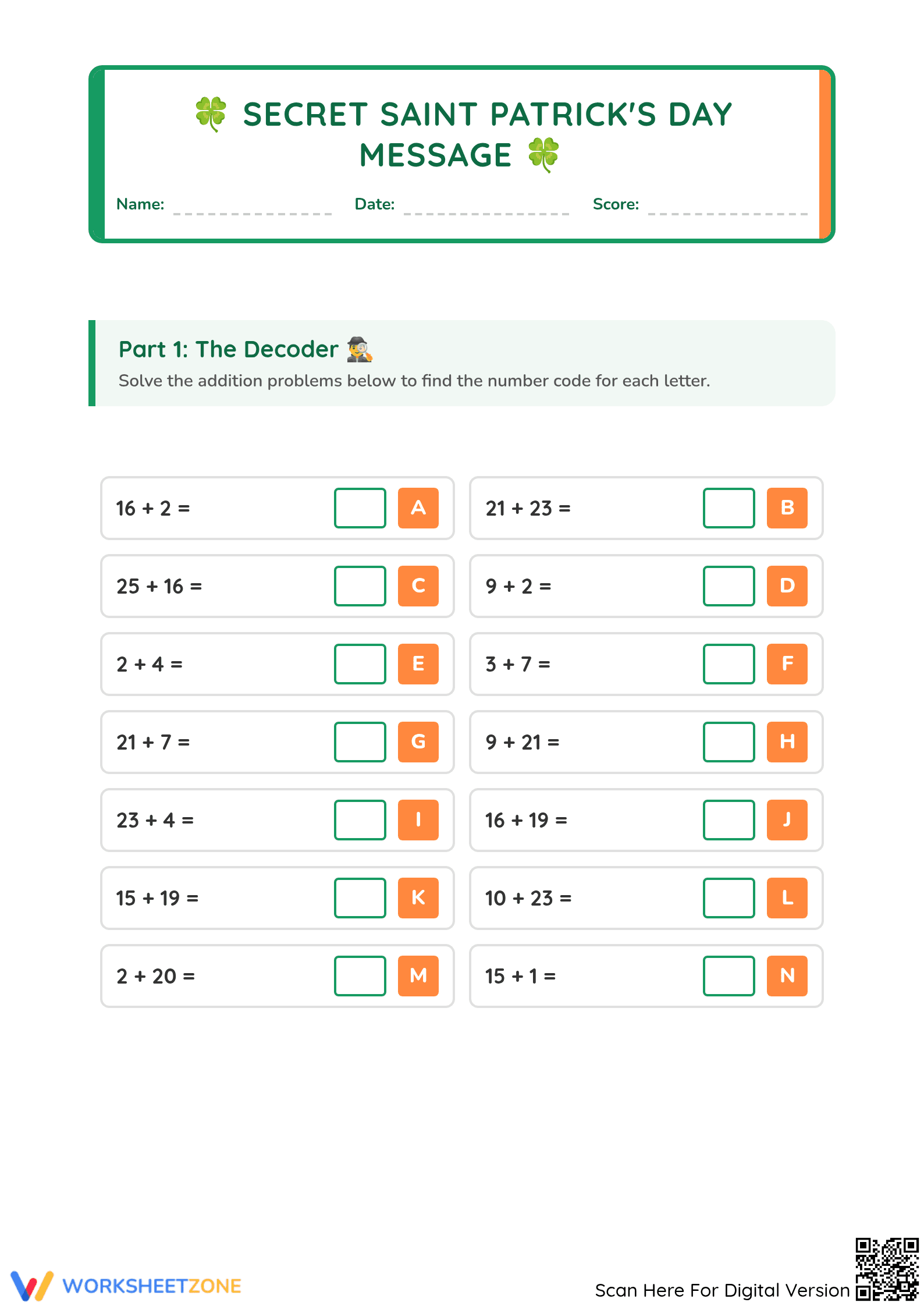
Bring holiday magic to math class with this engaging St. Patrick's Day secret message decoder. Students practice addition fluency within 100 to discover a festive hidden greeting. This activity transforms routine computation into an exciting puzzle-solving mission, ensuring high engagement while reinforcing critical arithmetic skills. It is the perfect blend of seasonal fun and rigorous academic practice.
At a Glance
- Grade: 1–2 · Subject: Math
- Standard:
CCSS.MATH.CONTENT.2.NBT.B.5— Fluently add within 100 using strategies based on place value- Skill Focus: Multi-digit addition and decoding
- Format: 3 pages · 33 problems · Answer key included · PDF
- Best For: Holiday centers and early finishers
- Time: 20–30 minutes
What's Inside
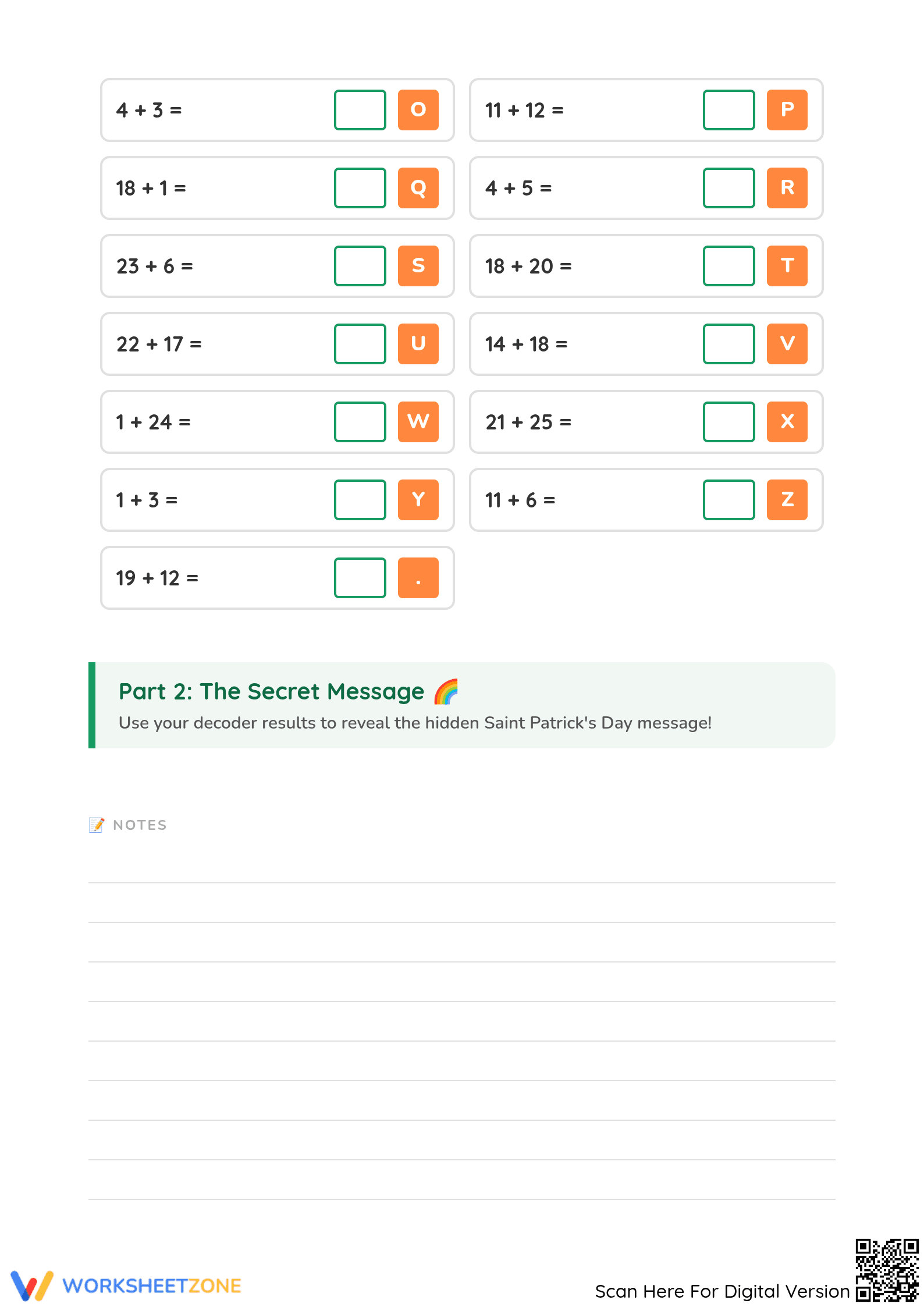
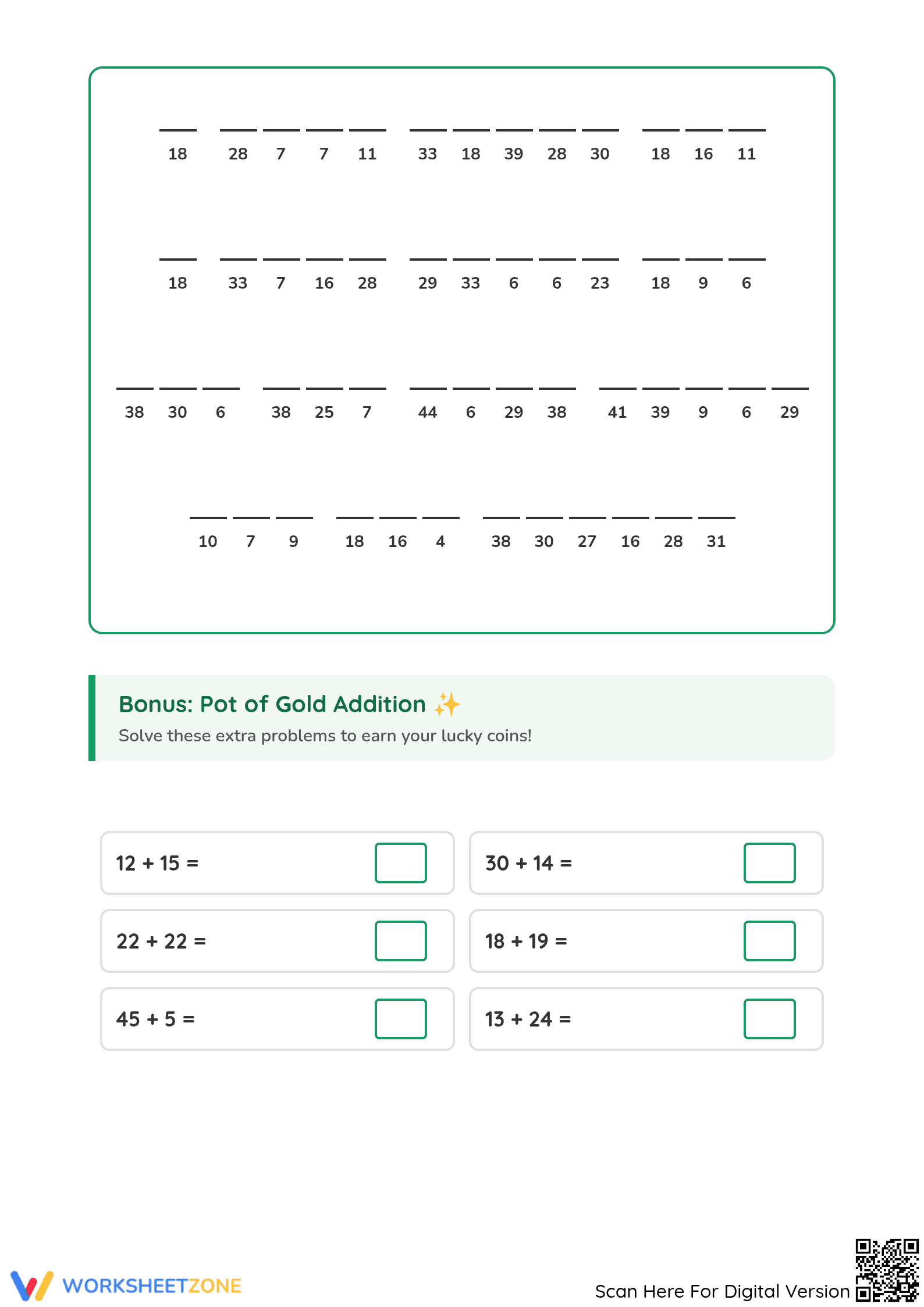
This three-page PDF features a multi-step learning journey. "The Decoder" presents 27 core addition problems where students solve for sums that correspond to letters. "The Secret Message" section allows students to map results to reveal a festive holiday phrase. A "Bonus" section offers six additional challenge problems to extend the learning and reward student persistence with lucky coins.
Zero-Prep Workflow
This worksheet is designed for immediate classroom implementation with under two minutes of prep. First, print the three-page set (30 seconds). Second, distribute the packets; the instructions are self-explanatory, requiring zero verbal setup (30 seconds). Finally, use the answer key for rapid grading or have students self-check their work (1 minute). This streamlined process is ideal for busy teachers and substitute situations.
Standards Alignment
The primary focus is CCSS.MATH.CONTENT.2.NBT.B.5, requiring students to fluently add within 100 using strategies based on place value. The worksheet also supports CCSS.MATH.CONTENT.1.NBT.C.4. Both standard codes can be copied directly into lesson plans, IEP goals, or district curriculum mapping tools, ensuring that holiday fun remains grounded in core educational requirements.
How to Use It
This resource excels as a festive math center activity. Place the packets in a station where students work independently to crack the code. It also serves as an excellent sub-plan filler; because the instructions are visual, students can remain productive with minimal guidance. Monitor students as they work to observe their strategies for two-digit addition, noting who relies on finger counting versus place value decomposition.
Who It's For
Tailored for Grade 1 and 2, this worksheet offers natural differentiation through its game-like structure. The bonus section provides an extension for advanced learners, while the decoding aspect motivates students who struggle with traditional drills. It pairs perfectly with holiday read-alouds or lessons on two-digit addition. The festive theme makes it a high-interest choice for morning work or rainy-day recess alternatives.
Integrating puzzles into mathematics instruction is a proven strategy for increasing student persistence and reducing math anxiety. According to research by Fisher & Frey (2014), the "gradual release of responsibility" model is most effective when combined with high-interest, independent application tasks like this secret message decoder. By aligning with CCSS.MATH.CONTENT.2.NBT.B.5, this resource ensures that the festive theme does not detract from the core requirement of addition fluency within 100. The multi-step nature of the task—solving the problem, locating the letter, and transcribing the message—builds cognitive endurance and attention to detail. Educators can confidently implement this tool knowing it bridges the gap between seasonal engagement and standard-aligned mastery. This worksheet provides the structured practice necessary for students to move from concrete modeling to abstract numerical fluency in a low-stakes, highly rewarding format.


