


























Views
Downloads
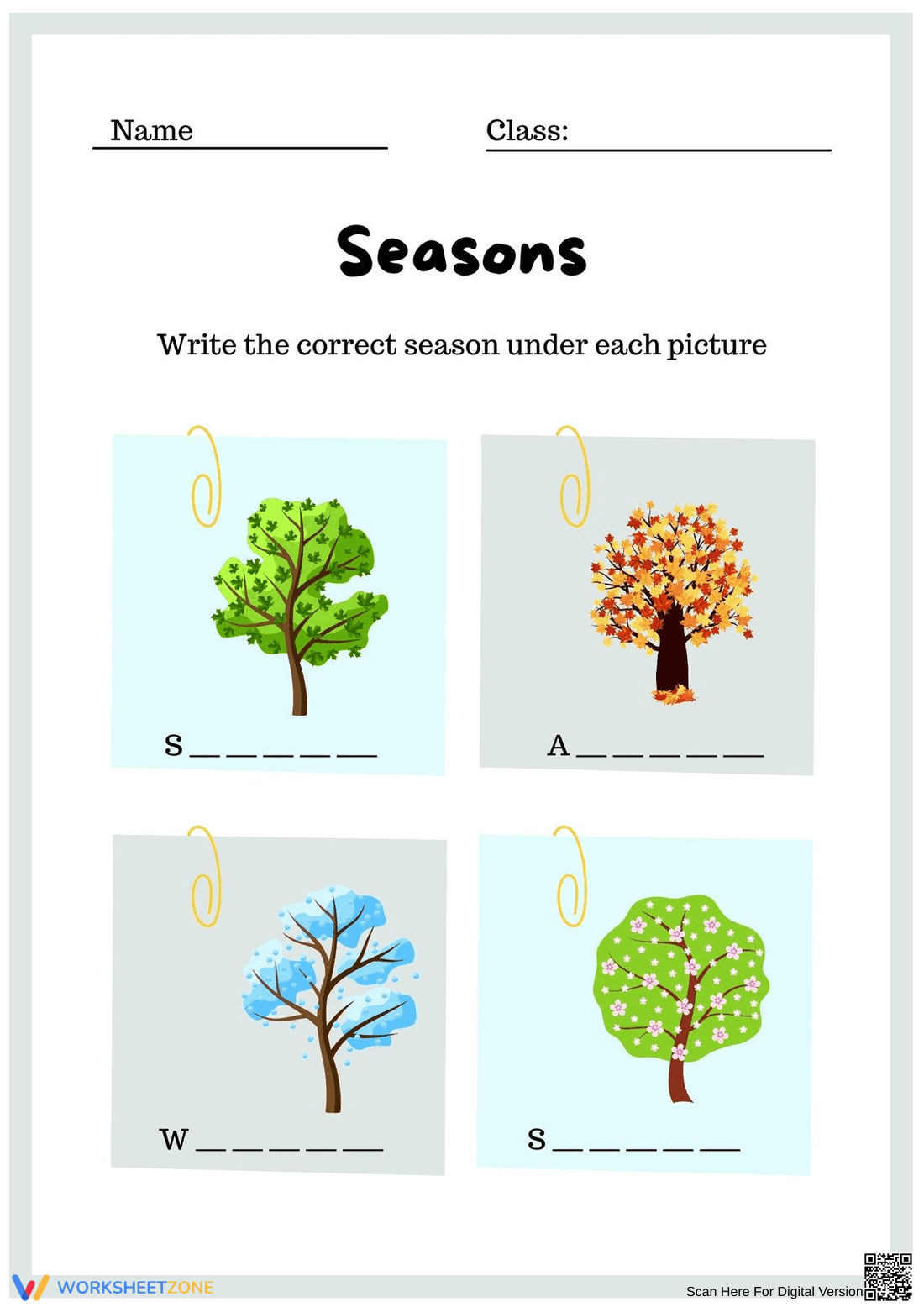

Grade 1 Seasons Vocabulary — Printable No-Prep Worksheet
Paste this activity's link or code into your existing LMS (Google Classroom, Canvas, Teams, Schoology, Moodle, etc.).
Students can open and work on the activity right away, with no student login required.
You'll still be able to track student progress and results from your teacher account.
This Grade 1 ELA worksheet helps students master essential seasons vocabulary by matching words to visual representations. By identifying the four seasons based on tree illustrations and initial letter clues, young learners build foundational spelling and word recognition skills necessary for reading comprehension and environmental awareness.
At a Glance
- Grade: 1 · Subject: ELA
- Standard:
CCSS.ELA-LITERACY.L.1.4— Determine the meaning of unknown words- Skill Focus: Seasons Vocabulary
- Format: 1 page · 4 problems · Answer key included · PDF
- Best For: Independent practice and EFL
- Time: 5–10 minutes
Inside this single-page resource, educators will find a straightforward vocabulary exercise featuring four distinct tree illustrations representing spring, summer, autumn, and winter. Each image is accompanied by a fill-in-the-blank spelling task that provides the first letter of the season as a helpful scaffold. A complete answer key is included to ensure quick grading and immediate feedback for students.
Zero-Prep Workflow
- Print (1 minute): Simply download the PDF and print the required number of copies. The clear design ensures crisp reproduction.
- Distribute (1 minute): Hand out the worksheets during morning work, literacy centers, or as a quick transition activity.
- Review (3 minutes): Go over the answers as a class, allowing students to self-correct and discuss the visual clues they used to identify each season.
Total teacher prep time is under two minutes, making this an ideal, self-explanatory resource for emergency sub plans or last-minute schedule changes.
Standards Alignment
This resource is aligned to CCSS.ELA-LITERACY.L.1.4, requiring students to determine or clarify the meaning of unknown words and phrases based on grade 1 reading and content. It also supports cross-curricular connections with early science standards regarding seasonal changes. Both standard codes can be copied directly into lesson plans, IEP goals, or district curriculum mapping tools.
How to Use It
Teachers can deploy this worksheet as a formative assessment after a direct instruction lesson on the four seasons. It serves perfectly as an independent literacy center activity where students practice spelling and vocabulary recall. Alternatively, use it as a morning bell-ringer to activate prior knowledge before reading a seasonal picture book. While students work, observe whether they rely on the initial letter scaffolds or the visual tree clues to complete the words. Expected completion time is a brief five to ten minutes.
Who It's For
This worksheet is designed for Grade 1 students, kindergarteners needing enrichment, and beginner EFL/ESL learners acquiring foundational English vocabulary. The visual scaffolds make it highly accessible for English Language Learners and students requiring modified spelling tasks. It pairs naturally with a classroom anchor chart detailing the months of the year and seasonal weather patterns.
Mastering foundational vocabulary such as the four seasons is a critical step in early childhood literacy and language acquisition. Aligned with CCSS.ELA-LITERACY.L.1.4, this resource helps students determine the meaning of unknown words through visual context clues. According to Fisher & Frey (2014), providing structured vocabulary practice with clear visual scaffolds significantly improves word retention and reading comprehension in early elementary and EFL settings. By connecting the abstract concepts of spring, summer, autumn, and winter to concrete visual representations of trees, educators can effectively bridge the gap between spoken language and written text. This targeted practice ensures that young learners build the necessary schema to understand seasonal changes in both literary texts and real-world environments, fostering long-term academic success and building confidence in independent spelling tasks.


