


























Views
Downloads
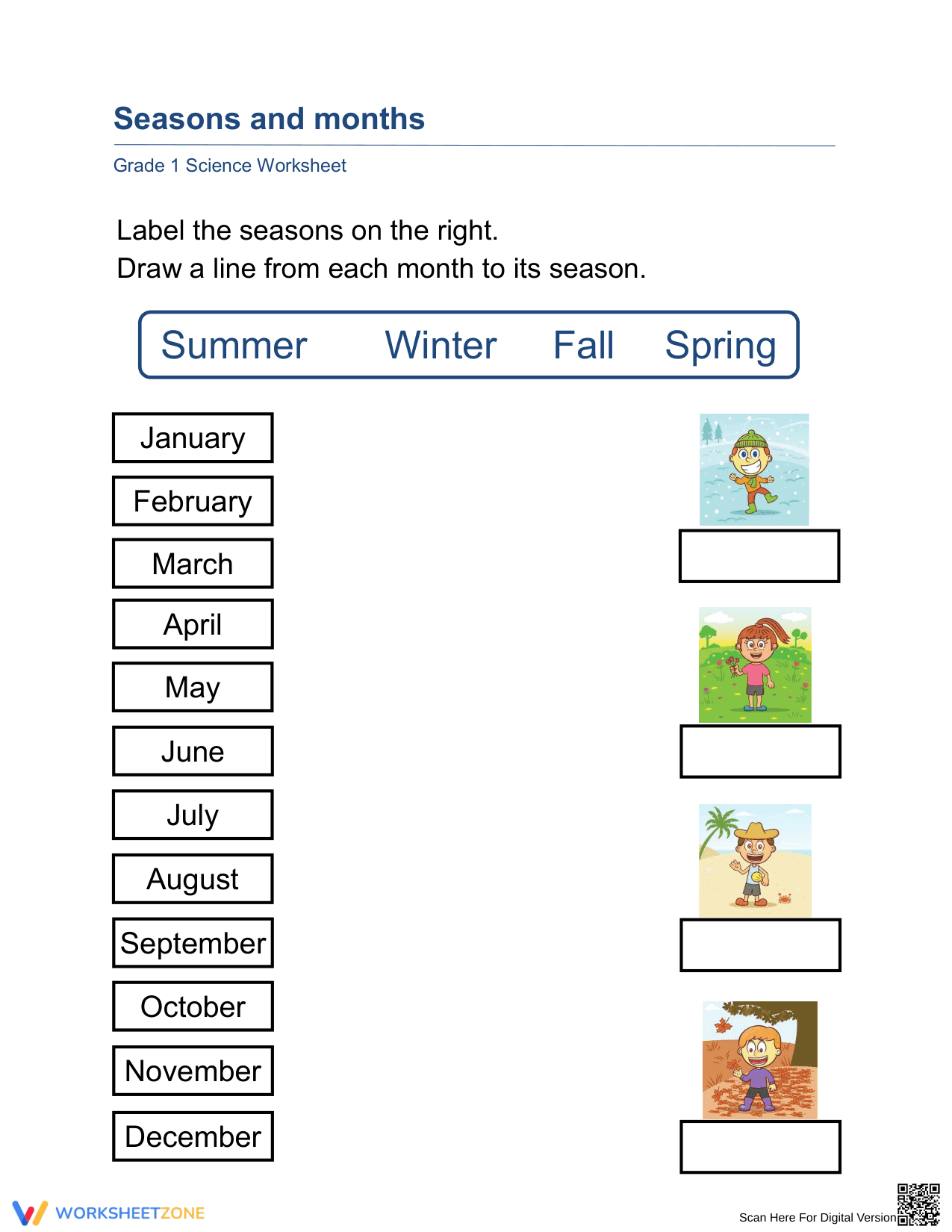


Essential Grade 1 Seasons and Months Matching Worksheet
Paste this activity's link or code into your existing LMS (Google Classroom, Canvas, Teams, Schoology, Moodle, etc.).
Students can open and work on the activity right away, with no student login required.
You'll still be able to track student progress and results from your teacher account.
This seasons and months worksheet helps first-grade students master the temporal patterns of the year through visual association and categorization. By identifying the four distinct seasons and correctly linking each of the twelve months, learners build a foundational understanding of Earth's cyclical changes. This resource provides immediate clarity for students exploring how time and weather intersect.
At a Glance
- Grade: 1 · Subject: Science
- Standard:
K-ESS2-1— Use observations of weather to describe patterns over time- Skill Focus: Seasonal Chronology and Month Identification
- Format: 2 pages · 16 problems · Answer key included · PDF
- Best For: Independent science centers and weather units
- Time: 10–15 minutes
This resource contains a single-page student activity and a comprehensive answer key. The worksheet features two distinct task types: a labeling section where students identify four seasonal illustrations and a matching column where they draw lines connecting each month name to its corresponding season. The layout uses high-contrast text and clear, engaging clip art to support early readers and visual learners as they navigate the calendar year.
Implement this activity using a simple three-step workflow. First, print the single-sided student page in under 30 seconds. Second, distribute the worksheets for independent practice or a quick morning warm-up activity, taking approximately 1 minute. Finally, use the included answer key to review responses as a whole class or for rapid individual grading in less than 2 minutes. The total teacher preparation time remains under two minutes, making it ideal for substitute plans or last-minute lesson extensions.
The primary alignment for this resource is `K-ESS2-1`, which requires students to use and share observations of local weather conditions to describe patterns over time. Understanding which months belong to specific seasons is a critical prerequisite for observing these weather patterns throughout the school year. This standard code can be copied directly into lesson plans, IEP goals, or district curriculum mapping tools for easy documentation.
This worksheet serves as an excellent formative assessment during a unit on weather and climate. Assign it after a direct instruction lesson on Earth's rotation and seasonal changes to check for student comprehension. For a collaborative approach, have students work in pairs to discuss their observations of the current month's weather before completing the matching task. Observe whether students can identify transition months like March or September to gauge their nuanced understanding of seasonal shifts.
Designed specifically for Grade 1 students, this activity is also highly effective for Kindergarten learners and Preschoolers with teacher support. The visual cues help English Language Learners (ELL) connect new vocabulary to familiar environmental concepts. It pairs naturally with a classroom calendar or a seasonal weather chart used during daily morning meetings to reinforce the relationship between dates and the environment.
Research by Fisher & Frey (2014) emphasizes the importance of visual scaffolding in early childhood science education to bridge the gap between abstract time concepts and concrete observations. Identifying patterns in the natural world, such as the relationship between months and seasons specified in standard `K-ESS2-1`, provides the cognitive framework necessary for later scientific inquiry. According to NAEP data, students who master foundational Earth science concepts through structured practice demonstrate higher proficiency in complex environmental analysis in later grades. This worksheet utilizes evidence-based matching and labeling techniques to reinforce the retention of chronological sequences. By integrating seasonal imagery with text-based month names, the resource supports dual-coding theory, enhancing memory retrieval of the 16 specific tasks included.


