


























Views
Plays


Grade 7 Scientific Revolution — Printable No-Prep Worksheet
Paste this activity's link or code into your existing LMS (Google Classroom, Canvas, Teams, Schoology, Moodle, etc.).
Students can open and work on the activity right away, with no student login required.
You'll still be able to track student progress and results from your teacher account.
This middle school history and science worksheet evaluates student understanding of the Scientific Revolution. By completing this assessment, students demonstrate their knowledge of pivotal historical figures, paradigm-shifting theories, and foundational scientific methods. The straightforward format ensures educators can quickly measure comprehension of these critical historical concepts.
At a Glance
- Grade: 7 · Subject: History
- Standard:
CCSS.ELA-LITERACY.RH.6-8.4— Determine the meaning of domain-specific historical words- Skill Focus: Scientific Revolution concepts
- Format: 2 pages · 10 problems · Answer key included · PDF
- Best For: Formative assessment or review
- Time: 15–20 minutes
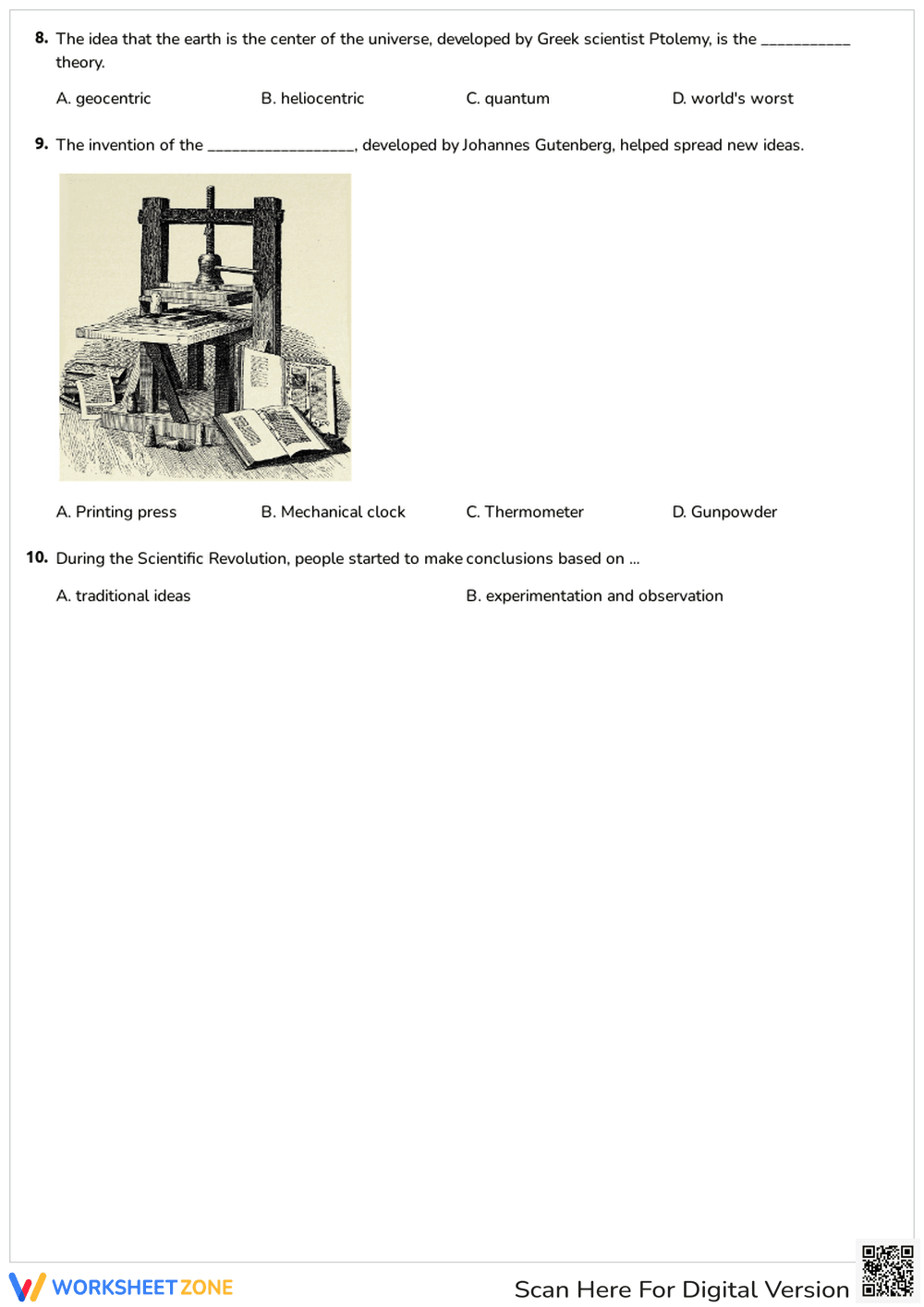
This resource features a two-page, ten-question multiple-choice quiz focused on the Scientific Revolution. The assessment covers essential vocabulary and historical milestones, including the heliocentric and geocentric theories, the steps of the scientific method, and the contributions of key figures like Isaac Newton, Galileo Galilei, and Johannes Kepler. Visual aids, such as diagrams of the solar system and the printing press, are integrated into specific questions to support visual learners. A complete answer key is provided for rapid grading.
Designed for immediate use, this resource requires minimal preparation:
- Print (1 minute): Print the two-page PDF.
- Distribute (1 minute): Hand out the assessment as a warm-up or quiz.
- Review (3 minutes): Use the answer key to quickly score the ten questions.
With prep time under two minutes, this is an excellent addition to any sub plan.
This assessment is aligned to CCSS.ELA-LITERACY.RH.6-8.4: Determine the meaning of words and phrases as they are used in a text, including vocabulary specific to domains related to history/social studies. It reinforces student recognition of critical academic vocabulary such as "heliocentric," "hypothesis," and "scientific method." Both standard codes can be copied directly into lesson plans, IEP goals, or district curriculum mapping tools.
End-of-Unit Assessment: Deploy this ten-question quiz after direct instruction to measure retention of key figures and theories. The multiple-choice format allows for quick data collection.
Substitute Teacher Activity: Because it requires no background setup, this worksheet is ideal for a sub plan. Students can complete the assignment independently in 15 to 20 minutes. As a formative assessment tip, observe which questions students miss most frequently—such as confusing Kepler's discoveries with Copernicus's—to guide your reteaching efforts the following day.
This resource is optimized for sixth, seventh, and eighth-grade students in middle school history or science courses. The clear, multiple-choice structure provides built-in scaffolding for students who struggle with open-ended recall, making it accessible for diverse learners. It pairs perfectly with a primary source reading activity on Galileo's trial or a hands-on lab introducing the scientific method.
Integrating targeted vocabulary and concept assessments into middle school history curricula significantly improves long-term retention of complex historical paradigms. According to Fisher & Frey (2014), structured opportunities to retrieve and apply domain-specific terminology enhance overall reading comprehension and critical thinking in the content areas. This specific resource supports that pedagogical framework by requiring students to actively recall and differentiate between critical concepts of the era, rather than passively consuming information. By aligning directly with CCSS.ELA-LITERACY.RH.6-8.4 to determine the meaning of domain-specific historical words, the assessment ensures students are understanding the foundational shifts in scientific thought. Regular use of brief, focused multiple-choice quizzes like this one provides educators with immediate, actionable data to adjust their instruction, ultimately fostering a deeper, more resilient understanding of how historical events and figures continue to shape modern scientific inquiry.


