


























Views
Plays




Grade 8 Scientific Revolution — Printable No-Prep Worksheet
Paste this activity's link or code into your existing LMS (Google Classroom, Canvas, Teams, Schoology, Moodle, etc.).
Students can open and work on the activity right away, with no student login required.
You'll still be able to track student progress and results from your teacher account.
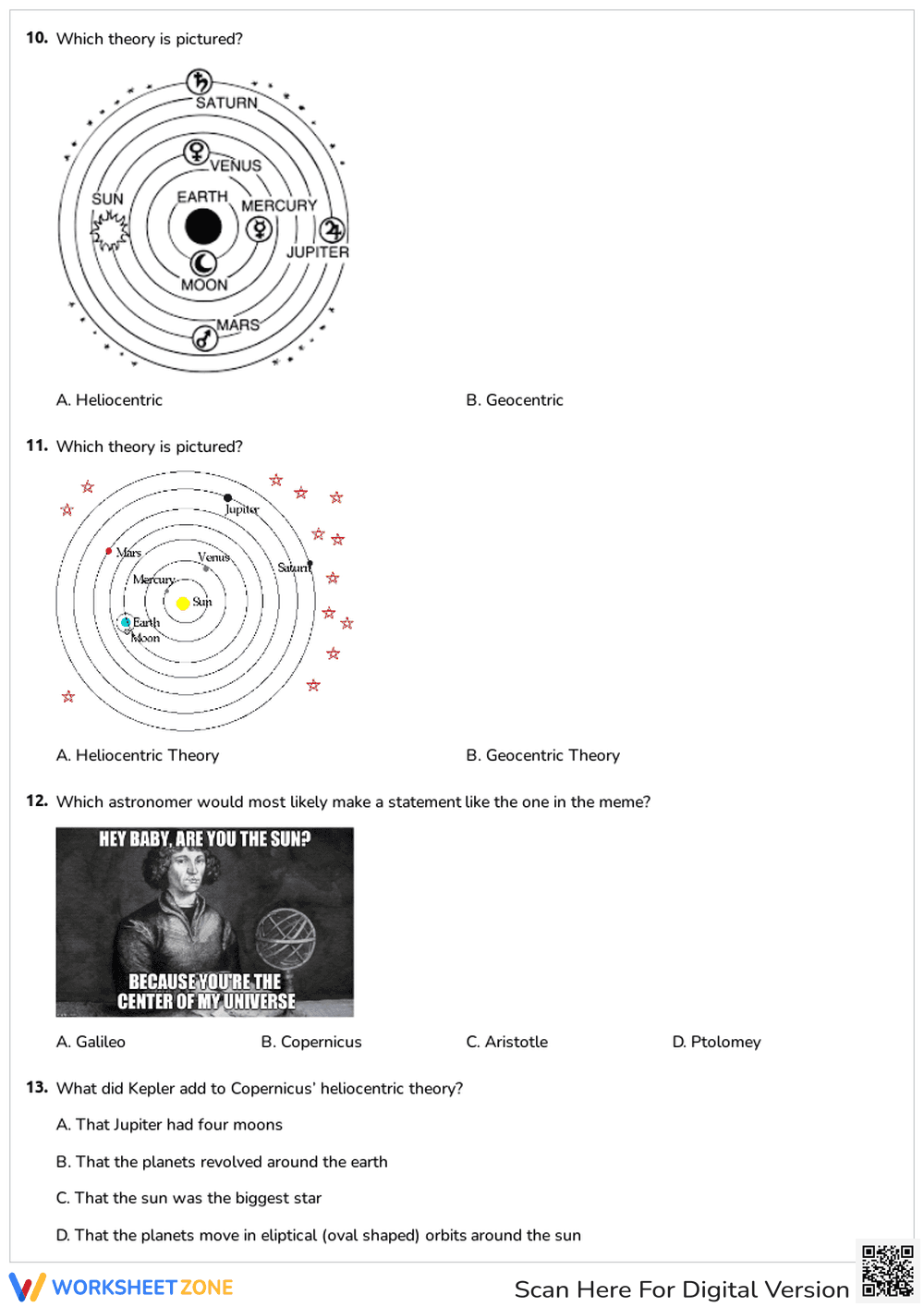
This Grade 8 history worksheet evaluates student comprehension of the Scientific Revolution and the Age of Discovery. Students will identify key historical figures, differentiate between geocentric and heliocentric theories, and demonstrate their understanding of the scientific method's origins to solidify their grasp of this transformative era.
At a Glance
- Grade: 8 · Subject: History
- Standard:
CCSS.ELA-LITERACY.RH.8.4— Determine the meaning of domain-specific historical vocabulary- Skill Focus: Scientific Revolution and Age of Discovery
- Format: 4 pages · 22 problems · Answer key included · PDF
- Best For: End-of-unit assessment or review
- Time: 25–35 minutes
Inside this resource, educators will find a 22-question multiple-choice assessment spanning four pages. The questions cover the contributions of Galileo, Copernicus, and Newton, alongside the societal impacts of shifting to empirical observation. Visual aids, including diagrams of planetary orbits, are integrated to engage learners. A complete answer key is provided for efficient grading.
This resource is designed for immediate classroom implementation with a streamlined zero-prep workflow:
- Print (1 minute): Download the PDF and print the assessment.
- Distribute (1 minute): Hand out the worksheets to students.
- Review (3 minutes): Use the included answer key to quickly grade the 22 questions.
With minimal teacher prep time required, this worksheet is an excellent option for emergency sub plans.
This worksheet is aligned to CCSS.ELA-LITERACY.RH.8.4, requiring students to determine the meaning of words and phrases as they are used in a text, including vocabulary specific to domains related to history and social studies. By engaging with terms like "heliocentric," "inductive reasoning," and "scientific method," students build crucial academic language. Both standard codes can be copied directly into lesson plans, IEP goals, or district curriculum mapping tools.
This worksheet serves perfectly as a summative assessment after completing a unit on the Scientific Revolution. Alternatively, it can be used as an independent study guide or homework assignment. As a formative assessment observation tip, teachers can monitor which specific questions cause the most hesitation, indicating areas that require reteaching. Students should complete the 22 questions within a 25 to 35-minute timeframe.
Designed for 8th-grade history students, this resource is also effective for 7th and 9th-grade classrooms. The multiple-choice format provides built-in scaffolding for students who struggle with open-ended writing tasks. Pair this assessment with a primary source reading on Galileo's trial or an anchor chart detailing the scientific method.
Integrating structured vocabulary and concept assessments is vital for historical literacy. Aligned with CCSS.ELA-LITERACY.RH.8.4 to determine the meaning of domain-specific historical vocabulary, this resource ensures students can accurately identify and apply terms essential to the Scientific Revolution. According to Fisher & Frey (2014), providing students with clear, targeted opportunities to interact with academic vocabulary significantly increases their reading comprehension and content retention in the social sciences. By testing knowledge of figures like Copernicus and concepts like the heliocentric theory through varied multiple-choice formats, educators can reliably measure student understanding. This assessment not only reinforces historical facts but also strengthens the critical thinking skills necessary for analyzing how scientific advancements impact society. Utilizing such targeted evaluations supports robust instructional planning and helps identify specific areas where students may need additional academic support.


