


























0
Views
0
Downloads

0.0
0
Save
0 Likes
Share
Scientific Method: A Detailed Guide
0 Views
0 Downloads
Paste this activity's link or code into your existing LMS (Google Classroom, Canvas, Teams, Schoology, Moodle, etc.).
Students can open and work on the activity right away, with no student login required.
You'll still be able to track student progress and results from your teacher account.
Information
Description
What It Is:
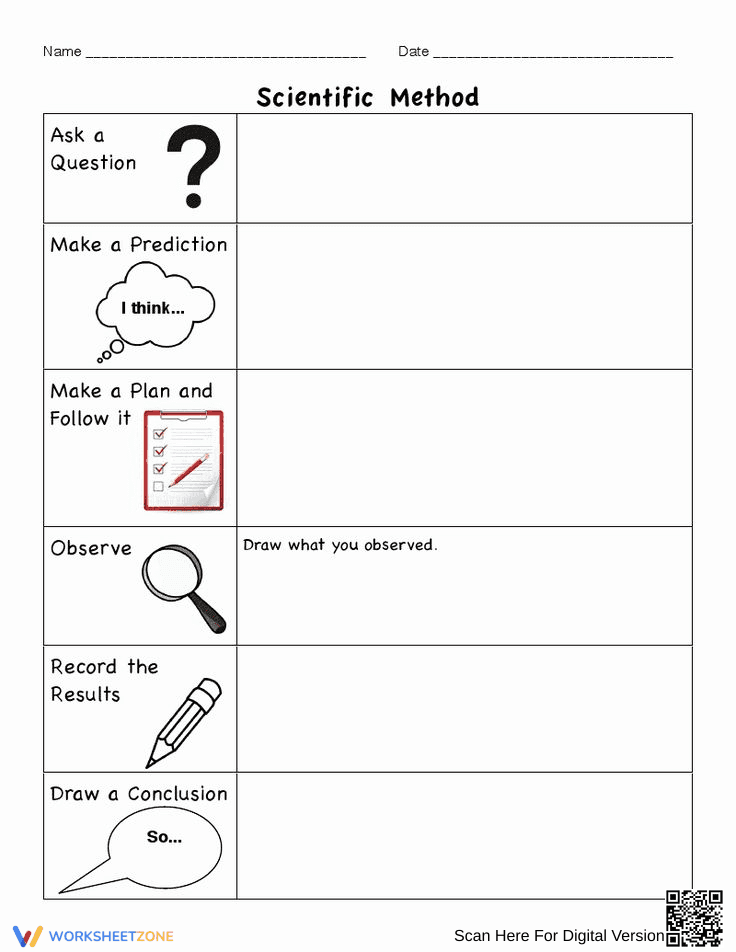
This is a worksheet designed to guide students through the scientific method. It includes sections for asking a question, making a prediction (with a thought bubble prompt 'I think...'), making a plan and following it (with a checklist graphic), observing (with space to draw observations and a magnifying glass graphic), recording the results (with a pencil graphic), and drawing a conclusion (with a speech bubble prompt 'So...'). Each step is presented in a separate box with space for students to write or draw their responses.
Grade Level Suitability:
This worksheet is suitable for grades 2-5. The simple language and visual prompts make it accessible for younger students, while the structured format helps older elementary students organize their thoughts and follow the scientific method.
Why Use It:
This worksheet provides a visual and structured way for students to learn and apply the scientific method. It encourages critical thinking, observation skills, and data recording. The prompts help students formulate their ideas and conclusions.
How to Use It:
Begin by having students identify a question they want to investigate. Guide them to make a prediction about the outcome. Help them create a plan for their experiment and follow it carefully. Encourage them to draw what they observe during the experiment. Have them record their results and then draw a conclusion based on their findings.
Target Users:
This worksheet is ideal for elementary school teachers, homeschool parents, and students learning about the scientific method. It is also beneficial for students who need visual aids and structured activities to support their learning.
This is a worksheet designed to guide students through the scientific method. It includes sections for asking a question, making a prediction (with a thought bubble prompt 'I think...'), making a plan and following it (with a checklist graphic), observing (with space to draw observations and a magnifying glass graphic), recording the results (with a pencil graphic), and drawing a conclusion (with a speech bubble prompt 'So...'). Each step is presented in a separate box with space for students to write or draw their responses.
Grade Level Suitability:
This worksheet is suitable for grades 2-5. The simple language and visual prompts make it accessible for younger students, while the structured format helps older elementary students organize their thoughts and follow the scientific method.
Why Use It:
This worksheet provides a visual and structured way for students to learn and apply the scientific method. It encourages critical thinking, observation skills, and data recording. The prompts help students formulate their ideas and conclusions.
How to Use It:
Begin by having students identify a question they want to investigate. Guide them to make a prediction about the outcome. Help them create a plan for their experiment and follow it carefully. Encourage them to draw what they observe during the experiment. Have them record their results and then draw a conclusion based on their findings.
Target Users:
This worksheet is ideal for elementary school teachers, homeschool parents, and students learning about the scientific method. It is also beneficial for students who need visual aids and structured activities to support their learning.


