


























Views
Downloads

Grade K Counting — Printable No-Prep Worksheet
Paste this activity's link or code into your existing LMS (Google Classroom, Canvas, Teams, Schoology, Moodle, etc.).
Students can open and work on the activity right away, with no student login required.
You'll still be able to track student progress and results from your teacher account.
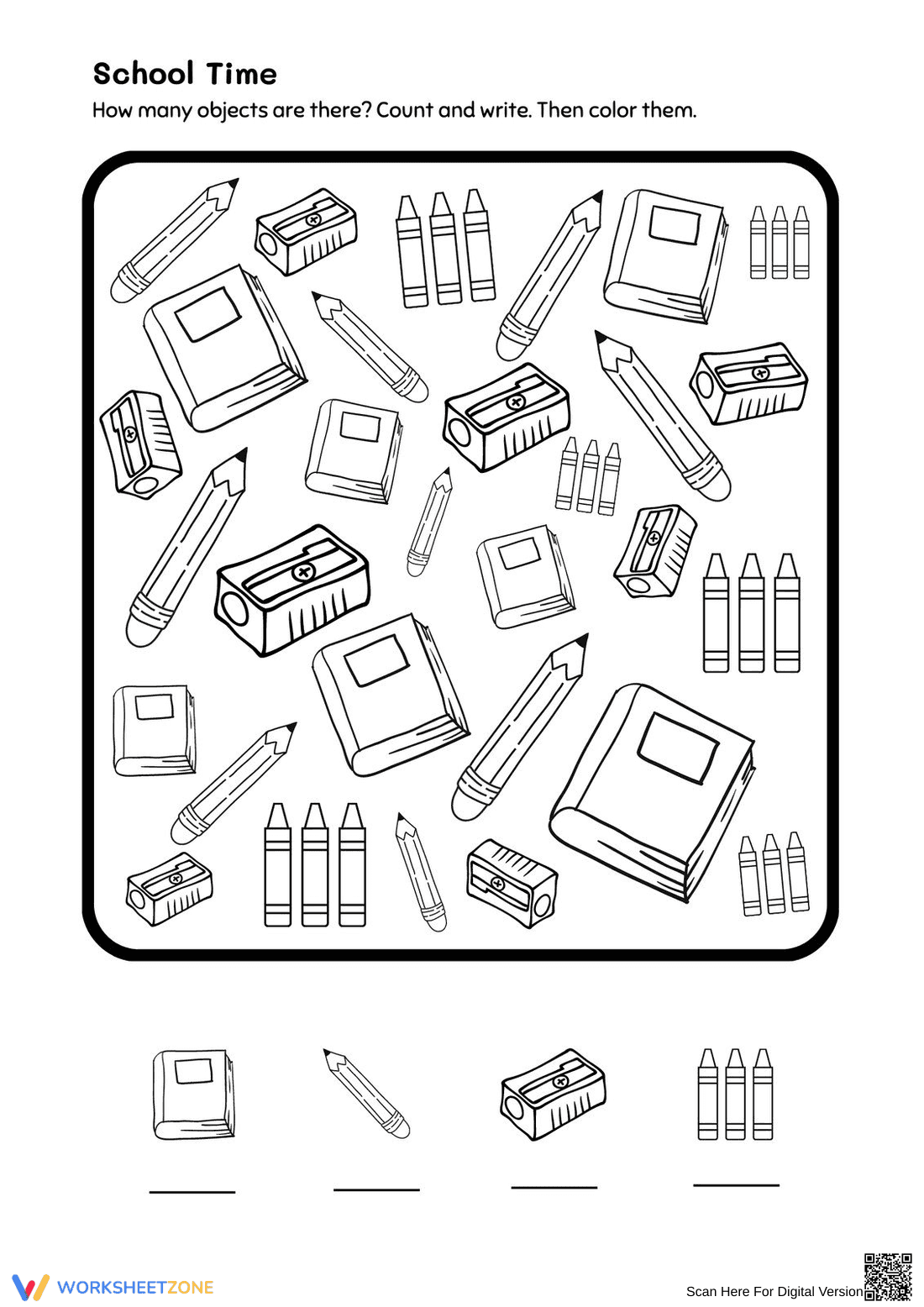
This Kindergarten math worksheet provides young learners with engaging practice in counting scattered objects and writing numbers. By finding specific school supplies in a mixed group, students develop foundational cardinality skills and visual discrimination. The coloring element adds a fun fine-motor component to early math practice.
At a Glance
- Grade: K · Subject: Math
- Standard:
CCSS.MATH.CONTENT.K.CC.B.5— Count up to 10 scattered objects- Skill Focus: Counting and writing numbers
- Format: 1 page · 4 problems · No answer key · PDF
- Best For: Morning work or math centers
- Time: 10–15 minutes
This single-page resource features a scattered assortment of familiar school supplies, including books, pencils, sharpeners, and crayons. Students are presented with four task lines prompting them to locate a specific item, count the total quantity, and write the corresponding numeral. The line art format encourages students to color objects as they count, serving as a helpful tracking strategy to prevent double-counting.
Zero-Prep Workflow
This resource is designed for immediate classroom implementation with no teacher preparation required.
- Print (1 minute): Download the PDF and print a class set. The design is highly ink-efficient.
- Distribute (1 minute): Hand out pages with pencils and crayons. Visual instructions are intuitive.
- Review (2 minutes): Quickly check student work by verifying the four written numerals.
With a total prep time under two minutes, this activity is an excellent addition to any sub plan.
Standards Alignment
This activity is directly aligned to primary standard CCSS.MATH.CONTENT.K.CC.B.5, which requires students to count to answer "how many?" questions about as many as 10 things in a scattered configuration. It also supports early number writing skills as students record their final counts. Both standard codes can be copied directly into lesson plans, IEP goals, or district curriculum mapping tools.
How to Use It
This worksheet serves as an excellent independent practice activity during morning arrival or math centers. Teachers can use it after direct instruction on counting strategies, such as crossing out items as they are counted. As a formative assessment observation tip, watch if students use a systematic approach to track items, or if they randomly scan. Expected completion time ranges from 10 to 15 minutes.
Who It's For
This resource is designed for Kindergarten students mastering one-to-one correspondence. It is also appropriate for Pre-K students ready for a challenge, or first-graders needing review. To differentiate for students who struggle with visual tracking, provide physical manipulatives to place over objects before counting. This pairs perfectly with a back-to-school read-aloud or a lesson on sorting objects.
Mastering early counting skills requires repeated, contextual practice with varied visual arrangements. According to a recent EdReports 2024 analysis of early childhood mathematics curricula, students who engage with scattered configurations develop significantly stronger spatial reasoning and cardinality concepts than those who only count linear arrays. This worksheet directly addresses CCSS.MATH.CONTENT.K.CC.B.5 by asking students to count up to 10 scattered objects within a busy visual field. By integrating a coloring component, the activity also supports fine motor development while providing a natural, tactile strategy for tracking counted items. Early intervention in one-to-one correspondence is a critical predictor of future mathematical fluency. Providing targeted, visually engaging tasks like this school supply counting activity ensures that young learners build the necessary cognitive frameworks to succeed in subsequent algebraic reasoning and complex problem-solving tasks.


