


























Views
Downloads

Printable Adding to 10 Worksheet | Grade K-1 Math
Paste this activity's link or code into your existing LMS (Google Classroom, Canvas, Teams, Schoology, Moodle, etc.).
Students can open and work on the activity right away, with no student login required.
You'll still be able to track student progress and results from your teacher account.
Build foundational math fluency with this focused addition worksheet designed to help early learners master sums up to 10. By combining numerical practice with a structured color-coding system, students develop the speed and accuracy necessary for mental math while staying engaged through a hands-on task. This printable resource ensures that learners internalize number relationships effectively through repeated, purposeful practice.
At a Glance
- Grade: Kindergarten–1 · Subject: Math
- Standard:
CCSS.K.OA.A.2— Solve addition word problems, and add and subtract within 10- Skill Focus: Addition sums to 10
- Format: 2 pages · 32 problems · Answer key included · PDF
- Best For: Independent math centers and daily fluency practice
- Time: 15–20 minutes
What's Inside
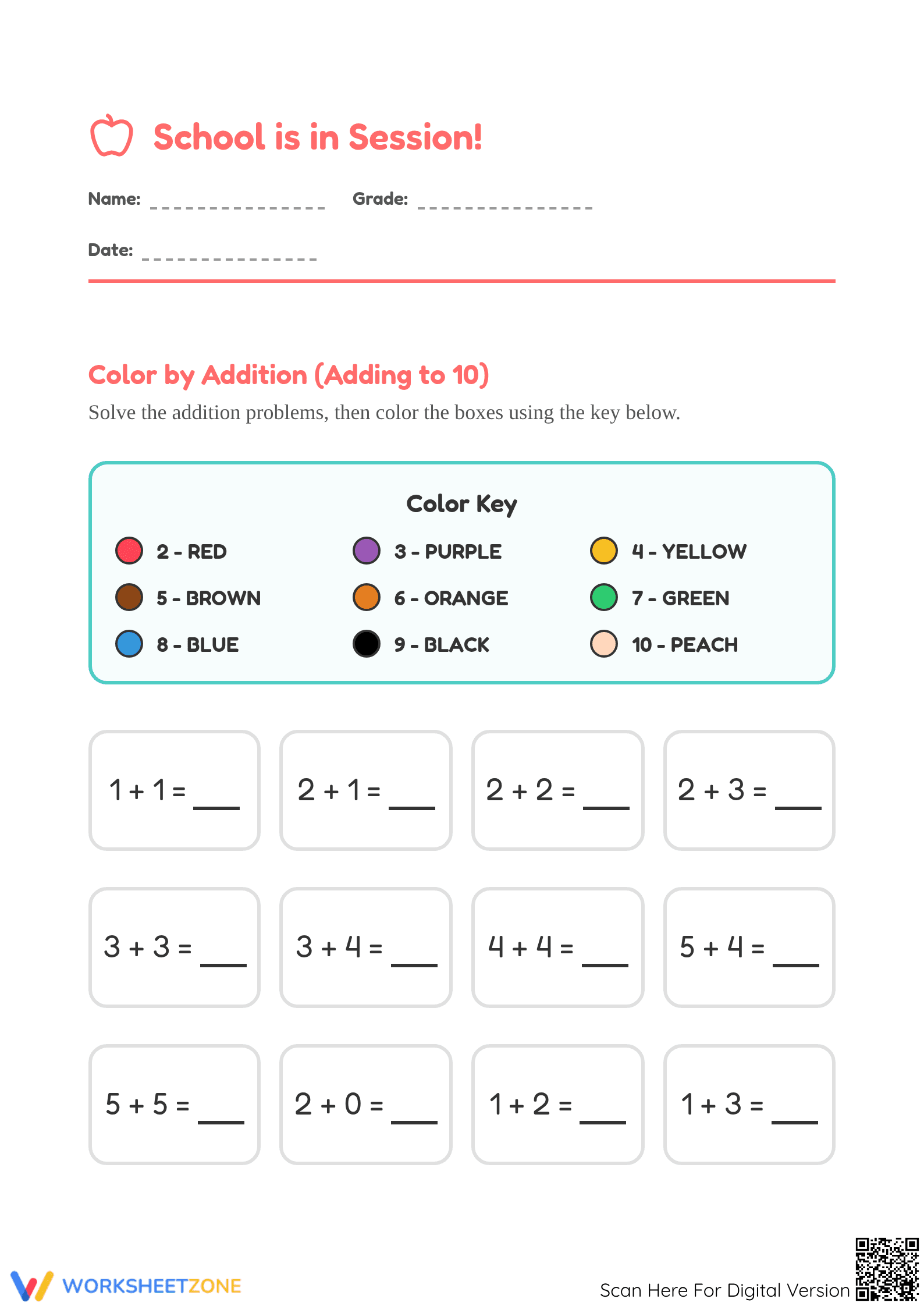
This two-page instructional packet features 32 vertical addition problems, each presented in a clear, accessible box. The first page includes a comprehensive color key that assigns specific hues to sums ranging from 2 to 10, allowing students to verify their calculations visually. A complete answer key is provided to facilitate rapid grading or student self-correction, making it a versatile tool for various classroom settings.
Skill Progression
- Guided Practice: The first 12 problems introduce standard addition pairs with a clear color-key reference to scaffold the relationship between numbers and their sums.
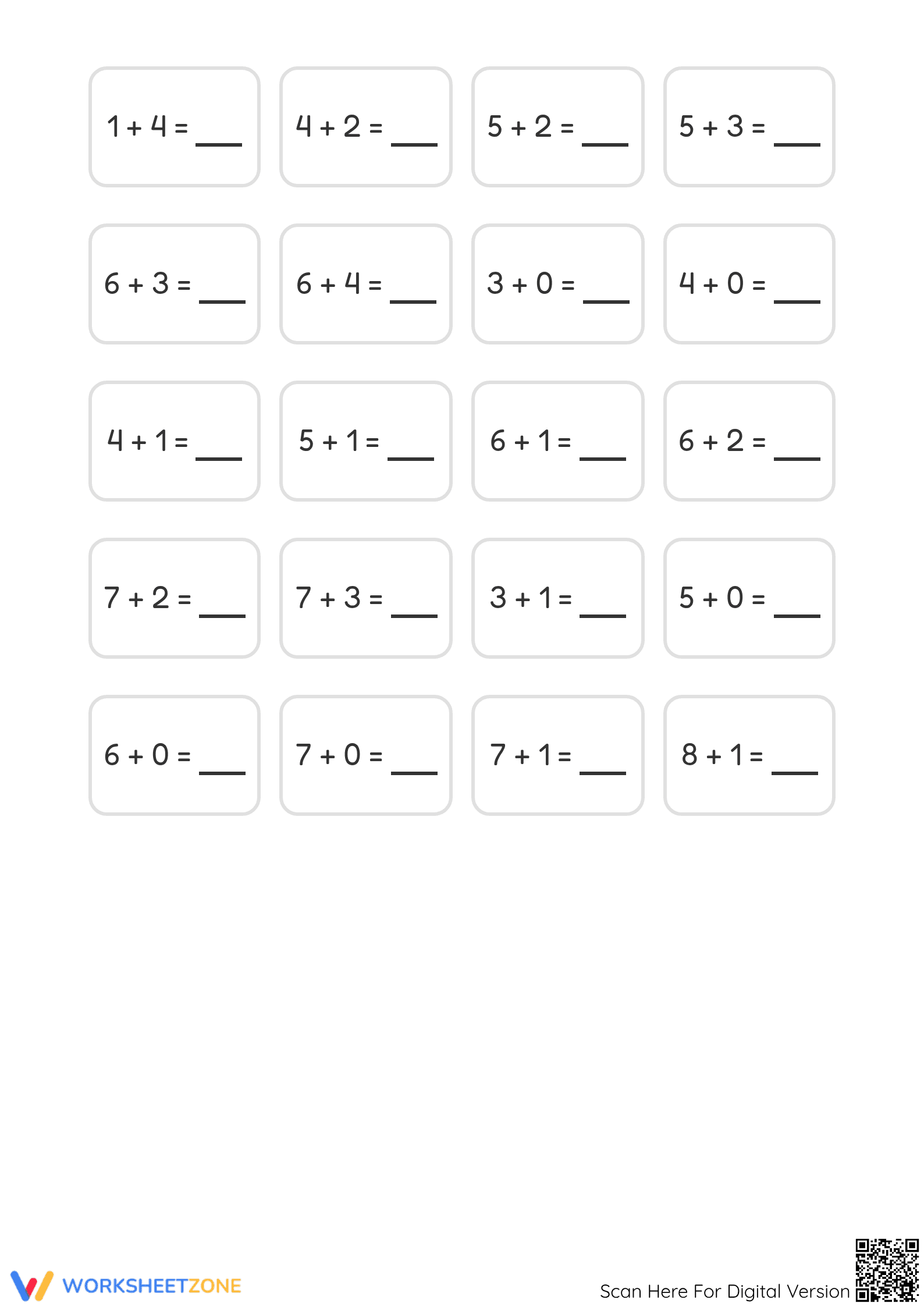
- Supported Practice: Students transition to a larger set of 20 problems on the second page, applying their calculation skills to a wider variety of number combinations within the 0–10 range.
- Independent Practice: The final sets encourage students to solve problems without immediate visual cues, promoting the gradual release of responsibility and the development of automaticity.
Standards Alignment
This resource is strictly aligned with CCSS.MATH.CONTENT.K.OA.A.2: "Solve addition and subtraction word problems, and add and subtract within 10, e.g., by using objects or drawings to represent the problem." It also supports foundational skills for Grade 1 operations. Both standard codes can be copied directly into lesson plans, IEP goals, or district curriculum mapping tools.
How to Use It
This worksheet is most effective when used during the "You Do" phase of a lesson or as a dedicated station in a math center. Teachers can observe students as they solve the problems, looking for the use of finger counting or number lines as a formative assessment of their current strategy level. Expect a typical completion time of 15 to 20 minutes depending on the student's fluency level.
Who It's For
This resource is primarily designed for Kindergarten and Grade 1 students who are building confidence in basic operations. It is also an excellent tool for intervention groups or as a remedial activity for Grade 2 students needing a refresher. Pair this worksheet with physical manipulatives or a number line to provide additional support for diverse learners.
The CCSS.K.OA.A.2 standard emphasizes that fluency in addition within 10 is a critical precursor to multi-digit arithmetic and algebraic thinking. According to the NAEP framework, early mastery of basic sums reduces cognitive load, allowing students to focus on more complex problem-solving tasks in later grades. Research from EdReports (2024) indicates that high-quality, aligned practice materials are essential for closing achievement gaps in early numeracy. By providing 32 structured opportunities for calculation, this worksheet ensures that students move beyond counting-all to more efficient counting-on strategies. The inclusion of a color-coded feedback mechanism supports metacognitive development, as students must evaluate their numerical answers against a secondary visual key. This dual-verification process is a proven method for reinforcing neural pathways associated with number recognition and arithmetic retrieval, ensuring that students are prepared for more advanced mathematical challenges.


