


























Views
Downloads



Grade 1 Same Singular and Plural Nouns | Essential Worksheet
Paste this activity's link or code into your existing LMS (Google Classroom, Canvas, Teams, Schoology, Moodle, etc.).
Students can open and work on the activity right away, with no student login required.
You'll still be able to track student progress and results from your teacher account.
This Grade 1 English Language Arts worksheet helps students master the tricky concept of nouns that do not change form between singular and plural states. By practicing with specific words like aircraft, deer, and fish, students learn to use context clues and sentence structure to indicate quantity rather than relying on standard suffixes. This resource ensures students can accurately communicate about single or multiple items using irregular lexical forms.
At a Glance
- Grade: 1 · Subject: ELA
- Standard:
CCSS.ELA-LITERACY.L.1.1.C— Use singular and plural nouns with matching verbs in basic sentences- Skill Focus: Irregular nouns with identical singular/plural forms
- Format: 4 pages · 6 tasks · Answer key included · PDF
- Best For: Independent grammar practice and sentence construction
- Time: 15–20 minutes
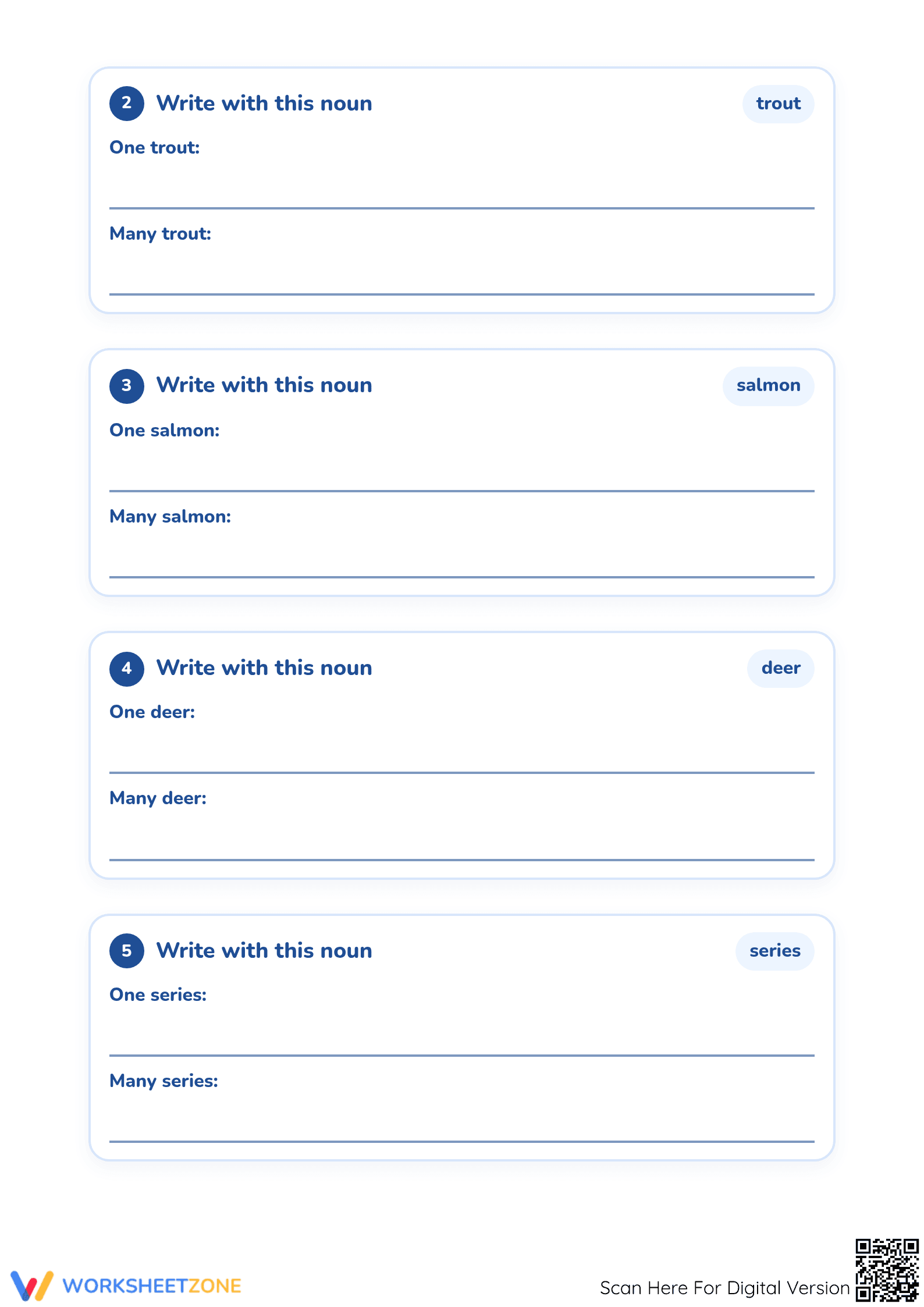
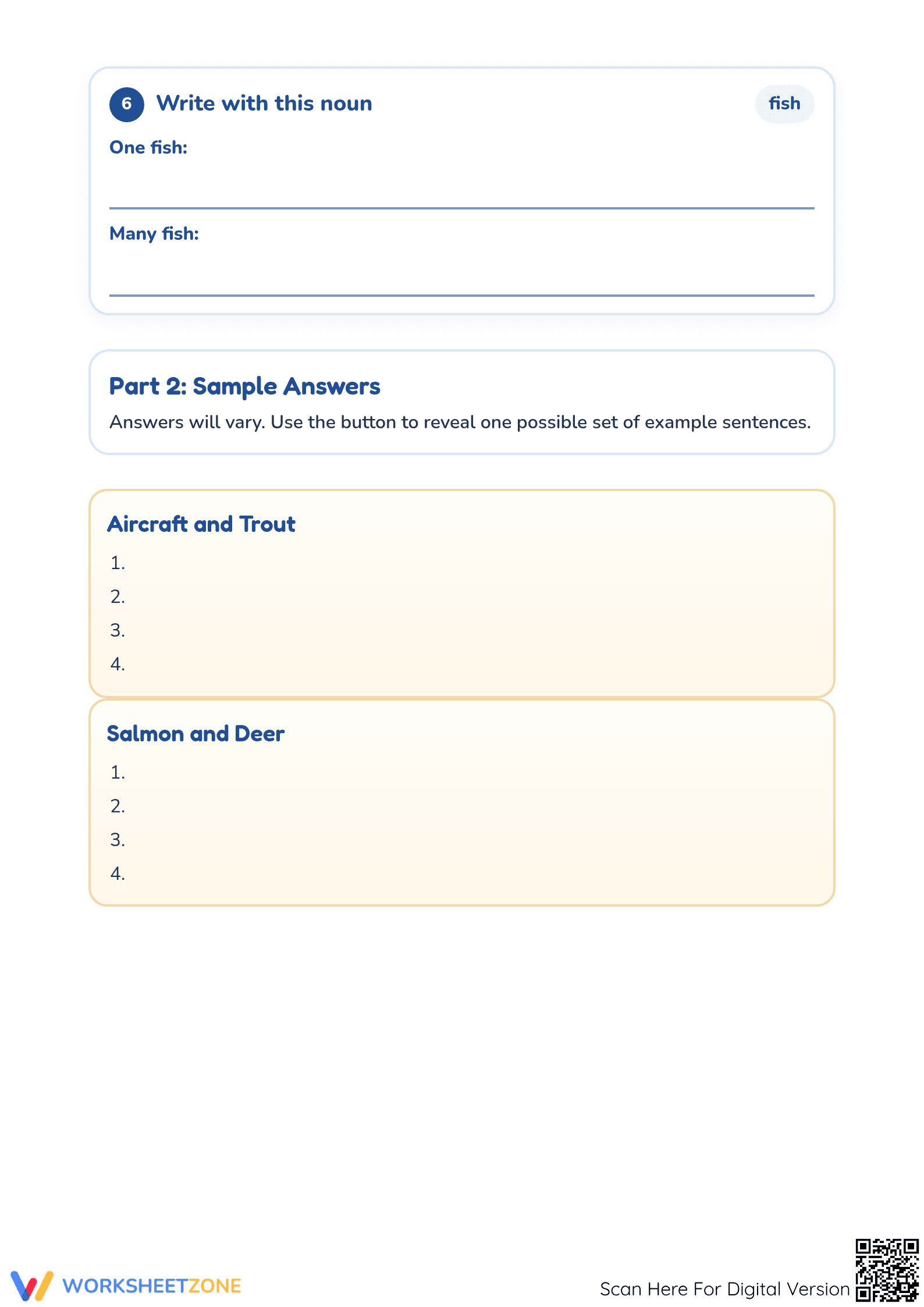
What's Inside: This comprehensive 4-page PDF includes a helpful tip box that defines the concept with a clear example (one moose, two moose). The worksheet features 6 dedicated task blocks, each focusing on a specific noun. Students are required to write two distinct sentences for each word: one representing a single object and one representing multiple objects. The final pages provide a structured sample answer key to assist with grading and student feedback.
Zero-Prep Workflow
- Print: Select the pages you need and print the PDF in seconds (1 minute).
- Distribute: Hand out the worksheets during your grammar block, literacy centers, or as a quick morning work task (1 minute).
- Review: Use the provided sample answers to facilitate a quick class discussion or for rapid grading (5 minutes).
Total teacher preparation time is under 2 minutes, making this an ideal resource for sub plans or supplemental practice.
Standards Alignment: This resource is aligned to `CCSS.ELA-LITERACY.L.1.1.C`, which focuses on the correct use of singular and plural nouns within basic sentence structures. By requiring students to write full sentences, the worksheet also supports general conventions of standard English. This standard code can be copied directly into lesson plans, IEP goals, or district curriculum mapping tools.
How to Use It: This worksheet is best utilized after a direct instruction lesson on irregular nouns. It serves as an excellent formative assessment to see if students understand that some words do not take an "-s" or "-es" ending. Teachers should observe whether students change the accompanying verbs or articles (e.g., "An aircraft is..." vs "Many aircraft are...") to indicate plurality. Expect completion within 20 minutes.
Who It's For: This resource is designed for first-grade students but is also highly effective for second-grade review or for English Language Learners (ELL) who are struggling with English noun morphology. It pairs naturally with a classroom anchor chart showing common irregular nouns or a shared reading passage featuring animals like deer and fish.
The CCSS.ELA-LITERACY.L.1.1.C standard requires Grade 1 students to demonstrate command of singular and plural noun forms within sentence structures. This worksheet specifically targets the linguistic nuance of nouns that maintain identical forms in both singular and plural contexts, such as "deer" or "fish." According to the RAND AIRS 2024 report on foundational literacy, explicit instruction in irregular morphological patterns is critical for preventing overgeneralization errors in early writing. By requiring students to compose original sentences for both quantities, the resource moves beyond simple identification into active application. This dual-sentence approach reinforces the concept that context, rather than suffixation, determines plurality for this specific word class. Research indicates that structured sentence-level practice helps solidify these lexical exceptions in a student's long-term memory, facilitating smoother transitions into complex reading and writing tasks as they progress through the primary grades.


