


























Views
Downloads

Printable Salmon & Crab Life Cycles Worksheet | Grade 1
Paste this activity's link or code into your existing LMS (Google Classroom, Canvas, Teams, Schoology, Moodle, etc.).
Students can open and work on the activity right away, with no student login required.
You'll still be able to track student progress and results from your teacher account.
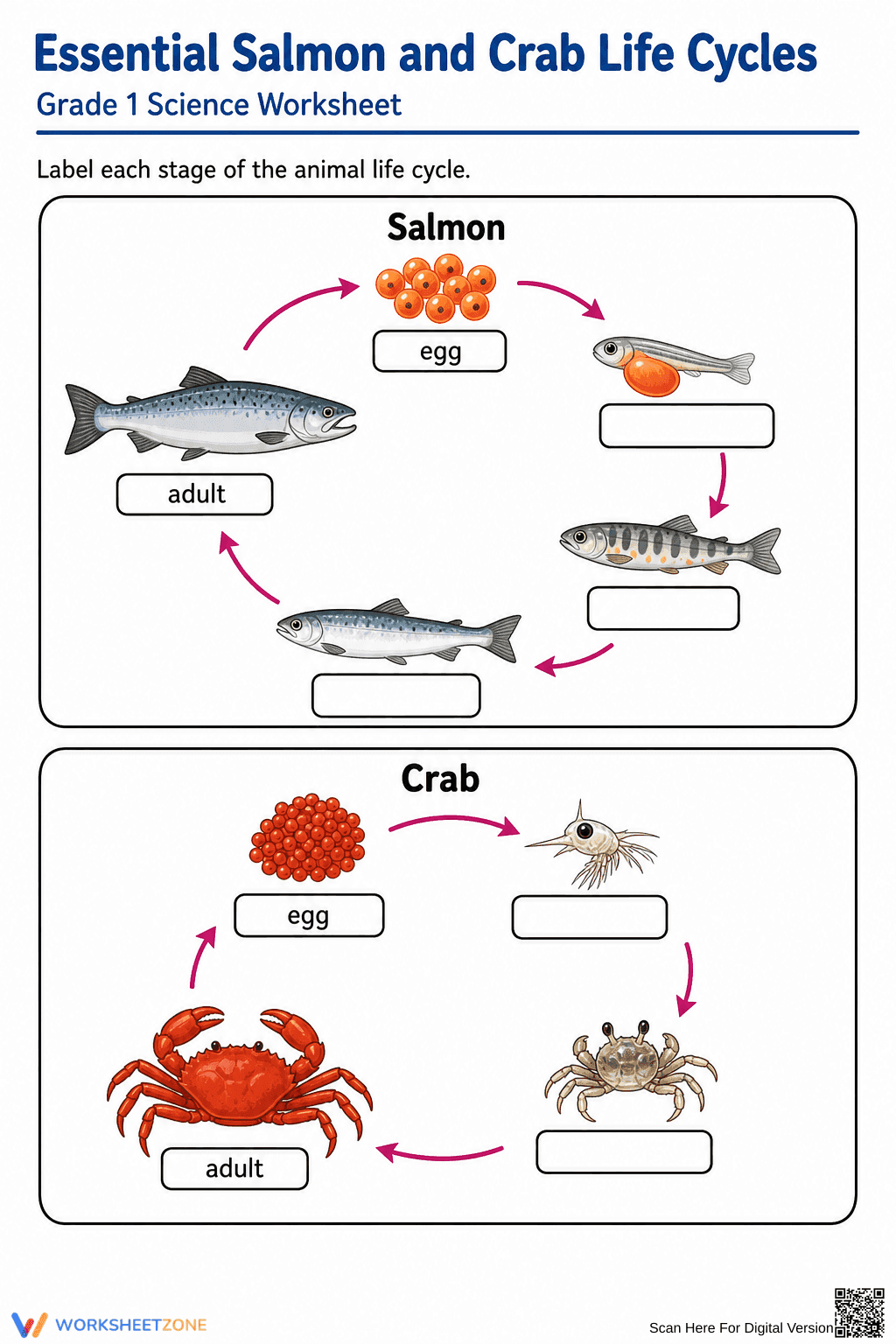
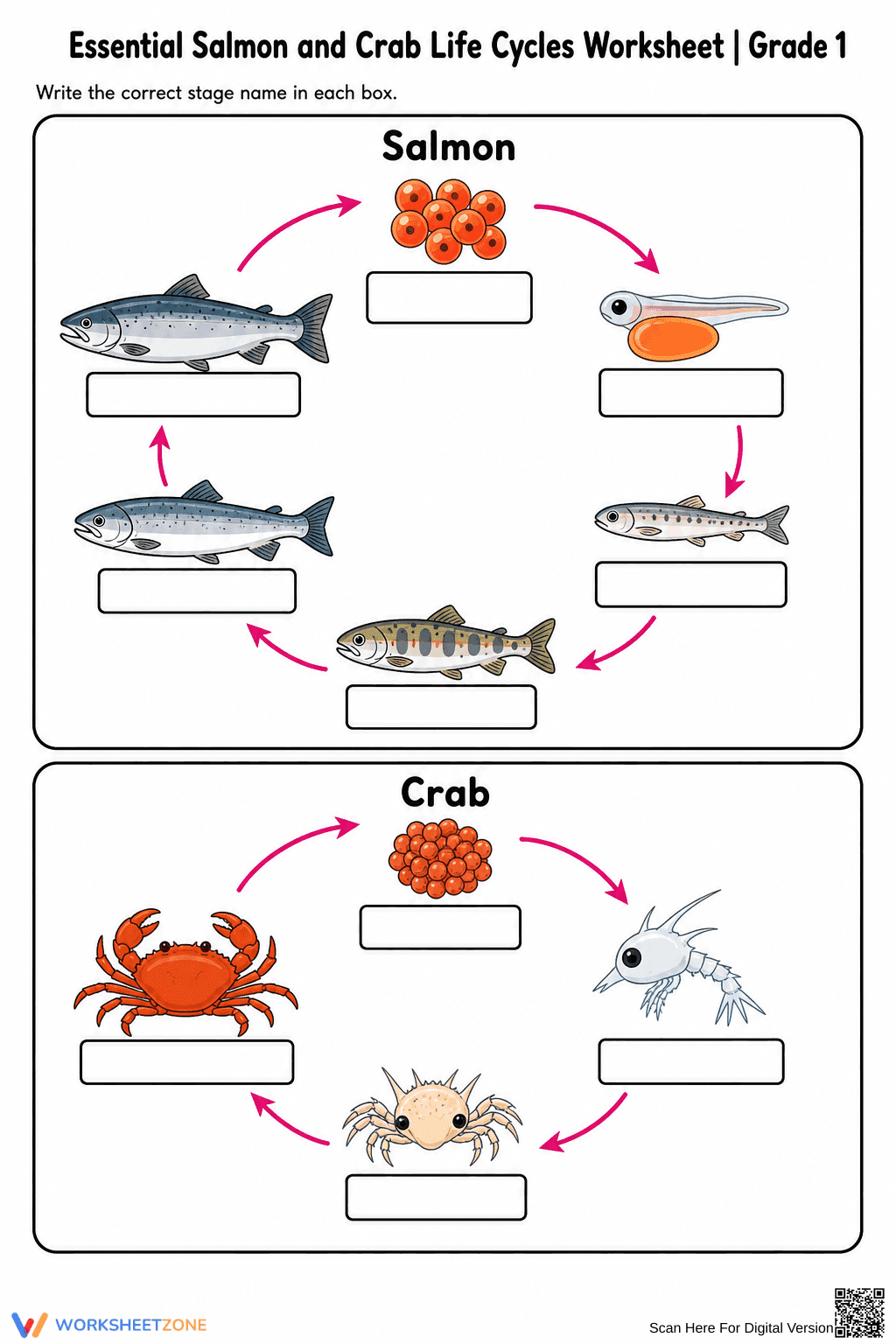
This Grade 1 science worksheet helps students visualize the complex transformations of aquatic life by identifying specific developmental stages of salmon and crabs. By labeling these unique life cycles, young learners build a strong foundation in biological growth and environmental adaptation while comparing how different species progress.
At a Glance
- Grade: 1 · Subject: Science
- Standard:
1-LS3-1— Observe and record how young animals are similar to their parents- Skill Focus: Identifying animal life cycle stages
- Format: 3 pages · 10 problems · Answer key included · PDF
- Best For: Independent practice or science centers
- Time: 15–25 minutes
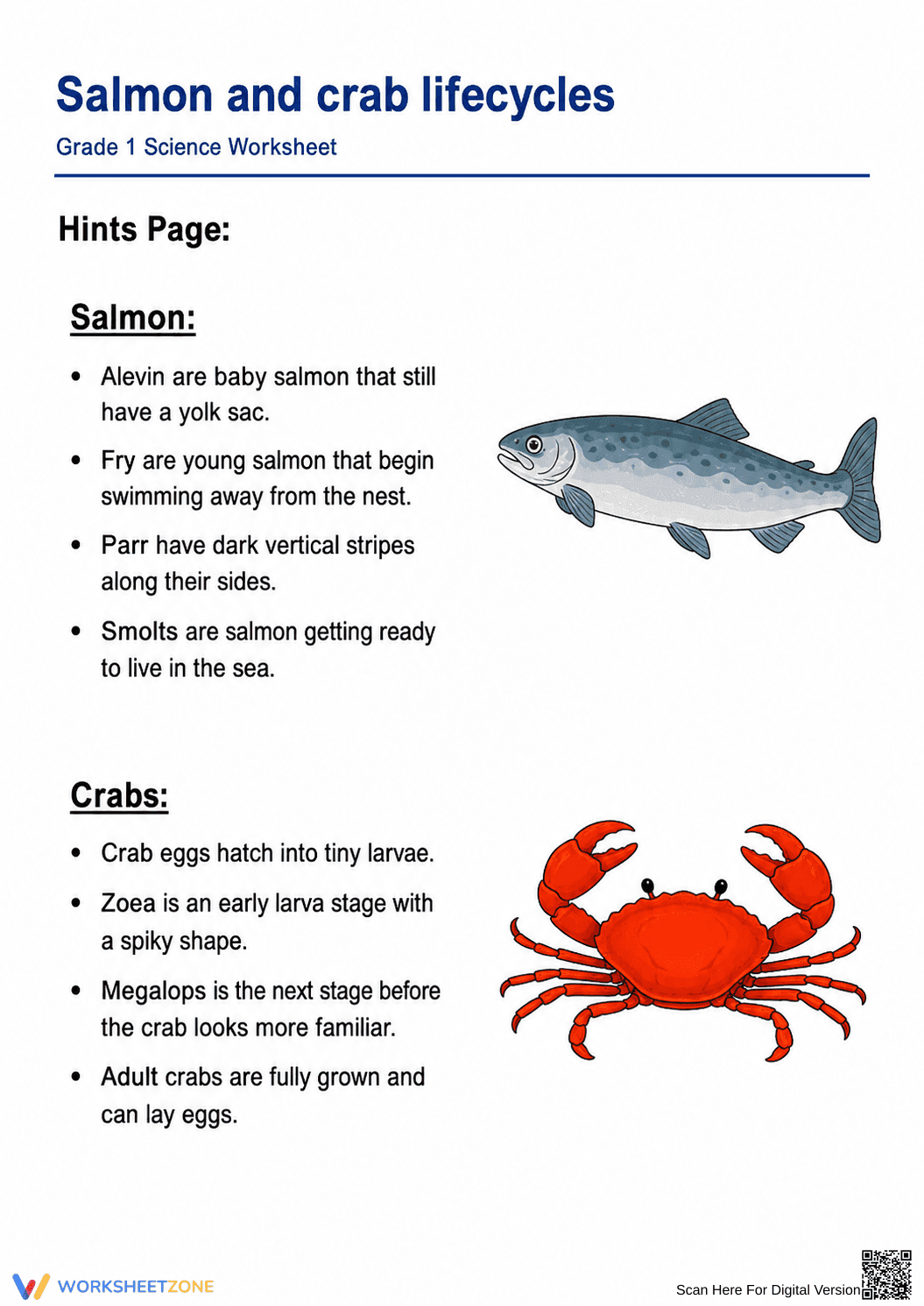
This 3-page PDF includes a primary labeling worksheet featuring two circular life cycle diagrams, a dedicated hints page for student support, and a full answer key for easy grading. Students label six distinct stages for the salmon (including alevin and smolt) and four stages for the crab. The visual layout uses clear arrows to indicate chronological progression, making the concept of biological cycles highly accessible.
Zero-Prep Workflow
- Print (30 seconds): Simply print the blank worksheet and the accompanying hints page for your class.
- Distribute (1 minute): Hand out the diagrams and reference sheets to encourage independent research and vocabulary building.
- Review (30 seconds): Use the provided answer key for instant formative feedback or self-grading.
Total teacher prep time is under 2 minutes. This resource is ideal for substitute lesson plans or as a quick transition activity between science units.
Standards Alignment
Aligned to 1-LS3-1: "Make observations to construct an evidence-based account that young plants and animals are like, but not exactly like, their parents." It also builds foundational knowledge for 3-LS1-1 by introducing diverse life cycles. Both standard codes can be copied directly into lesson plans, IEP goals, or district curriculum mapping tools.
How to Use It
Use this as a follow-up activity after a lesson on aquatic habitats or animal growth. It works best during the independent practice phase of a science block. Teachers can observe how students use the hints page to identify technical terms like alevin or zoea, providing a quick window into their reading comprehension and scientific vocabulary acquisition. Expected completion time is 15 to 25 minutes.
Who It's For
This resource is perfect for Grade 1 students, particularly those needing visual scaffolds to understand biological processes. It pairs naturally with a classroom life cycle anchor chart, a short documentary on marine migration, or direct instruction on animal habitats.
Research from RAND AIRS 2024 emphasizes that visual models in early science education significantly improve long-term retention of complex biological sequences. By requiring students to map the progression of salmon and crab development, this worksheet reinforces the NGSS 1-LS3-1 standard, which focuses on observing and recording how young animals are similar to their parents. The inclusion of a hints page provides the necessary support for students to transition from guided observation to independent mastery. This structured approach ensures that learners do not just memorize names but understand the circular nature of reproduction and growth in the natural world. Engaging with these specific aquatic life cycles gives early elementary students a concrete framework for understanding broader ecological concepts and the diverse ways organisms grow and change over time.


