


























Views
Downloads

Printable St. Patrick's Day Cloze Worksheet | Grade 5 ELA
Paste this activity's link or code into your existing LMS (Google Classroom, Canvas, Teams, Schoology, Moodle, etc.).
Students can open and work on the activity right away, with no student login required.
You'll still be able to track student progress and results from your teacher account.
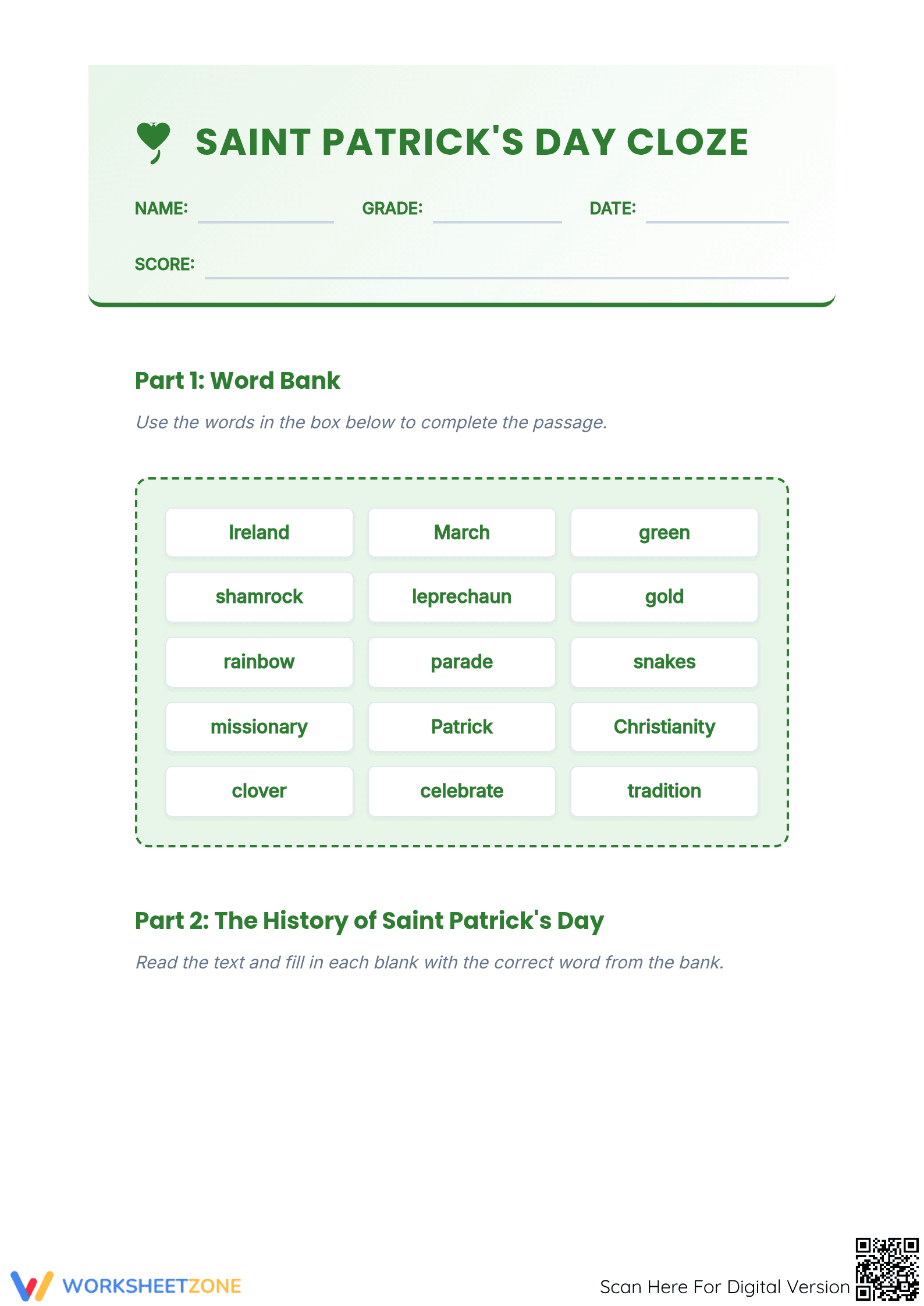
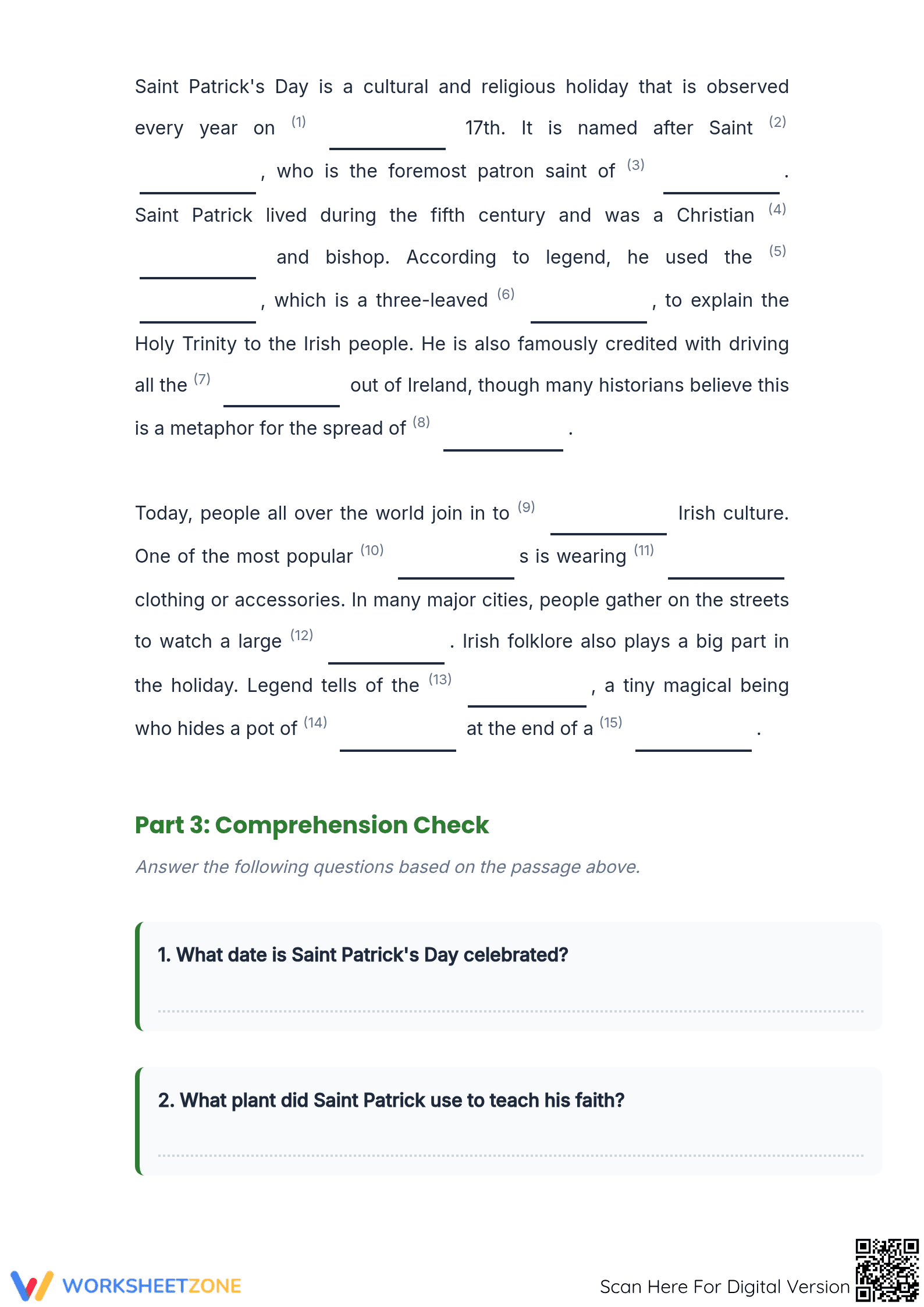
This comprehensive Grade 5 Saint Patrick's Day worksheet provides a complete historical overview through an interactive Cloze passage and vocabulary building exercises. Students will master key terminology and demonstrate reading comprehension by completing 23 unique tasks. It is an essential resource for integrating holiday themes with rigorous ELA standards.
At a Glance
- Grade: 5 · Subject: English Language Arts
- Standard:
CCSS.ELA-LITERACY.RI.5.4— Determine the meaning of general academic and domain-specific words and phrases- Skill Focus: Context clues and historical vocabulary
- Format: 3 pages · 23 problems · Answer key included · PDF
- Best For: Holiday thematic units and sub plans
- Time: 25–40 minutes
What's Inside
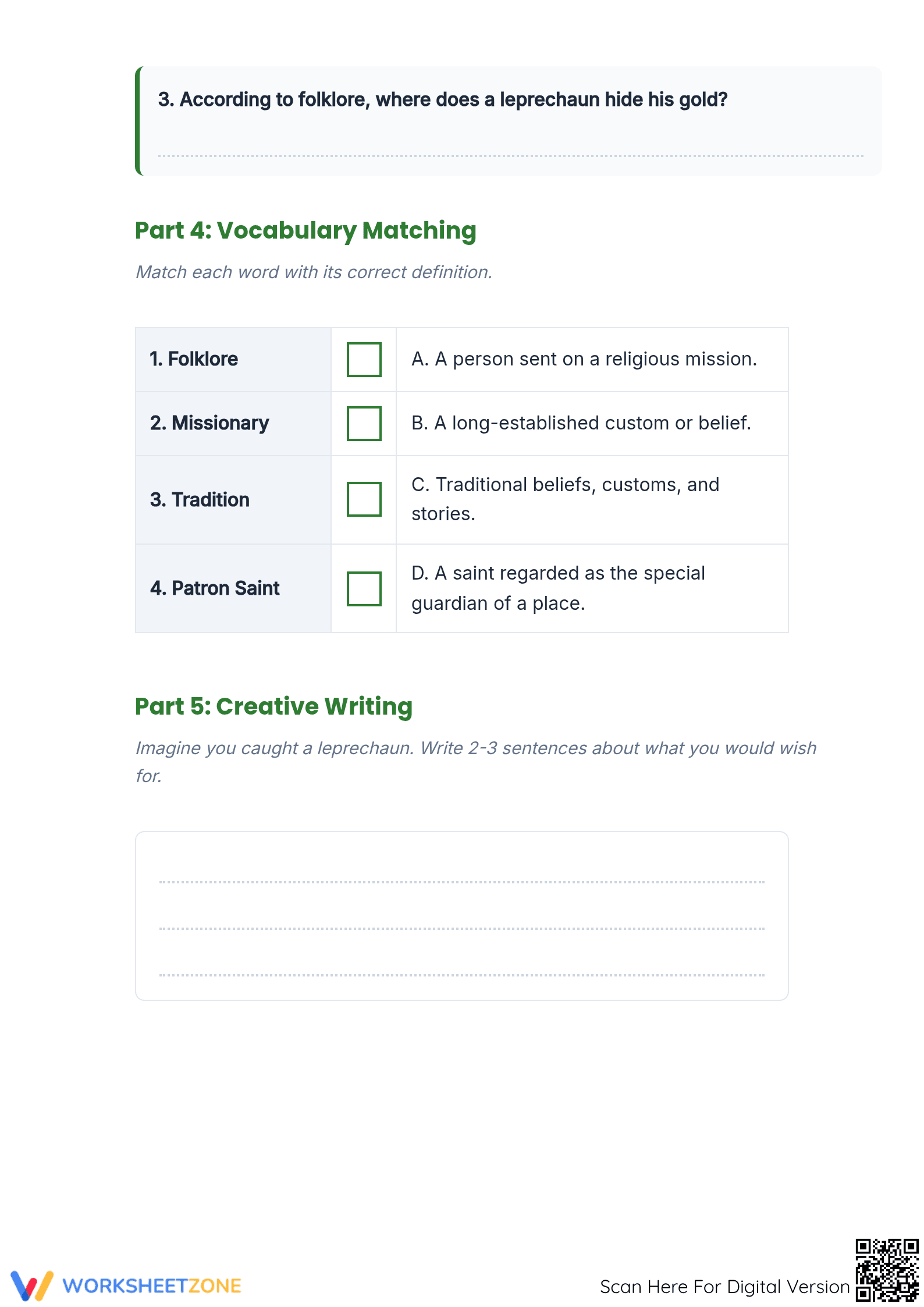
This three-page PDF is structured into five distinct parts to ensure varied student engagement. It begins with a 15-word bank and a corresponding Cloze passage detailing the history of the holiday. Following the reading, students complete a three-question comprehension check, a four-item vocabulary matching table, and a creative writing prompt that encourages imaginative expression. A full answer key is provided for immediate feedback.
Zero-Prep Workflow
This resource is designed for maximum efficiency in busy classrooms. 1. Print (30 seconds): Simply print the three-page set for each student or group. 2. Distribute (1 minute): Pass out the sheets as a warm-up or a standalone holiday activity. 3. Review (1 minute): Use the included answer key for quick grading or a whole-class review. Total teacher preparation time is under three minutes, making it an ideal emergency sub plan.
Standards Alignment
The primary standard addressed is CCSS.ELA-LITERACY.RI.5.4, which requires students to determine the meaning of domain-specific words within a text. By using context clues to fill in the Cloze passage and matching terms like "missionary" and "tradition" to their definitions, students build critical academic vocabulary. This standard code can be copied directly into lesson plans, IEP goals, or district curriculum mapping tools.
How to Use It
Use this worksheet as a culminating activity after a direct instruction lesson on world cultures or as a formative assessment of reading comprehension skills. For the creative writing section, teachers can observe students' ability to transition from factual recall to imaginative application. The expected completion time range is 25 to 40 minutes depending on student reading speed.
Who It's For
This activity is perfectly suited for general education fifth-grade students, but the high-interest topic and clear scaffolds also make it accessible for EL learners and students with IEPs. It pairs naturally with a short informational video about Ireland or an anchor chart displaying St. Patrick's Day symbols and their meanings.
Research from the NAEP 2024 frameworks emphasizes that domain-specific vocabulary acquisition is most effective when situated within a thematic context, such as a holiday-focused reading. This Grade 5 worksheet utilizes the CCSS.ELA-LITERACY.RI.5.4 standard to ensure students apply context clues to reconstruct a factual narrative. By integrating 23 distinct tasks across three pages, the resource mirrors multi-modal learning strategies recommended by Fisher & Frey (2014) for increasing student retention of informational texts. The creative writing prompt further extends cognitive demand, moving students from basic recall to synthesis. This structured approach provides educators with a reliable tool for measuring progress in both vocabulary depth and reading stamina. Furthermore, the inclusion of a vocabulary matching section allows for a different mode of assessment that supports various learning styles within the classroom.


