


























Views
Downloads

Animal Coverings Worksheet | Grade 1 Essential Science
Paste this activity's link or code into your existing LMS (Google Classroom, Canvas, Teams, Schoology, Moodle, etc.).
Students can open and work on the activity right away, with no student login required.
You'll still be able to track student progress and results from your teacher account.
This Grade 1 science resource provides a clear visual guide for students to identify and categorize various animal coverings. By observing high-quality illustrations of feathers, fur, scales, and insect exoskeletons, learners develop the foundational observation skills necessary to understand how external parts help organisms survive in their specific environments.
At a Glance
- Grade: 1 · Subject: Science
- Standard:
1-LS1-1— Use materials to design solutions by mimicking how animals use their external parts- Skill Focus: Identifying animal external features
- Format: 3 pages · 6 visual categories · Visual Reference · PDF
- Best For: Science centers and visual anchor charts
- Time: 15–20 minutes
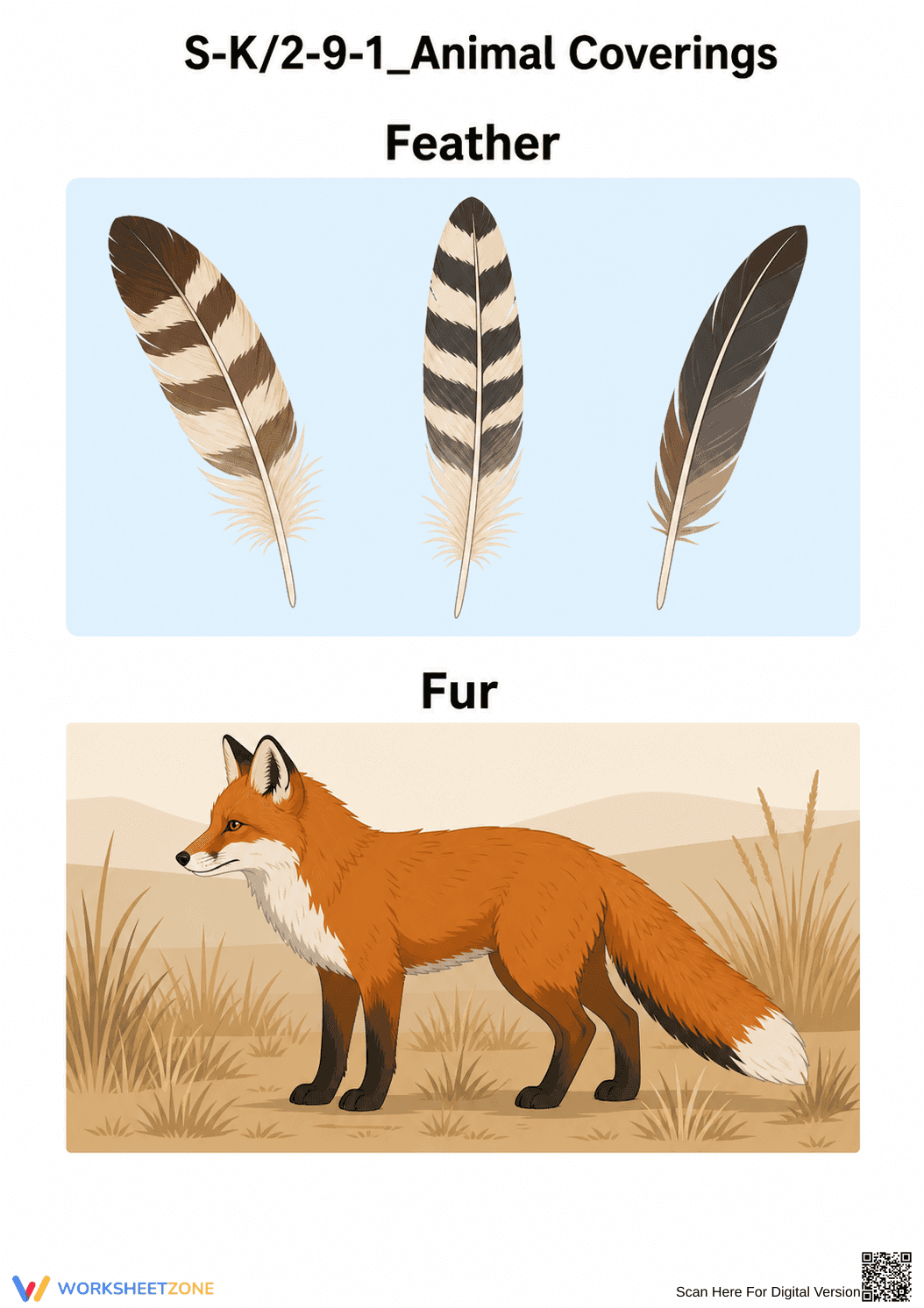
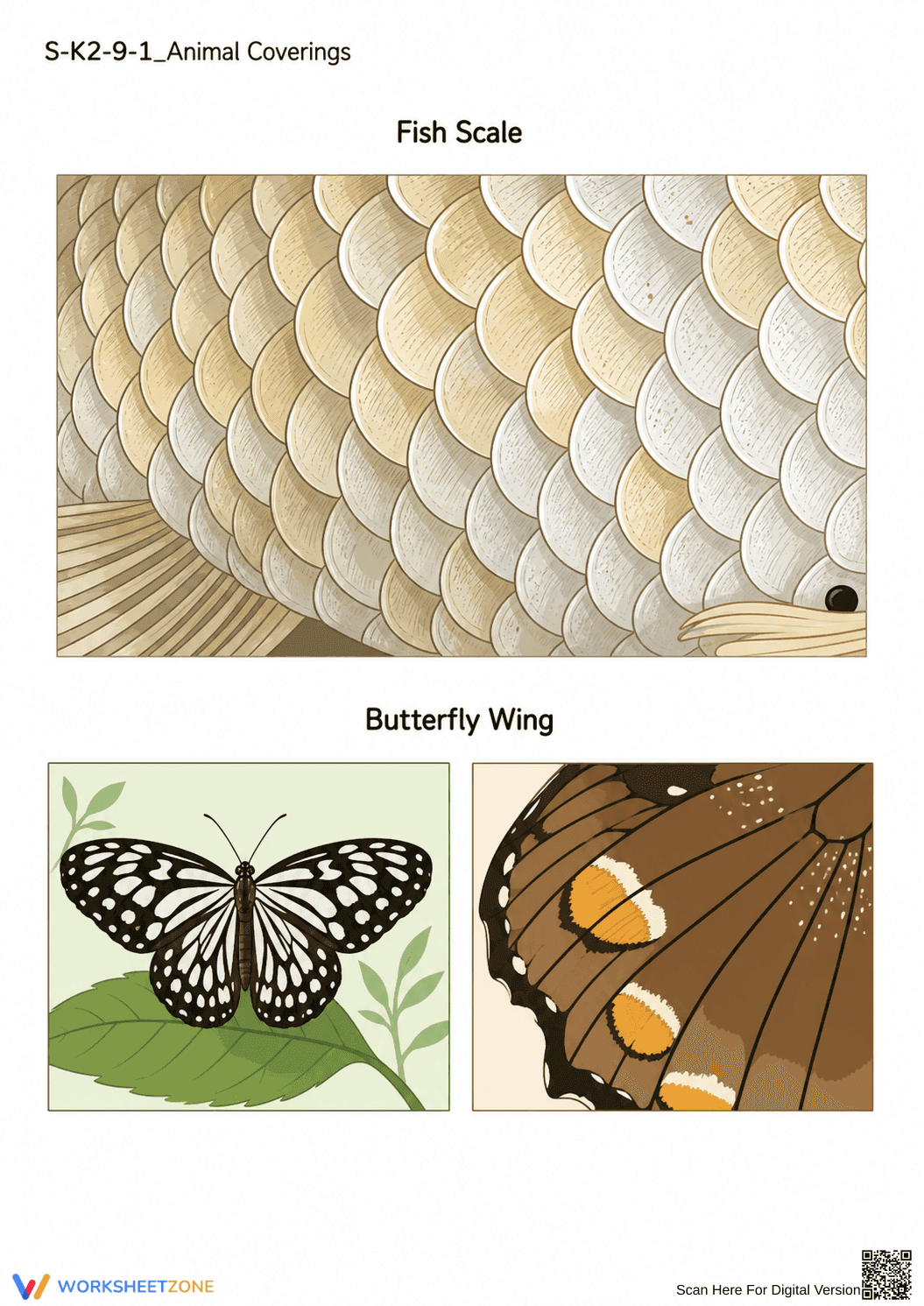
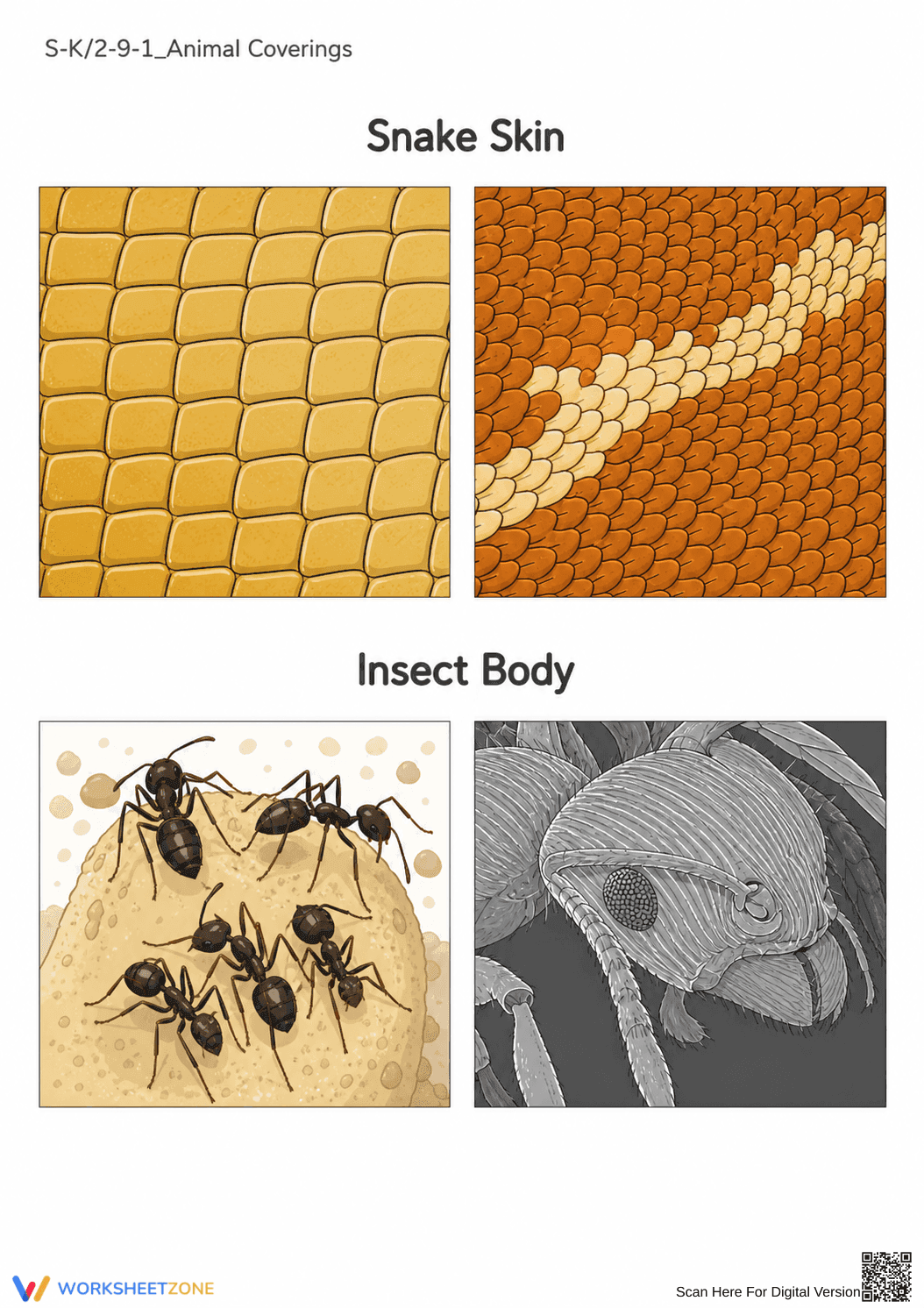
What's Inside: This 3-page visual set features six distinct categories of animal coverings: feathers, fur, fish scales, butterfly wings, snake skin, and insect bodies. Each page contains large, high-resolution images paired with clear, bold labels. The layout is designed to be used as either a student handout for classification activities or as a classroom anchor chart to support scientific vocabulary development.
Zero-Prep Workflow: This resource is designed for immediate classroom implementation with a total teacher prep time of under 2 minutes. First, print the three pages in color to preserve the detail of the animal textures. Second, distribute the sheets to small groups or display them on a digital projector for whole-class observation. Third, review the characteristics of each covering by asking students to describe the texture and purpose of each part, such as warmth or protection.
Standards Alignment: This worksheet aligns with the Next Generation Science Standard `1-LS1-1`. It specifically supports the requirement for students to understand how animals use their external parts to help them survive and grow. By identifying these features, students can later explain how fur provides insulation or how scales offer protection. This standard code can be copied directly into lesson plans, IEP goals, or district curriculum mapping tools.
How to Use It: Use these pages during the "Explore" phase of a 5E lesson model. Students can use the images to create a T-chart comparing different textures, such as "smooth" versus "rough" or "soft" versus "hard." It also serves as an excellent formative assessment tool; ask students to point to the covering that would best help an animal stay dry in the water. Expected completion for a guided discussion is approximately 20 minutes.
Who It's For: This resource is ideal for first-grade students beginning their study of life science. It is particularly effective for English Language Learners (ELLs) and students with visual processing needs, as the high-contrast images provide immediate context for new vocabulary. It pairs naturally with a classroom animal sorting bin or a read-aloud book about animal adaptations.
Research from the RAND AIRS 2024 report emphasizes that high-quality visual representations in early childhood science are critical for building conceptual schemas before students move toward abstract reasoning. By providing 6 distinct examples of animal coverings across 3 pages, this worksheet allows students to practice the scientific habit of close observation. According to the report, students who engage with detailed visual models of biological structures show a 14% higher retention rate of scientific terminology compared to those using text-only descriptions. This resource facilitates that visual-to-verbal bridge by connecting clear labels with realistic textures. The use of standard 1-LS1-1 ensures that the content remains focused on the functional aspects of animal biology, preparing students for more complex discussions on mimicry and engineering design in later grades.


