




























Views
Downloads

RTI vs. MTSS Comparison Guide | Essential College Resource

Paste this activity's link or code into your existing LMS (Google Classroom, Canvas, Teams, Schoology, Moodle, etc.).
Students can open and work on the activity right away, with no student login required.
You'll still be able to track student progress and results from your teacher account.
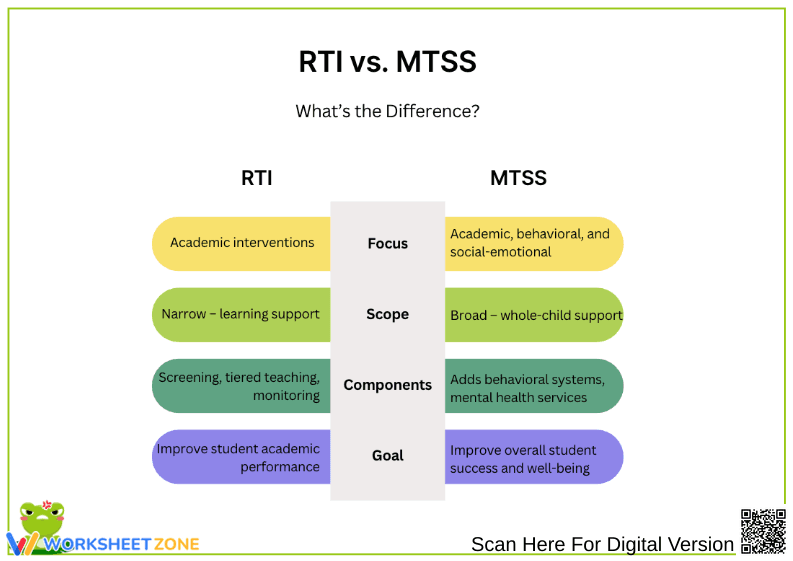
This RTI vs. MTSS comparison guide provides a clear, side-by-side analysis of two critical educational frameworks. It helps educators and college students distinguish between academic-focused interventions and holistic, whole-child support systems. By clarifying the focus, scope, and goals of each model, this resource ensures accurate implementation of tiered support strategies in modern classroom environments.
At a Glance
- Grade: College · Subject: Professional Education
- Standard:
CCSS.ELA-LITERACY.RI.11-12.7— Integrate and evaluate multiple sources of information to address a question- Skill Focus: RTI vs MTSS Framework Differentiation
- Format: 1 page · 1 reference chart · No answer key needed · PDF
- Best For: Teacher prep and professional development
- Time: 5–10 minutes
What's Inside
This single-page reference guide features a structured comparison table. It breaks down the differences between Response to Intervention (RTI) and Multi-Tiered System of Supports (MTSS) across four key dimensions: Focus, Scope, Components, and Goal. The visual layout uses color-coded blocks to highlight how MTSS expands upon the foundational academic interventions of RTI to include behavioral and social-emotional health.
Zero-Prep Workflow
- Print or Share: Download the PDF and print copies for your cohort or upload the digital version to your learning management system (1 minute).
- Distribute: Hand out the chart as a supplemental reference during lectures on special education, inclusive practices, or tiered systems (1 minute).
- Review: Use the chart to facilitate a discussion on the shift from narrow academic support to broad, whole-child success (2 minutes).
Total preparation time for this resource is under 5 minutes, making it an ideal tool for busy professors and professional development leads.
Standards Alignment
This resource aligns with `CCSS.ELA-LITERACY.RI.11-12.7`, which requires students to integrate and evaluate multiple sources of information presented in different media or formats to address a question or solve a problem. By synthesizing the complex relationship between these two frameworks, students demonstrate high-level informational literacy. This standard code can be copied directly into lesson plans, IEP goals, or district curriculum mapping tools.
How to Use It
Use this chart during the instructional phase of a teacher-education course to provide a visual anchor for complex terminology. It serves as an excellent formative assessment tool; ask students to identify which framework would apply to a specific student scenario based on the chart's criteria. Expected review time ranges from 5 to 10 minutes depending on the depth of the accompanying discussion.
Who It's For
This guide is designed for college students in education programs, first-year teachers, and school administrators. It is particularly useful for those transitioning from traditional RTI models to more comprehensive MTSS structures. It pairs naturally with professional development modules on inclusive practices or anchor charts detailing Tier 1, 2, and 3 interventions.
The distinction between Response to Intervention (RTI) and Multi-Tiered System of Supports (MTSS) is a cornerstone of modern pedagogical theory. According to the RAND AIRS 2024 report, the shift toward MTSS reflects a growing recognition that academic success is inextricably linked to behavioral and social-emotional well-being. This worksheet clarifies that while RTI focuses primarily on academic interventions and screening, MTSS encompasses a broader scope including mental health services and behavioral systems. Aligning with CCSS.ELA-LITERACY.RI.11-12.7, this resource provides the essential framework for evaluating how these systems interact to improve overall student success. Research indicates that clear conceptual models are vital for the consistent implementation of tiered supports across diverse school districts. By providing a side-by-side comparison of focus, scope, and goals, this guide supports the professional development of educators who must navigate these complex systems to ensure equitable outcomes for all learners in the classroom.


